On 22 August 2026 tens of thousands of people will dance the pizzica in Melpignano, a village of just over 2,200 people, at the 29th Notte della Taranta. Yet for most of the twentieth century that same music was something people in the Salento stopped playing when strangers arrived: peasant music, best not mentioned. This is the story of how an embarrassment became an identity — and of the people who kept it alive during the years when nobody wanted it.
Every August, one village in the heel of Italy hosts what is billed as the largest concert of traditional popular music in Europe. Getting there means driving through olive groves on roads that were not built for it, and the whole thing ends somewhere around three in the morning.
What almost nobody tells visitors is the part that makes the evening remarkable. Forty years ago, this music was dying — and not because anyone was suppressing it. It was dying because the people who owned it had decided it was better left behind.
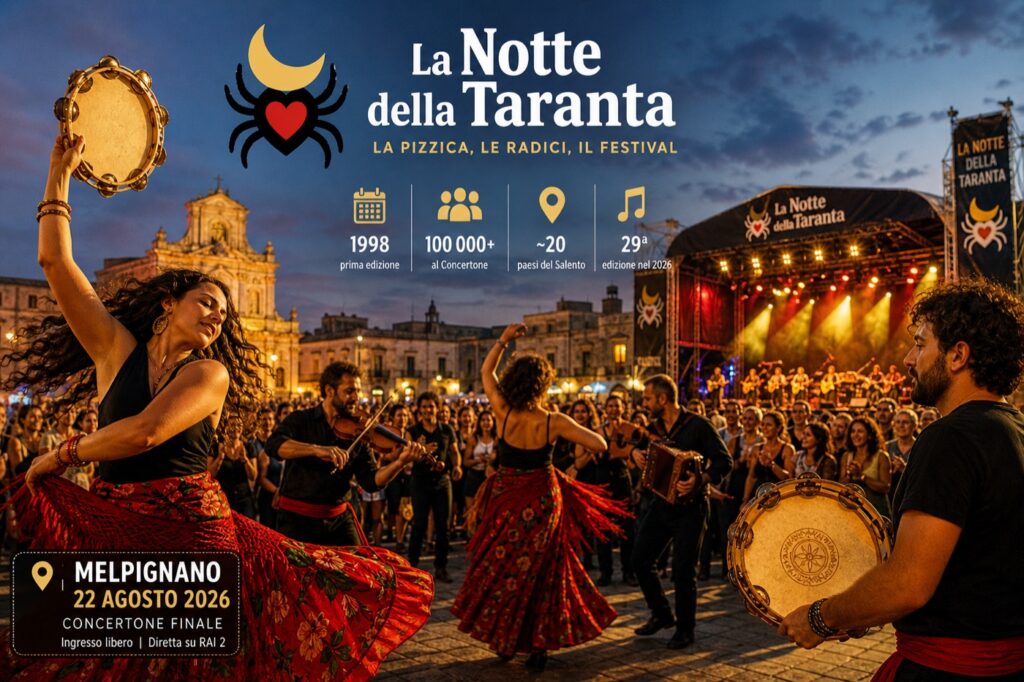
Where the pizzica was danced before there was a stage
Before the festival existed, the pizzica had no audience. It had occasions: weddings, courtyards, the feast day of a village patron saint, and two or three nights a year that everyone knew about.
The most famous of those nights is still going. On 15 August, at Torre Paduli, the ronda — the circle of onlookers that forms around the dancers — assembles by itself after dark and keeps going until dawn. No tickets, no running order, no guest conductor. Whoever brought a tambourine plays.
Two different things, often confused. The festive dance — the pizzica pizzica, danced by a couple, the woman holding a handkerchief — is not the dance of the tarantate. That was something else entirely: a healing rite that could last for days, indoors, with musicians called in for the purpose. The full story is in our guide to pizzica and the Notte della Taranta, and in the account of tarantismo and the chapel at Galatina.
Then came the decade when nobody played it
This is the part that usually gets skipped, and it is the heart of the story.
There had been an earlier attempt to bring traditional music back into the light, between the late 1960s and the early 1970s, in the years of the student movement, driven among others by the Salento writer Rina Durante. It was a project with a political argument inside it: peasant culture as an alternative voice to a middle-class one.
It did not hold. Through the 1980s other musical and cultural interests prevailed, and the groups still active in the Salento — left without bookings and without attention — broke up or changed direction. That is the reconstruction given by Vincenzo Santoro in Pizziche e tarante. Il rinascimento della musica popolare nel Salento, and it explains everything that follows.
Because in those years the pizzica was not a threatened tradition. It was an embarrassment. It was the music of grandparents who had worked in other people’s fields, of a world an entire family was trying to climb out of — through a diploma, a salaried job, a car. Playing it in public meant saying out loud where you came from, at precisely the moment you were trying not to say it.
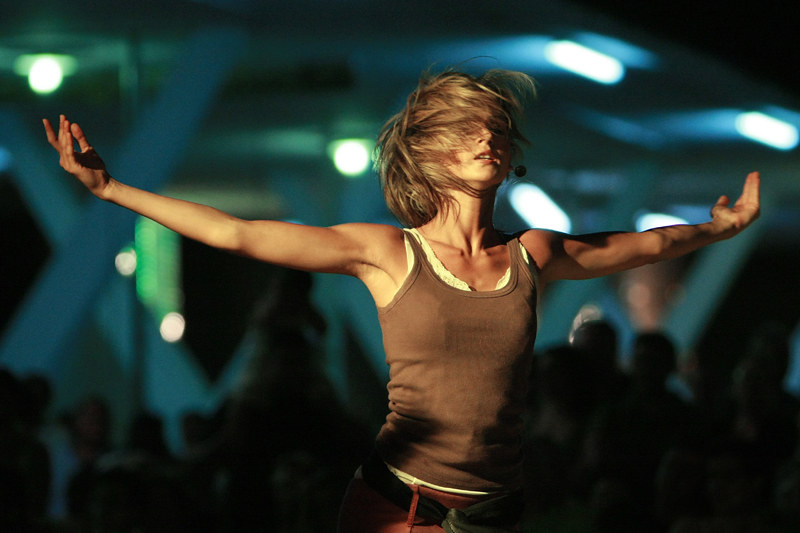
Who kept it alive while nobody wanted it
At the end of the 1980s the story restarts in a way nobody had planned. Not through institutions, but through what Santoro calls underground work: local organisers, small bands, student communities — with a recognised part played by the film director Edoardo Winspeare, who put that music back in front of a camera.
Through the 1990s the movement turned into a claim about identity: no longer «poor people’s music», but our music. Public administrations arrived afterwards, not before — towards the end of the decade, once the thing had already grown on its own.
24 August 1998, Piazza San Giorgio
The first Notte della Taranta was held in 1998, on the initiative of the union of municipalities of the Grecìa Salentina and the Diego Carpitella Institute. The closing concert took place in Melpignano, in Piazza San Giorgio. The conductor was Daniele Sepe.
From 2000 the festival became itinerant, touring the villages of the area before closing in Melpignano. Twenty-eight years later the square is no longer big enough: the stage stands on the forecourt of the former Augustinian convent, and the 22 August 2026 edition is the twenty-ninth, with Ermal Meta as musical director. Practical details — timings, line-up, how to get there — are in our guide to the 2026 Concertone.
Thirty years, in three lines. 1980s: the bands break up because nobody books them. 1998: one concert in a village square. 2026: the largest European concert of traditional popular music. In between there was no masterplan — there was a generation that stopped being ashamed.
What you will watch is not the rite, and that is fine
It is worth saying plainly, because every first-time visitor asks. The Concertone is not the rite. The tarantismo that the anthropologist Ernesto De Martino went to document at Galatina in 1959 — the fieldwork behind La terra del rimorso, published in 1961 — was a healing practice inside a peasant society that no longer exists.
What exists now is a different thing: a festival, a show, a piece of the local economy that fills hotels across two provinces. It is not a betrayal, and it is pointless to ask it to be authentic in the way a rite was. It is how a community decided to keep its own music instead of letting it die quietly — which is exactly what was about to happen forty years ago.
What to look for, if you go
The most interesting thing on the night is not on the stage. Look at the people dancing at the back, far from the lights, where the ronda still forms the way it forms at Torre Paduli, without anyone organising it. That is the part of the Concertone that most resembles what existed before the Concertone.
And if you are planning a trip around it: the festival tours the villages of the Salento for three weeks before the final night, and those evenings — free, in small squares, with a few hundred people — are where you will hear the music at closer range than in Melpignano.
Sources. The chronology of the revival of traditional music in the Salento — the first revival of the late 1960s, the retreat of the 1980s, the 1990s revitalisation and the late arrival of public funding — follows Vincenzo Santoro, Pizziche e tarante. Il rinascimento della musica popolare nel Salento. Details of the 2026 edition (date, venue, edition number, musical director) come from the official site of the Notte della Taranta Foundation. Ernesto De Martino’s fieldwork at Galatina took place in 1959; La terra del rimorso was published in 1961.