In short. In Puglia the last Sunday of August was not a Sunday: it was the day of the sauce. The family got up before dawn, crates of tomatoes arrived, and for twelve hours the courtyard turned into an assembly line staffed entirely by relatives. This is what that day looked like — the hand-cranked mill, the fizzy-drink bottles washed one by one, the method called alla manta, which takes its name from the blankets — and what is left of it now.
Ask an Apulian in their fifties when summer ended, and you will not get a date. You will get a smell: tomatoes boiling in a great pot in the middle of a courtyard, on the last Sunday of August, while outside it is still hot enough to stay in the shade. It was not a recipe and it was not a party. It was a deadline: from that day on, the pantry had to last until the next summer.
🍅 “On Sunday we make the sauce” was not an invitation
The sentence arrived mid-week and expected no answer. Nobody asked whether you were free: it was taken for granted that you were. Those who lived away came home, those who worked arranged it, and anyone who really could not come still got their share of bottles — because the sauce was made together and then divided.
The tomatoes came on the Saturday: bought at the market by the crate, or picked on the family plot, or bargained from a farmer you knew who had too many that year. In the accounts of people who were there, the sauce is never measured in kilos: it is counted in crates first and bottles afterwards, and that number was how a family said how big it was.
The evening before, the tomatoes were gone through one by one and the bruised ones thrown out. That was not fussiness. It was the only quality control available, and everybody knew that one bottle gone bad could mean throwing away ten.
🔥 The courtyard became an assembly line
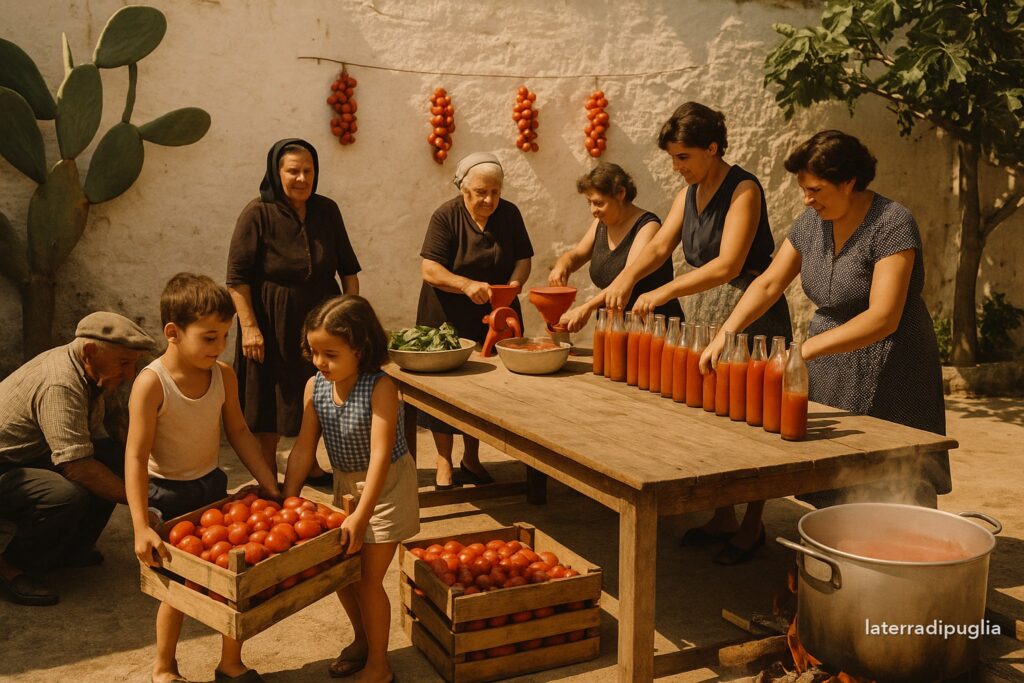
Anyone who has seen a day of the sauce remembers it as an organised operation, not a picnic. Each person had a place at the table and stayed there for hours, and the places were not interchangeable: not just anybody was put on the mill.
- Washing — the tomatoes in a tub of cold water, changed constantly, then left to drain on a sheet spread in the sun.
- Cooking — the big pot, the one used once a year and hung up for the rest of the time, over a wood fire lit in the courtyard, because indoors there would have been neither the room nor the air.
- The crank — the tomato mill clamped to the edge of the table with a wing screw. Sauce came out of one side and skins and seeds out of the other, and those went through a second time, because nothing was thrown away.
- The funnel — bottles filled one at a time, with a gap left at the top, and a basil leaf pushed in before or after according to a rule that changed from family to family and was never agreed on.
- The pot again — the bottles capped, put back in the water to boil, with old rags wedged between them so they could not touch and break.
Then there was lunch, eaten standing up and in a hurry, because the fire could not be left. Usually it was pasta with last year’s sauce: the final bottle of the old store was opened on exactly that day, while the new one was being made. It was how the year closed over itself.
🧣 Why it is called alla manta
The name of the oldest Apulian method does not come from an ingredient, and not from a town either. It comes from a blanket. Manta means just that, and it describes the last step of the day: when the boiling was over, the bottles were not taken out. They were left in the water and the whole thing was covered with blankets — the old ones, kept aside for the purpose — and there they stayed until the following morning.
The point is that the cooling has to be extremely slow. A boiling bottle pulled out into the night air cracks, and twelve hours of work go with it. That long, patient heat is also why home bottling goes wrong when it is rushed: we have written separately about why home-made passata turns watery, which is nearly always a question of cooking.
A distinction that starts real arguments in Puglia. What was made in the courtyard was not passata, it was salsa: cooked tomato put through a mill, without the industrial definitions that separate the products on a supermarket shelf. The words matter here in a way they do not in English, where “tomato sauce” covers all of it.
👧 The children’s job was the dullest, and everyone wanted it
The children got the bottles to wash. They were the ones salvaged through the year — beer, fizzy drinks, mineral water — put aside one at a time from January onwards, and they had to be scrubbed inside with a brush, rinsed, and turned upside down to dry. Slow, repetitive, thankless work, and everybody wanted to do it, because it was the only way to be in the courtyard with the adults on a day when the adults sent nobody away.
The other job was the basil leaf, handed to the smallest children as though it were an enormous responsibility. In a sense it was: losing count meant a bottle without one.
The reward came at the end of the day and it was always the same: bread with the new sauce, still warm, with oil and salt. Those who were there swear they have never eaten it like that since.
⚠️ What nobody in that courtyard could have explained
Telling a tradition properly does not mean telling it as though it were perfect. The day of the sauce worked for two reasons that nobody in that courtyard would have been able to spell out: the tomato is a fairly acid fruit in itself, and acidity is an environment in which dangerous bacteria struggle; and the boiling was long, far longer than it looked as though it needed to be.
The real risk in home preserving has a name — Clostridium botulinum — and it is a bacterium that develops in the absence of oxygen, which is exactly the condition created inside a sealed bottle. It is not the bacterium that is lethal but the toxin it produces. This article is a story, not a canning guide: if you intend to bottle at home, follow proper preserving instructions from a food safety authority in your own country, because the temperatures and times are not a matter of opinion.
It is worth saying because nostalgia, on the subject of preserves, is a poor adviser. An inherited habit has no stated safety margin: it only has the fact that so far it has gone well. The grandmothers were right about the method and did not know why — and the why, today, can be known.
🥫 What is left of the day of the sauce
It is not over, but it has shrunk. Families are smaller, courtyards have become garages, the wood fire has become a gas ring, and there are fewer crates. Above all the reason for doing it has gone: today sauce is bought, and back then it was not. What remains is no longer a necessity but a choice — which is exactly why the people who still do it care so much.
The calendar remains too. If you look at when the Apulian food festivals of September are concentrated, you will notice that the end of August and September are the months in which the region celebrates what it has just finished harvesting. The day of the sauce was the same thing, done at home and without an audience.
And the gesture that survived everything remains: it is made together, and then it is divided. The bottles that leave with the brother-in-law, the ones taken to the son who lives in the north, the ones that stay in the cellar and are counted one by one. In Puglia a full pantry has never been only a full pantry: it was a way of telling somebody that they had been thought about.
If you are not going to spend a Sunday in a courtyard — and most people are not — the pantry can still be built. Our shop has the Apulian tomato passata and the preserves of Puglia, made with the same tomatoes and with the checks a courtyard cannot have. And if you would rather try it yourself, our pages on Apulian preserves are the place to start.
The alla manta method and the note on botulism come from our own archive in Italian. Everything else — the crates, the crank, the fizzy-drink bottles, the basil leaf — is oral, collective memory, and is told here as such: it changes from town to town and every family has its own version. If you have one, tell us in the comments: how many of you there were, how many bottles, and who held the crank.