Five days in the Salento staying in masserie, the fortified farmhouses of Puglia, instead of city hotels: traditional farming, the Baroque of Lecce, ceramics, old villages and both coasts, the Adriatic and the Ionian. From Galatina and its tarantate to Lecce, from Cutrofiano to Gallipoli, down to the “end of the land” at Santa Maria di Leuca and the cathedral of Otranto.
A masseria (plural masserie) is a large farm estate of southern Italy. In the Salento many of them are true rural fortresses, built between the 16th and the 18th century to hold out against raids, and today they are working farms open to visitors. This tour uses them as its bases instead of hotels in town: it starts from the masserie of the Grecìa Salentina and crosses the Salento from north to south, from Lecce to the far tip at Leuca, through the villages of ceramics, of the Baroque and of the pizzica.
Day 1: arriving in the Grecìa Salentina, and Galatina
The tour starts at Brindisi airport or at Lecce railway station. The base is Masseria Appidè in Corigliano d’Otranto, in the heart of the Grecìa Salentina: a linguistic island where people still speak Griko, the Greek language that has survived here for two thousand years. The first stop is Masseria Pizzo Falcone in Supersano, then lunch at Masseria Le Stanzie, once a Roman staging post on the road of wine and oil that linked Gallipoli to Santa Maria di Leuca.
In the late afternoon there is a guided tour of Galatina, the town of the tarantate, the women who were believed to have been bitten by the tarantula: every 29 June the rite of Saints Peter and Paul linked to tarantism is still celebrated here (the story is in our article on tarantism and Galatina). The Basilica of Santa Caterina d’Alessandria is the stop not to miss: its cycles of frescoes, painted between the 14th and the 15th century, are among the most beautiful things in the Salento, and among the least known outside the region. Before heading back to the masseria, try the pasticciotto of Lecce, shortcrust pastry filled with custard and baked in a small aluminium mould: it is what the whole area eats for breakfast, or as an afternoon snack.
Day 2: Lecce and the Baroque of the Salento
In the morning, a visit to Masseria Chicco Rizzo in Sternatia, one of the oldest on this tour and still in business, to see at close range how the farming economy these estates have carried on for centuries actually works. In the afternoon the tour reaches Lecce and its Baroque.
The Baroque of Lecce is unique in Italian architecture. Lecce stone, soft and easy to carve when freshly quarried but very hard once it has dried, allowed decoration that was impossible elsewhere: capitals, pilasters, pediments, angels, cherubs, flowers and leaves covering every surface available. Piazza del Duomo, the Basilica of Santa Croce, Piazza Sant’Oronzo: a city-museum you can cross on foot in half an hour, but that needs days to be truly understood.
Day 3: the ceramics of Cutrofiano, and Castro
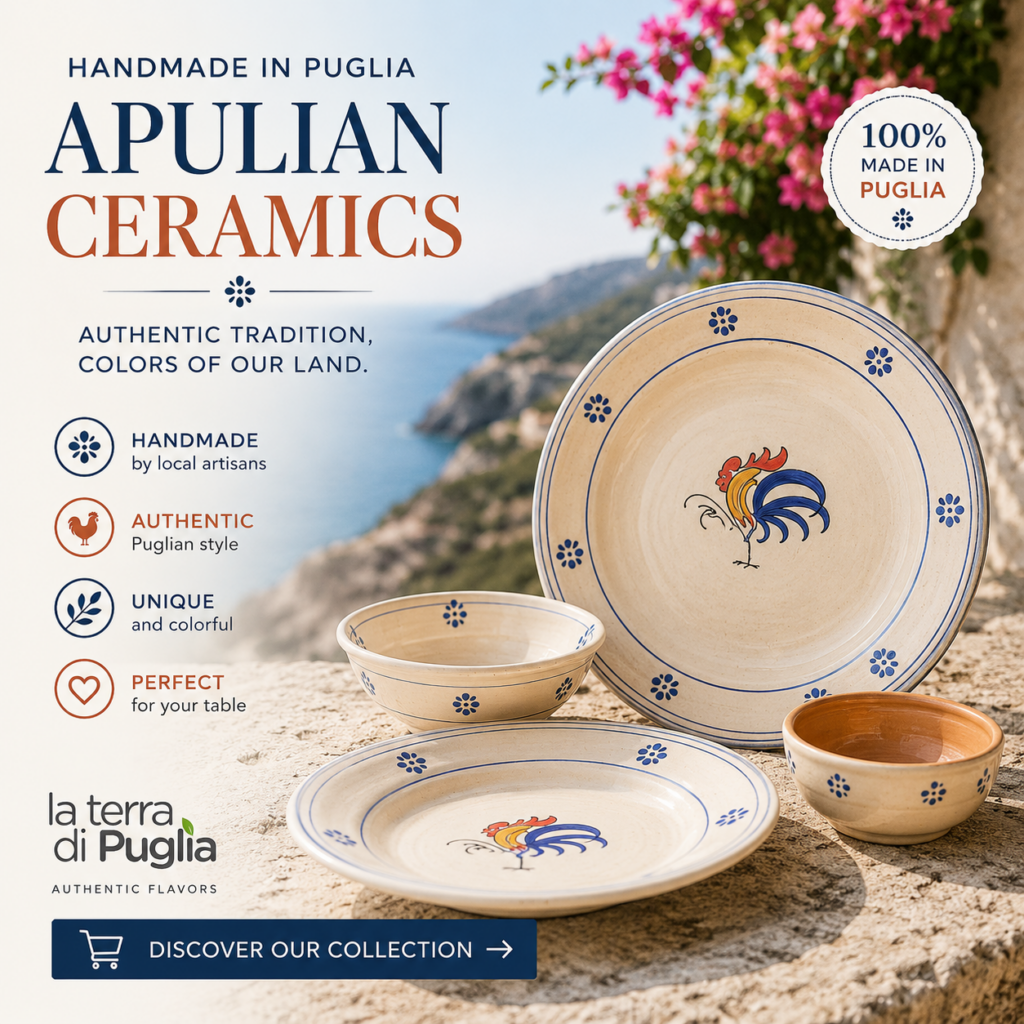
The morning is spent in Cutrofiano, one of the most important centres of Salento ceramics. The workshops still throw their pieces on the wheel, and not the decorative ceramics of Grottaglie: here they produce cookware, tableware, amphorae and jugs in the farming tradition of the area. Visiting a working kiln is a hands-on experience, not a museum visit.
In the afternoon the tour drops down to the Adriatic coast: Castro is one of the most beautiful seaside villages of the Salento, and its Zinzulusa sea cave, visited by boat, has stalactites that almost touch the water. The night is spent at Masseria Casina dei Cari in Presicce, built in the 16th century and once the summer residence of Ferdinand IV of Bourbon.
Day 4: Gallipoli and Presicce
The fourth day is spent entirely on the Ionian side. Gallipoli, whose Greek name means “beautiful city”, is built on an island joined to the mainland by a 17th-century bridge. You walk the old town through narrow lanes, Baroque churches and the Greek fountain. The port is still very much alive: the red prawns of Gallipoli are among the most prized in the Mediterranean.
In the afternoon, a visit to Masseria Don Cirillo in Ugento and a stop in Presicce, a village of the southern Salento known for its underground olive mills: presses carved into the limestone beneath the houses, where families worked for months in the dark, without ever coming out, until the season’s oil was finished.
Day 5: Santa Maria di Leuca and Otranto
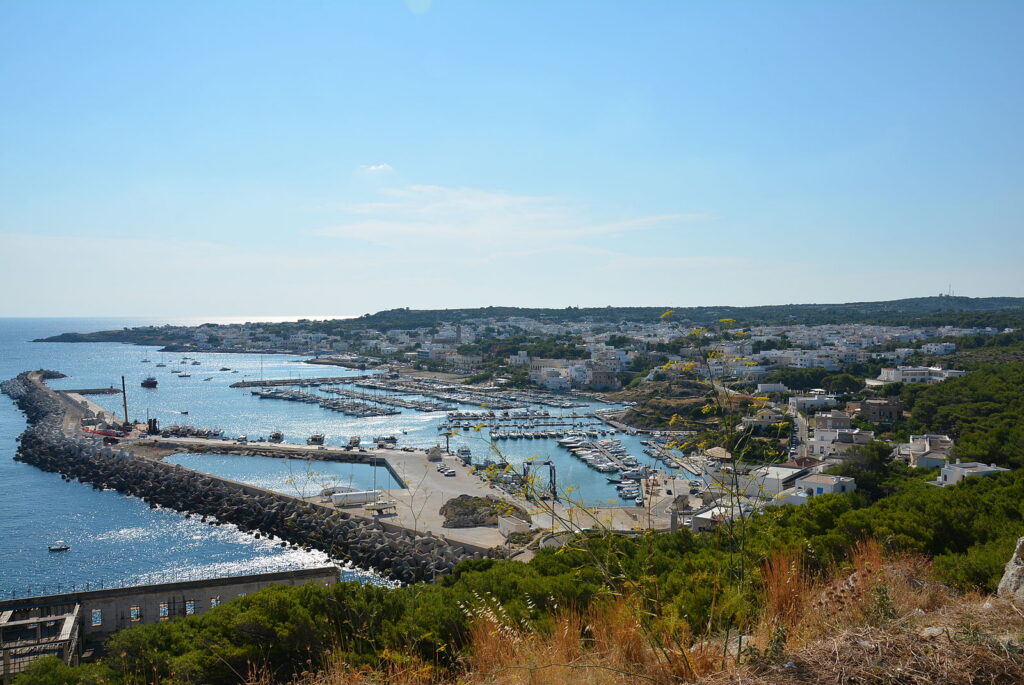
The last day reaches the two geographical extremes of the Salento. Santa Maria di Leuca is the Finibus Terrae, Latin for “the end of the land”: the point where the Adriatic meets the Ionian, and where pilgrims of the Middle Ages arrived after following the Via Appia from Rome. The monumental waterfall, where the Apulian Aqueduct pours straight into the sea, the sanctuary on the headland and the villas in the Liberty style, as Art Nouveau is called in Italy, from the early 1900s make up an unlikely and beautiful landscape.
In the afternoon the tour heads back up the Adriatic coast to Otranto. Its Norman cathedral has a 12th-century floor mosaic showing the tree of life, one of the most extraordinary works of art in Puglia: it lays out the whole view of the cosmos held in the Middle Ages, across 600 square metres of coloured tiles. Beneath the choir lie the relics of the 800 martyrs killed in 1480 during the Ottoman siege: history and faith in a place you will not forget.
Practical information
- Length: five days, which can be cut to four by leaving out Castro or Cutrofiano.
- Arrival and departure: Brindisi airport or Lecce railway station.
- Where you stay: Masseria Appidè (Corigliano d’Otranto) on days 1 and 2, Masseria Casina dei Cari (Presicce) on days 3 to 5.
- Transport: your own car is essential; public transport does not reach the masserie or the smaller villages.
- When to go: April to June and September to October. In August Gallipoli and Otranto are crowded, while Lecce is pleasant all year round.
This route is one of our multi-day itineraries in Puglia, from the Gargano down to the Salento.