Tomatoes in sea water are jarred tomatoes — peeled, datterini, small yellow tomatoes — packed in purified, food-grade sea water instead of the usual tomato juice. The label lists two ingredients, sometimes three. Here is what they are, how to cook with them without overdoing the salt, and three ideas from Puglia.
A tin of Italian peeled tomatoes usually holds tomatoes, tomato juice and a little salt. In recent years a few canneries in the south of Italy, in Puglia and Campania, have changed that last part: the tomato stays the same, but it sits in sea water. It is the same ingredient we covered in cooking with sea water, moved into the pantry.
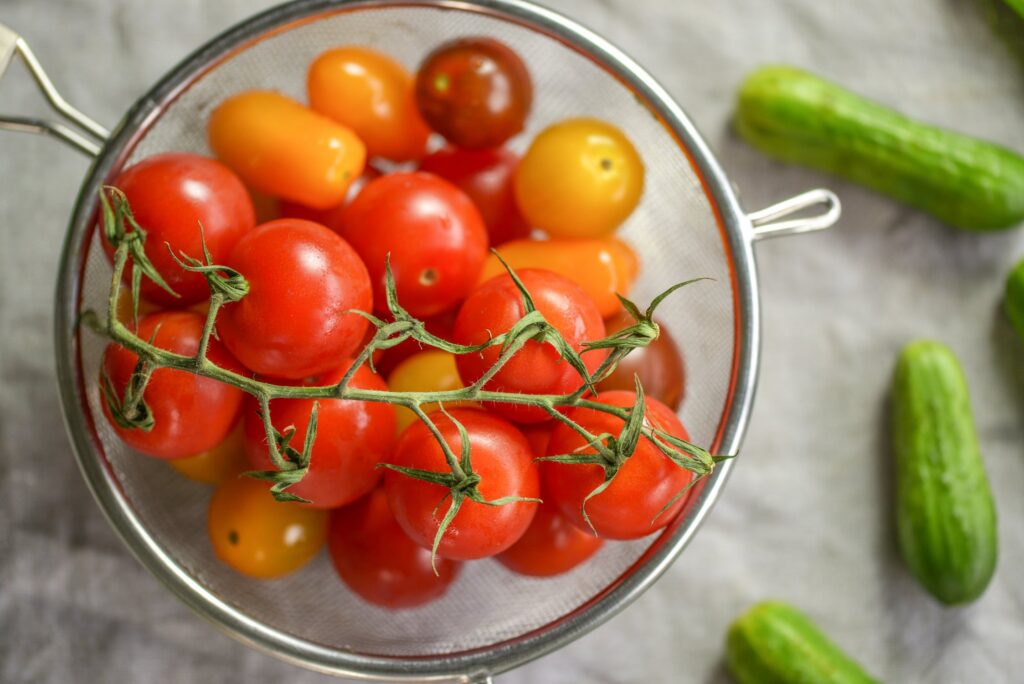
Red and yellow cherry tomatoes: the varieties you also find packed in sea water.
What is in the jar
The labels are short. An organic peeled tomato from Puglia lists tomato and sea water, and nothing else. The peeled datterini from the same producer read the same. A cannery near Vesuvius adds citric acid to its small yellow tomatoes, as an acidity regulator. Salt never appears: the sea water brings it, and in the Mediterranean that means 36 to 39 grams of salts per litre.
The water is not scooped up from the beach. Producers describe it as purified sea water for food use, filtered and treated before it goes into the jar. One of them mentions a patented process without explaining it. It is the same water sold in bottles for cooking.
These are the formats you will mostly find:
- Peeled tomatoes, sometimes peeled by hand.
- Hand-split tomatoes.
- Red datterini, whole or peeled.
- Small yellow tomatoes, whole.
- Corbarini, small tomatoes from Campania.
Our shop stocks peeled tomatoes in sea water from Laterradipuglia Conserve, made in Salento: peeled tomatoes, sea water and water, in a 500 g glass jar.
How to use them: keep the liquid
The difference from ordinary peeled tomatoes is all in the liquid. You do not drain it: it goes into the pan with the tomatoes, and it is what salts the sauce. So there is one rule: taste first, then salt. Often you will not need any, and if the sauce reduces a lot, the saltiness concentrates.
- Quick sauce: oil and garlic, or onion, in the pan, then the whole jar with its liquid, for about ten minutes with the lid ajar. This is the method one producer suggests, and it takes fish or meat as well.
- With fish: the most natural match, since the base already tastes of the sea. Use it to cook fillets or shellfish, in the spirit of the fishermen’s acqua pazza.
- The liquid on its own: what is left in the jar can be used in cooking instead of salt.
Once opened, the jar goes in the fridge and should be used within two or three days, as the labels say.
Less salt? Not really. Some producers present sea water as a lighter alternative to table salt. But sea water is salt in another form: it also contains magnesium, calcium and potassium, and sodium is still the largest part. You use it for flavour, not for a diet, and you measure it like salt.
Three ideas from Puglia
Frisella. In the Salento, people used to dip their frisella in the sea, as fishermen did. That is no longer done, but you can repeat the gesture at home: moisten the frisella with the liquid from the jar and top it with the tomatoes and a drizzle of oil. The basics are on our page about seasoned frise.
Pasta with mussels. The mussels’ own water and the tomato make the sauce: with datterini in sea water, salt goes in only at the end, if at all. Start from our spaghetti with mussels.
Fish soup. Mixed fish, shellfish and tomato in one pot: with peeled tomatoes in sea water you start from a base that is already seasoned. A good model is the Gallipoli fish soup.
Frequently asked questions
How are they different from ordinary peeled tomatoes? The liquid. In classic peeled tomatoes it is tomato juice with a little salt. Here it is food-grade sea water, which seasons on its own.
Should I drain them? No. The liquid is part of the sauce: it goes into the pan with the tomatoes.
Do I need to add salt? Only after tasting. Most of the time you will not.
Can I make them at home? No. Home preserves are not made with sea water: stick to the salted water of the traditional recipe.
How long do they keep? Unopened, in a cool, dry place as the label says, until the date on the jar. One producer gives 36 months. Opened, in the fridge, two or three days.