
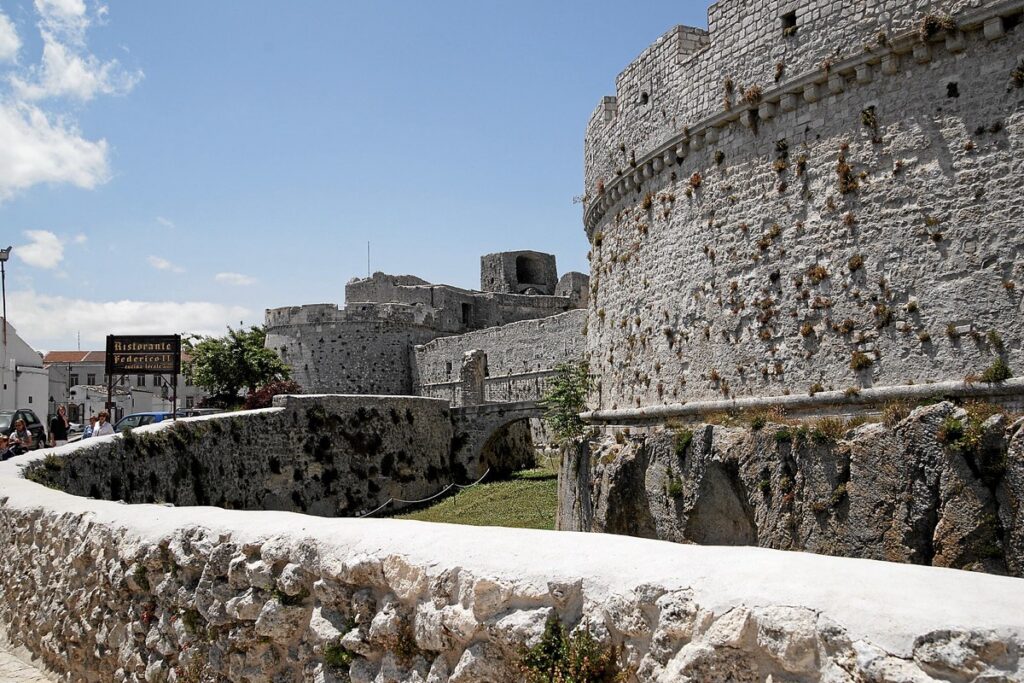
In the castle of Monte Sant’Angelo, on the Gargano promontory, legend says the ghost of Bianca Lancia still walks: the last wife and great love of Emperor Frederick II, kept there out of jealousy until she threw herself from the great tower. Here is the story, who Frederick was, and the twin legend of the castle of Gioia del Colle.
Planning a holiday in Puglia around history, legends and a little mystery? You are in the right place. We love stories where history and mystery meet, and this is one of the best: the ghost of the castle of Monte Sant’Angelo. Forgive us if, before we get to the ghost, we spend a few words on Frederick II of Swabia. You will soon see why.
A few words on Frederick II before you travel
It is almost impossible to visit Puglia without knowing at least something about Frederick II of Swabia, an enigmatic figure. Knowing who he was lets you appreciate far more of the region’s monuments and the history they still tell.
Although he came to the throne very young, Frederick II, grandson of Frederick Barbarossa, was a balanced, intelligent, cosmopolitan and sensible ruler, with a strong gift for what we would now call leadership and unusual foresight in politics, society and culture. Swabian (German) by dynasty, Norman on his mother’s side, raised by a Catholic guardian, he was used to living alongside Jews and Arabs, and his first wife was from Aragon. A rounded man and, for his age, a visionary.
Frederick II left a lasting mark on the history of southern Italy, and above all on Puglia, as you will notice on any trip here. There is hardly a castle in the region that he did not build or rebuild. Think of the famous Castel del Monte, his hunting residence and a meeting place for poets, astronomers and scholars of every kind; of the castle of Bari; of his hunting lodges in the Capitanata, the plain around Foggia; and of his elegant palatium, or palace, in Foggia itself. For a tour of all of them, see Frederick II’s Puglia and its castles.
Frederick II, “Stupor Mundi”, the wonder of the world. His contemporaries called him Stupor Mundi, the wonder of the world: a nickname that held both admiration and suspicion, because no other ruler of the Middle Ages had combined so much learning with so much power. He spoke six languages: Latin, Sicilian, German, French, Greek and Arabic. In 1224 he founded the University of Naples, the first state university in Europe not run by the Church. He wrote a scientific treatise on falconry, De arte venandi cum avibus, still regarded as a fundamental work of ornithology from the Middle Ages. He corresponded with Arab philosophers and Jewish astronomers. He was excommunicated by the pope, and yet he completed the Sixth Crusade through diplomacy, without shedding a drop of blood. Puglia is full of him: his castles, his laws, his roads.
The castle of Monte Sant’Angelo
The castle of Monte Sant’Angelo stands on the remains of an ancient Roman castrum, a fort. It was begun by Robert Guiscard, the Norman warlord who had the first town walls built and then a defensive tower. The castle grew up next to the tower and, as so often in Puglia, is the result of later work by the Swabians, the Angevins and the Aragonese.
During Frederick’s reign, he stayed in the castle of Monte Sant’Angelo with Isabella of England. Frederick II had three official wives: Constance, the Aragonese bride mentioned above, Yolande of Brienne and Isabella of England. To these must be added Bianca Lancia and the emperor’s countless lovers, who between them gave him around twenty children, legitimate and illegitimate. With Bianca Lancia he had three: Constance, Manfred and Violante. Manfred would later succeed Frederick in place of Conrad IV, until Charles I of Anjou, with the blessing of Pope Clement IV, defeated him and took the crown, opening the Angevin era.
The legend of the ghost: a story of love and jealousy
It seems that Frederick’s last wife, Bianca Lancia, was the only true love of his life. And it seems that her ghost still wanders the corridors of this old and atmospheric fortress. The legend says that Bianca, although she was at the emperor’s side, was never entirely free: she lived in the castle as a prisoner, perhaps because of the ruler’s blind jealousy. A cosmopolitan sovereign, open-minded, clever like few others, generous and far-sighted, and yet incredibly jealous in love. Worn down by her confinement, one day Bianca climbed the keep, the castle’s main tower, and threw herself from the top.
A very sad ending to a love story. But that love, in a way, never ended. Legend has it that Bianca’s ghost still drifts through the castle in a light white dress, with cries and weeping, an endless, heart-breaking memory of her captivity.
Monte Sant’Angelo: UNESCO heritage and a place of apparitions. Monte Sant’Angelo is not only the castle and the legend of Bianca Lancia. It is one of the places most charged with sacred history in all of southern Italy. The Basilica of Saint Michael the Archangel, dug into the rock of the Gargano, is one of the oldest Christian shrines in the West and has been a UNESCO World Heritage Site since 2011, as part of the sites of the Lombards in Italy. Saint Michael is said to have appeared here on four separate occasions: the first in 490 AD, the fourth in 1656, during an outbreak of plague. The old town of Monte Sant’Angelo is one of the best preserved on the Gargano: narrow alleys, houses of white limestone, craft workshops. It is worth a visit in any season.
A holiday in Puglia among mysteries and legends
The tale of love and death we have just told is not the only unusual event in the history of Monte Sant’Angelo: as we said, Saint Michael is believed to have appeared four times in these places, so rich in history. If you can, on your trip to Puglia, go up to Monte Sant’Angelo and its part of the Gargano, and do not miss either the castle or the sanctuary of Saint Michael.
And what about Gioia del Colle?
The castle of Gioia del Colle, south of Bari, is the setting of a very similar legend about Frederick II and Bianca Lancia. Not by chance, it has a tower called the Empress’s Tower. And there is more: in the castle’s underground rooms, once used as prisons, there is a relief that, according to the legend, shows Bianca Lancia’s breasts. In this version Bianca was locked up out of jealousy while she was pregnant with Manfred, before she was empress. Once she had given birth, the young woman sent the baby to his father together with her own breasts, and then threw herself from the tower.
Historians still do not agree on where this tragic episode, more legend than history, should be placed. What does seem settled is that after Manfred’s birth Bianca asked Frederick to make their union official, and that he, by then a widower after the death of Isabella, his third wife, agreed. So the fourth empress was born, although Frederick himself would die soon afterwards.
The Empress’s Tower at Gioia del Colle: history, legend and the relief. The castle of Gioia del Colle is one of the best preserved of Frederick’s castles in Puglia. Its present form is largely his work: he remodelled it deeply in the 13th century. The tower that tradition calls “the Empress’s” is the focal point of the Bianca Lancia legend, and the relief in the underground rooms that, according to the story, shows her breasts can still be seen by visitors. Modern historians tend to separate the historical Bianca Lancia, Frederick’s companion and later his lawful wife, from the romantic and tragic tale of the legend. But the power of the story has made Gioia del Colle one of the most visited castles of the Apulian Middle Ages, and the legend has been handed down intact for centuries.






You must be logged in to post a comment Login