On the night between 1 and 2 November, in many Apulian towns, the souls of the dead came home: the table was left laid, a dish of boiled wheat was made — colva, or cicc cuòtt — and the next morning the children found their stockings full. This is the story of that night, town by town, with what the sources actually say about each one.
There was one evening a year when nobody cleared the table. After dinner on All Saints’ Day the cloth stayed where it was, and something was left on it: a piece of bread, a glass of wine, an open pomegranate. It was for whoever would pass through the house during the night, and had eaten at that table for years.
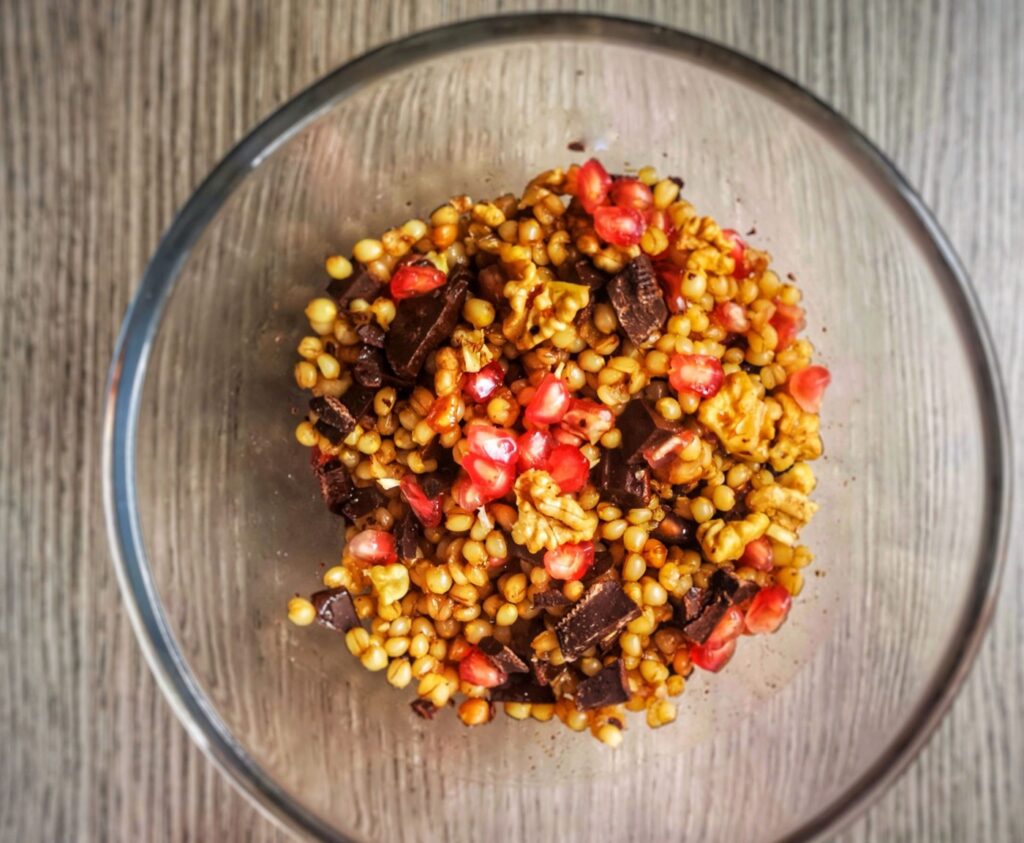
The wheat of the dead: boiled wheat, pomegranate, chocolate and vincotto.
The night the dead come home
In Italy, 1 November (All Saints) and 2 November (All Souls, the day of the dead) are two separate days, and it is the night in between that matters here. In Sammichele di Bari, a small town south of Bari, the Pro Loco — the volunteer association that looks after local traditions — tells the legend like this: that night the souls leave through the cemetery gate, walk the streets of the town and stop at the table laid at home, to have a bite and bless the living.
The same gesture turns up elsewhere, in other words. In Canosa di Puglia, the schoolteacher Peppino Di Nunno recorded the memories of a woman of ninety-four: for that night the table was set with bread, wine, pomegranates, dried figs and empty stockings. In the province of Foggia, in the north of the region, the local press reports that in Manfredonia salt cod was eaten that evening and a table was laid for the dead, that in Sannicandro Garganico the dead were said to walk the streets in order, like a procession, and that in Troia the procession of souls was believed to start from the church known as the Murticielli.
What was left on the table
There was no fixed menu. In Sammichele, the Pro Loco explains, some families make their loved one’s favourite dish, some leave only walnuts and almonds, others put out whatever was eaten during the day. Its president, Giovanni Tateo, put it in one sentence: you lay one extra place for your dead, and leave them something to eat.
Since 2014 that private table has also become a public one: the Pro Loco lays one open to everyone, in recent years in the courtyard of the Castello Caracciolo, where it stays on view all night.
Boiled wheat: colva, cicc cuòtt, the wheat of the dead
At the centre of that table, above all in the north of Puglia, sits a dish made once a year. It is called the wheat of the dead, colva, or in dialect cicc cuòtt. The register of traditional foods compiled by the University of Bari with the Puglia regional government describes it as typical of the province of Foggia, tied to the day of the dead on 2 November, and home-made: it is not sold, it is prepared and eaten in the family.
The base is soft wheat, boiled. Then, depending on the household, pomegranate, walnuts, almonds, dark chocolate, candied fruit, cinnamon, cloves, and vincotto — a dark syrup of long-cooked grape must — to bind it all. The name sounds grim, the meaning is not: wheat is the seed that dies in the ground and comes back, pomegranate stands for rebirth and life. In Monte Sant’Angelo, on the Gargano, the local press says maize is used instead of wheat.
If vincotto is new to you, our recipe for Italian fig syrup shows the same idea made with figs instead of grapes.
The vincotto for colva. To make it at home you need the grape syrup: our cuettu, mellow cooked grape must is the one poured over the wheat at the last moment.
The morning after: the children’s stockings
The dead did not only eat. They brought presents. In Canosa the empty stockings left on the table in the evening were full in the morning, and the woman interviewed by Di Nunno remembers the children shouting “Òne venéute!” — they came!
Around Foggia the stocking follows the same rules as the Befana’s, the old woman who brings Italian children their presents on 6 January. In Troia children got one twice a year, at All Saints and at Epiphany. In Manfredonia it held fruit, but the disobedient found garlic, onions, potatoes and coal. Seen from today, the point seems to have been this: letting children know that the grandparents who were gone were still thinking of them.
Orsara di Puglia, the night of fires. In the Daunian hills there is a village where the night of 1 November catches fire. In Orsara di Puglia it is called Fucacoste e cocce priatorje, the night of bonfires and heads of purgatory: in every street a sheaf burns, and pumpkins carved into faces hang with a light inside. According to the belief recorded by the Italian Network of Popular Culture, the souls come back to visit their families, and the lit pumpkin showed each of the dead the house where they had lived.
What is left of it
The boiled wheat has survived, because it is good and because families make it together. More of the region’s feasts and customs are gathered in our page on the traditions of Puglia.
How this piece was written. Each custom is attributed only to the towns for which a source documents it (the Sammichele Pro Loco, Peppino Di Nunno’s account of Canosa, the local press of the province of Foggia, the University of Bari’s register of traditional foods, the Italian Network of Popular Culture). The opening scene — the cloth left on the table, the bread, the glass — comes from oral memory and is told as such.

You must be logged in to post a comment Login