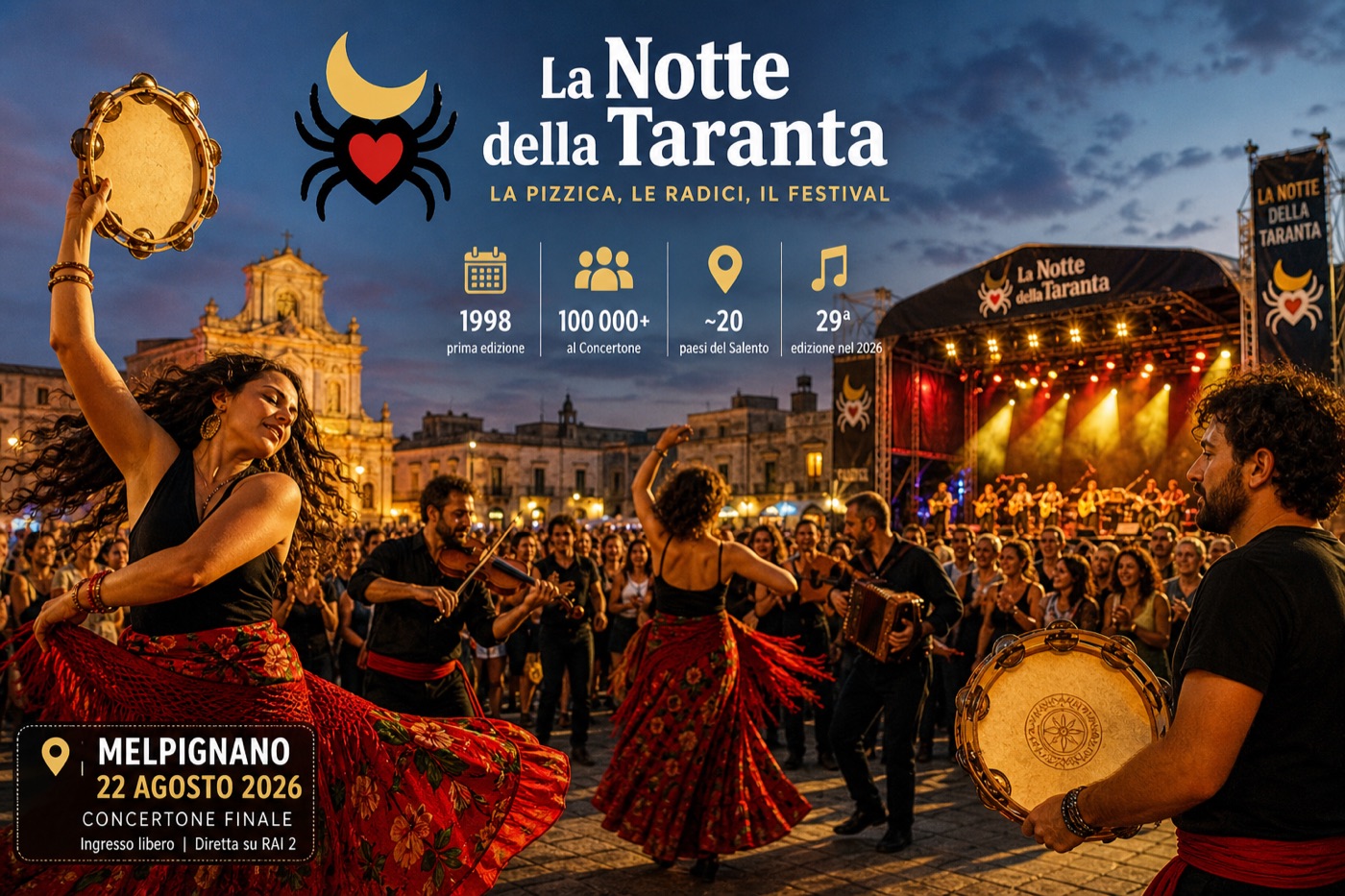
In short. The Concertone of the Notte della Taranta was held in Melpignano on Saturday 22 August 2026. On the podium, for the first time, Ermal Meta. The theme of the edition was the Mediterranean, the sea that connects. Here is who was on stage, how the evening went, and what to know before the next one.
Melpignano has 2,211 inhabitants. On 22 August the village held around 150,000, according to reports the following day.
It has happened this way for more than twenty-five years: a village of the Grecià Salentina — the enclave of the Salento where griko, a dialect of Greek origin, is still spoken — becomes, for one night, the place where the biggest tambourine in Italy is beating. This is the Concertone, the closing night of the Notte della Taranta.
🗓️ Saturday 22 August: it had started at seven
The meeting place was, as always, the esplanade of the former Augustinian convent, where the stage has always been built, under a baroque façade that looks out on an empty square for the rest of the year.
One piece of advice that holds for every edition: the pre-Concertone begins at 7 p.m., and it is not a warm-up act. This year it featured the students of the Progetto Matria, the Associazione I Sempre Vivi and Enza Pagliara with the Festa Adriatico Balcanica. Turning up around midnight for the headline act means missing the part where the music is still a village affair.
🎼 Ermal Meta: why him
The musical direction went to Ermal Meta, maestro concertatore for the first time. On paper a pop choice; up close, as coherent as it could be with the theme of the year — the Mediterranean as a space of relationships, the sea that connects instead of dividing.
Two shores, one sea. Ermal Meta was born in Fier, Albania, and grew up in Bari: his biography is precisely the theme of this edition. And he is no exception in this region — a few dozen kilometres from Melpignano, at San Marzano di San Giuseppe, Albanian has been spoken since the 15th century: it is the largest Arbëresh community in Italy. Here the Mediterranean that connects is not a press-release phrase. It is the language spoken at home.
The choreography was by Fredy Franzutti.
🎤 Who was on stage
The heart of the evening remained the Orchestra Popolare della Notte della Taranta. Around it, the guests announced:
- Alessandra Amoroso — from the Salento: she was playing at home
- Levante
- Gisela João — one of the voices of Portuguese fado, the far end of the same sea
- Maria Mazzotta — among the most recognisable voices in Salento singing
- Welo
- Giulia Vecchio — Apulian actress and impressionist, who sang L’acqua de la funtana, one of the best-known refrains of the popular tradition
The line-up filled up until the last moment. It is like that every year, and it is part of the game.
🌙 The twenty nights before
The Concertone is the end of a long run: since late July the festival has been travelling the Salento village by village, twenty stops in the squares of the Grecià Salentina and around it, nearly always free to enter. Anyone who has been knows the difference: in a village square, with two thousand people instead of forty thousand, you hear the pizzica from very close up.
🚗 Getting there without ruining the evening
A hundred and fifty thousand people in a village of two thousand means one thing: how you arrive decides the night. The gates open in the afternoon, car parks are bookable and can be a kilometre and a half from the stage, and getting out afterwards takes patience. Arriving prepared is half the work — and it will hold again for the thirtieth edition, in 2027.
🕷️ What is actually being danced
Before it was a festival, the pizzica was a cure. The bite of the taranta — the spider of the fields — struck mostly the women working the land, and there was only one treatment: dance to exhaustion, for hours, sometimes for days, to the sound of tambourines, with the whole village around you. Tarantism was a social fact for centuries, not a postcard.
The Concertone is the last form of that rite: enormous, electric, televised. But when the orchestra strikes up and the whole square starts moving the same way, the distance between today and the courtyards of the past gets noticeably shorter.
On 22 August, for one night, a village of two thousand souls stood at the centre of the Mediterranean. Then the stage came down, and Melpignano went back to the crickets.
Once the cameras are off, the same argument returns in the Salento every year. Our view of it: the spider in the Taranta’s web is not television — it is us.
The background to all of it: the pizzica and the Notte della Taranta, tarantismo and Galatina, and griko and the Grecià Salentina. Melpignano is in the Salento. The full guide to the festival — the stops, the history, the practical details — is on our page on the Notte della Taranta.