In short. In Italy it is called Ferragosto, and it is far more than the feast of the Assumption: it is the heart of the summer, the moment the whole country stops. In Puglia it is not one day but three — 14, 15 and 16 August — and each has its own character. The 14th belongs to the processions and the fireworks. The 15th to the sea and the long tables. The 16th to San Rocco, which closes the cycle.
The golden rule for Puglia in this period: the beaches fill up before nine in the morning, the villages after eight at night. Do it the other way round — the sea in the late afternoon, the old town at aperitivo hour — and you get the best of Puglia with half the crowd.
🌊 14 August: the Madonna della Madia arrives by sea
If you were to keep only one evening, it would be this one. On the night of 14 August, Monopoli re-enacts the arrival of its patron saint by sea, with the landing at Cala Batteria. This is not a procession like the others: it comes out of the water.
- 9.00 p.m. — the vigil of prayer to welcome the image of the Madonna della Madia, fireworks, and the procession up to the basilica-cathedral.
- 9.30 p.m. — concert in Piazza Vittorio Emanuele II with the Gran Concerto Bandistico “G. Piantoni” of Conversano, one of those village brass bands that are an institution in the south of Italy.
- 15 and 16 August — masses at 7.30, 10.00 and 11.30 in the morning; at 6.30 p.m. the solemn pontifical, followed by the procession through the old centre.
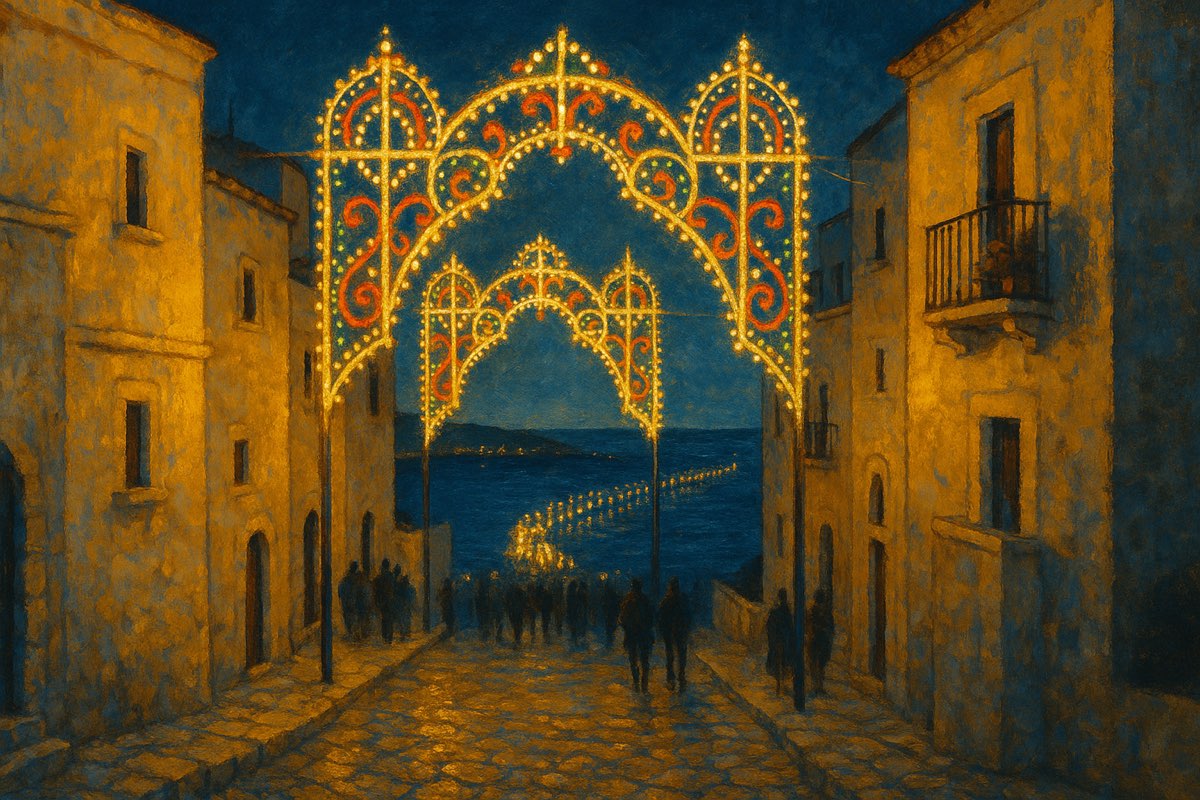
The traditional luminarie — those architectures of light built over the streets — are worth the trip on their own. One practical note: park a long way out and walk. The centre is closed to traffic, and anyone who insists on driving in loses a good hour.
🌅 15 August at dawn: a concert as the sun comes out of the sea
There is a way of starting that day which has become a small local tradition: arrive at dawn rather than at midday. At Ostuni, the white town, the Teatro Madre Festival closes its edition with a dawn concert on 15 August, in the archaeological park of Santa Maria di Agnano, a little outside the town.
⚠️ Check before you set off. Programme, artist and start time — somewhere between 4.30 and 4.45 a.m. — are confirmed late and vary from year to year. Entry is ticketed and booking is advisable: look at the festival’s own channels before driving out in the middle of the night.
The principle holds regardless: at five in the morning, in an archaeological park among the olive trees, you are in a Puglia that no longer exists by eleven.
🍺 14 to 16 August at Mesagne: three days of festival in the square
For anyone who prefers the loud version, the one with full squares, Mesagne hosts the “Boccale d’Oro” festival in Piazza Orsini del Balzo, from 14 to 16 August, free to enter, with Apulian craft beer and music. It is the opposite formula to the dawn concert: it starts as night falls and finishes late.
⚠️ The day-by-day programme is usually confirmed at short notice: check the times with the town council before planning your evening.
💃 14 August at Pulsano: free pizzica, without the crowd
Not everybody can get to the great closing concert of the Notte della Taranta, and not everybody wants to be in the middle of a hundred thousand people. On 14 August, in the old centre of Pulsano, the “Summer Music” evening with the Pizzica Pizzica Ensemble is free and given over to the popular music of the Salento.
The pizzica is the trance dance born in the Salento countryside and now the musical emblem of the region: we tell the story in the pizzica and the Notte della Taranta.
🍷 15 and 16 August: San Rocco, and the most self-deprecating festival in the Salento
On 15 August, at Ruffano, the feast of San Rocco mixes religious celebration, food stalls and a fair: this is the village Ferragosto, the one that makes no headlines and fills the streets until very late.
On 16 August, at Marittima di Diso, comes the Festa della Fica — the fig festival — which celebrates Salento agricultural biodiversity with a good deal of self-mockery. It is the kind of event that explains the Salento better than a guidebook does.
🏖️ And the sea? On 15 August, think first
Spending Ferragosto in Puglia without setting foot on a beach is close to sacrilege, but 15 August is the worst day of the year to improvise. Two figures to keep in mind:
The free beaches fill from first light: arrive at ten and the only space left is the kind you pay for. And the most sought-after beach clubs are fully booked several days in advance.
📅 How to plan the three days
- One evening only: the 14th at Monopoli. Fireworks, sea and luminarie in one place — that combination is not available anywhere else.
- All three days: the 14th at Monopoli, the 15th early at the sea and then Ruffano or Mesagne at night, the 16th at Marittima di Diso.
- With children: the evening processions are long and packed. The squares of Mesagne and Pulsano are better — you come and go as you like.
- If you are avoiding crowds: dawn at Ostuni on the 15th, then an inland village at lunchtime, when everyone else is at the beach.
Read next: how Apulians went to the sea on 15 August before there were cars, and the five Blue Flag beaches of the region. Monopoli is on the Adriatic coast; Ruffano, Pulsano and Marittima di Diso are in the Salento.
Dates and programmes are those published for August 2026. Most of these appointments recur every year on the same dates — the Madonna della Madia at Monopoli on the 14th, San Rocco on the 16th — but patron saint festivals often change their timings at the last moment, for weather or organisational reasons: a check with the town council the day before is always worth it.