In short. Cisternino is one of the hundred official most beautiful villages in Italy, and the quietest of the five towns in the Valle d’Itria. Its old town is limewashed, paved in local stone and built by nobody in particular — architects call it spontaneous architecture. It is also where you eat bombette, standing up, in a butcher’s shop.
If you want the Puglia of the postcard — white lanes, bougainvillea over the doorways, geraniums on every sill and the sense that it is permanently summer — this is the shortest route to it. Cisternino has fewer set-piece monuments than its neighbours and more atmosphere than any of them.
Where it is
Cisternino sits in the Valle d’Itria, the strip of country wedged between the provinces of Brindisi, Bari and Taranto — going there, you are not taking sides. Geologically this is the southern end of the Murgia hills, where the limestone has dissolved and dropped into a proper valley. The three best-known towns of that valley are Cisternino, Locorotondo and Martina Franca: all three white, all three well kept, all three set against a landscape of dark green scrub and red earth.
The old town
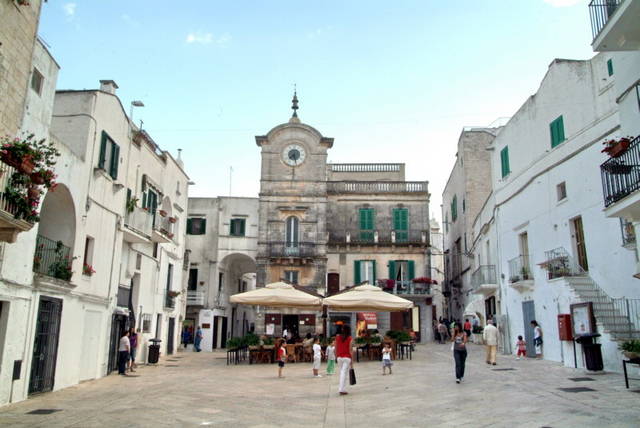
Cisternino belongs to the circuit of the hundred most beautiful villages in Italy, and the centre earns it. The lanes are paved with chianche, the local flagstones, and the houses are limewashed and immaculately kept — this is a place people live in all year, not a set.
Spontaneous architecture. Planners and architects use a specific term for Cisternino: it was never designed. There was no scheme, no grid and no architect — houses and small palaces accumulated one against another over centuries, each solving its own problem, and the result is a coherent whole that nobody drew. It is the opposite of Alberobello’s uniformity, and it is why the town rewards wandering without a map.
Two things to look for while you walk: the Chiesa Madre di San Nicola, built over the ruins of an earlier church put up by Basilian monks, and the Norman-Swabian tower, the medieval gate that marked the entrance to the town. Beyond the walls, the countryside is full of masserie, the fortified farms that are now mostly guesthouses.
The bombette, and how this works
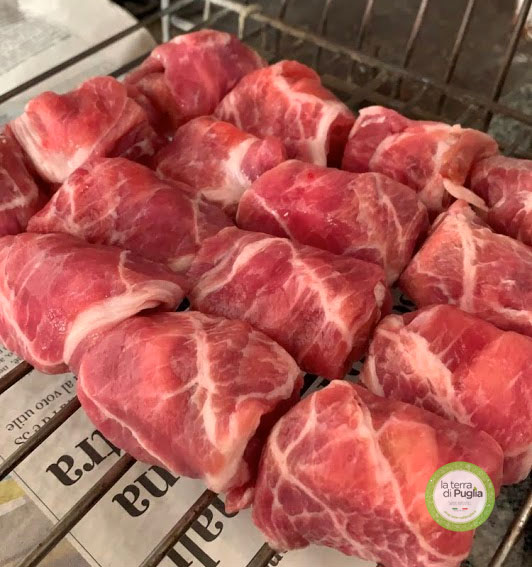
Cisternino is famous for bombette: rolls of pork stuffed with pancetta and caciocavallo cheese, cooked over a wood fire. Tradition puts their invention in Martina Franca; their fame belongs to Cisternino.
Order at the counter, not at the table. The whole valley is full of butchers’ shops where you sit down and eat what you have just picked out of the display — the meat goes from the counter to the wood oven and comes back to you. In Cisternino this is the normal way to have dinner. The meat is threaded onto skewers and grilled alongside potatoes that absorb everything dripping off it. Not a light meal, and not one to skip. Beyond bombette there is hand-cut sausage, plain and hot varieties, capocollo and whatever else is grilling.
Ask for the house wine: the valley makes its own, and it is what this food is built around.
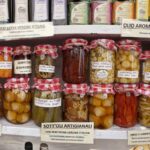
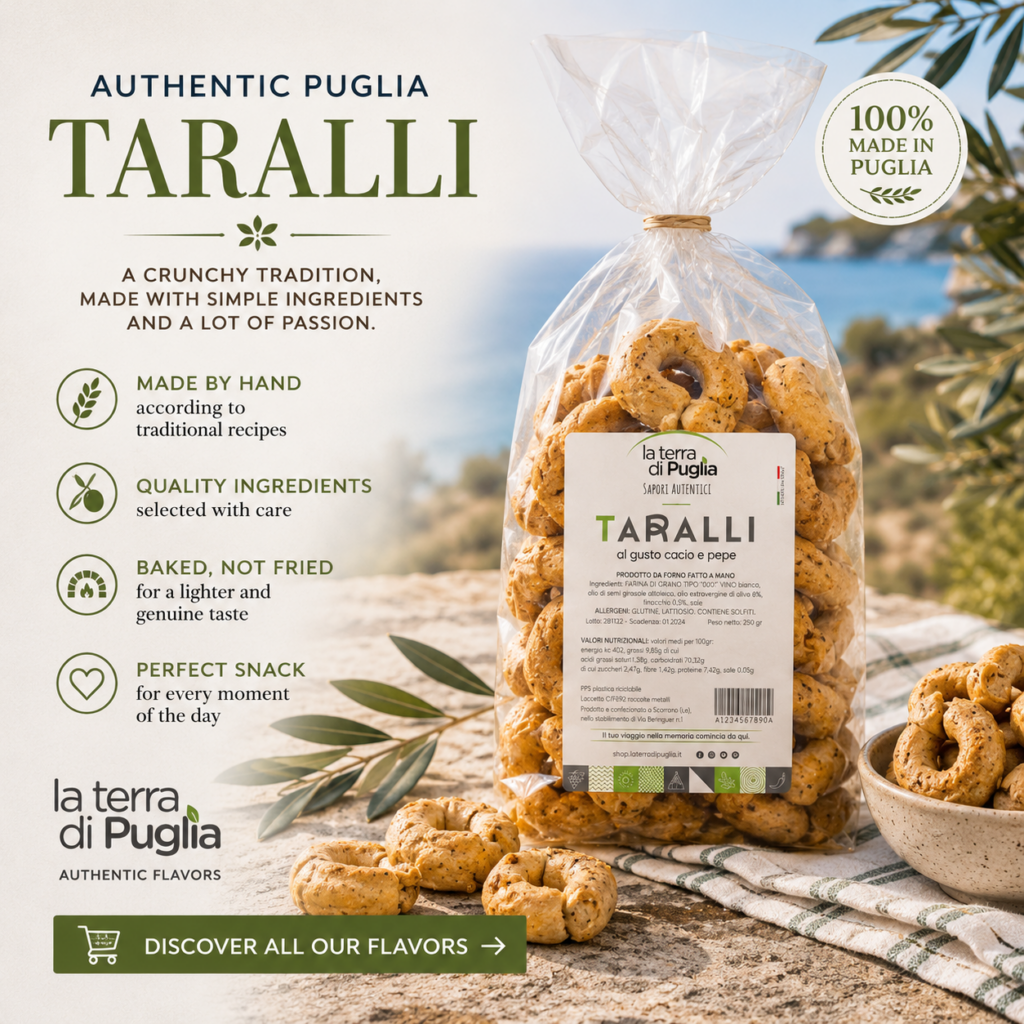
Some of it ships. The oil, the taralli, the preserves and the capocollo of the Valle d’Itria go out from Puglia directly: see the shop.
Around it
Everything in the valley is close. Alberobello for the trulli, Locorotondo for the circle and the view, Martina Franca for the baroque and the capocollo, Ostuni for the white town and the sea. Ceglie Messapica and Fasano are the same short distance in the other direction.
Give it a weekend at least. The mistake most people make with Cisternino is stopping for lunch and driving on.
Cisternino is the quietest of the five towns of the Valle d’Itria — and the one people come back to.