In short. Saint Nicholas — the man who became Santa Claus — is buried in Bari. And in Puglia, until a few decades ago, it was on the night of 5 December, not at Christmas, that children left something out and received presents.
The Anglo-Saxon world got Santa Claus through the Dutch Sinterklaas. Puglia never needed the detour: the saint himself has been here since 1087.
🎁 The night of the 5th of December
The feast of San Nicola was deeply felt by Apulian children, as it was across Italy, and until some decades ago this was the occasion for receiving a small gift — not Christmas.
On the night between the 5th and the 6th of December, children left out what they had: a handful of dried fruit, for instance, or some fodder for the saint’s donkey. Those with a little more left a pair of shoes on the doorstep, or some sweets. In exchange, they received a present.
A peasant tradition, largely forgotten. The custom faded as Christmas took over as the gift-giving date. It is worth recording precisely because it disappeared inside living memory — the grandparents in any Apulian family remember it. Leaving food or shoes on the doorstep was not unique to this feast: the same was done on the night of All Saints, waiting for the dead to visit.
🍎 Why he brings presents to children
Two legends sit behind it. In the better known one, three sisters had no dowry and no future; Nicholas gave them one, and with it the chance of a decent life — which is why he is invoked by women hoping to marry.
The one that made him the protector of children is different. Three children had nothing to eat, and Nicholas gave them three apples, one each. Overnight the apples turned to gold, and the families came out of poverty.
The column in the crypt. Another story has Nicholas in Rome, finding a marble column in a prostitute’s lodging. He marked it with an X and threw it into the Tiber; back at Myra, he saw it surface out of the Mediterranean. When his remains were taken to Bari the column is said to have followed them by sea, and it stands in the crypt of the basilica to this day — where young women still touch it and ask to be married soon.
⛪ Why Bari
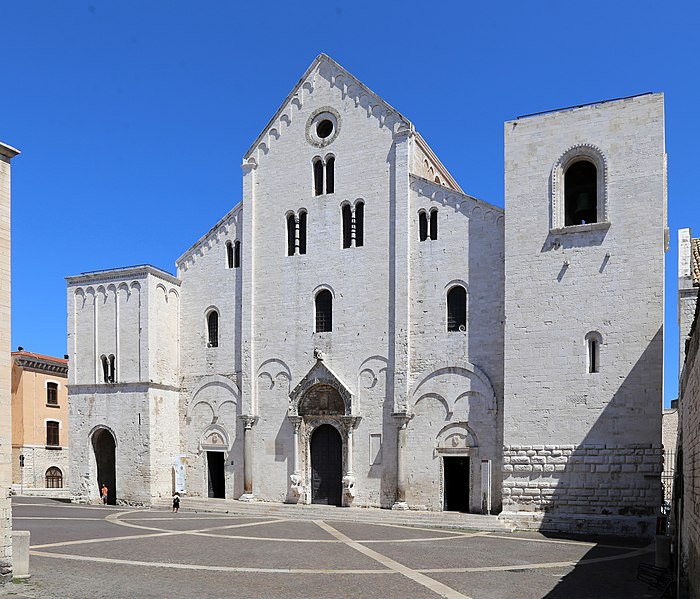
Nicholas was a Christian bishop of Myra, in what is now Turkey, in the days of the Eastern Roman Empire. After his death his remains were taken — stolen, in the traditional telling — and carried to Bari by sea in 1087, and the Basilica di San Nicola was built to house them. It remains a major pilgrimage site for both Catholic and Orthodox Christians — one of the few places where the two traditions worship in the same building.
The feast in May. Bari also celebrates San Nicola on 7–9 May, marking the arrival of the relics, with a procession that puts the statue out to sea on a boat. It is the city’s biggest event of the year.