Brasciòle are Apulian meat rolls stuffed with garlic, parsley and pecorino, cooked for hours in tomato sauce until that sauce becomes the Sunday ragù. Old recipes use horse meat, now often replaced by veal; the sauce dresses the orecchiette, and the meat comes after. Since 2025 the dish has been on Italy’s national list of traditional food products.
In many homes in Puglia, Sunday starts early, and it starts at the stove. Before anyone lays the table, the sauce has to simmer gently for hours, and in it, tied with string or pinned with toothpicks, are the brasciòle. Lunch is already settled: the sauce for the pasta, the meat for later.
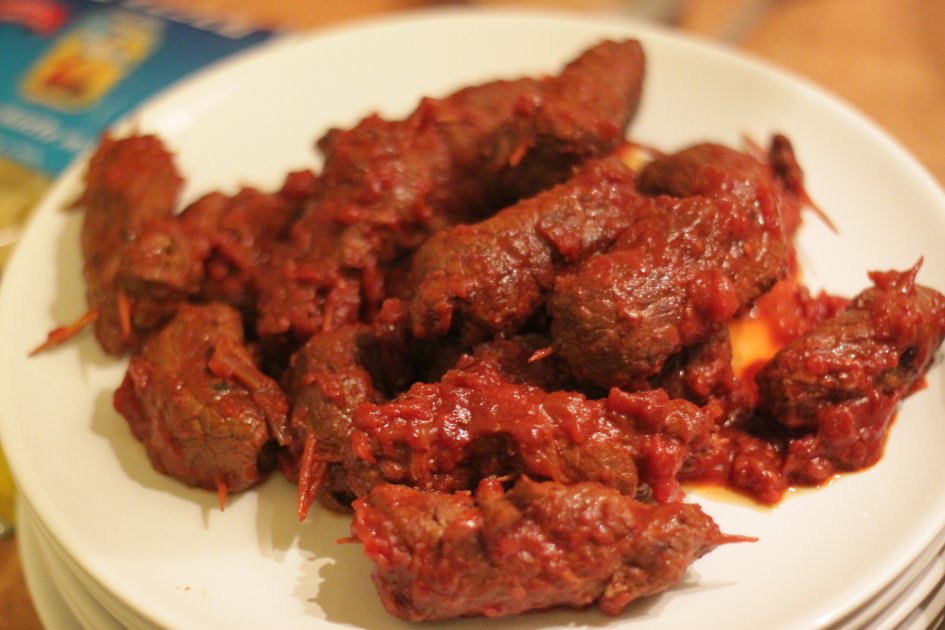
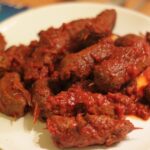
Brasciòle at the end of cooking: the sauce has reduced and clings to the meat.
What brasciòle are
Every Italian region keeps an official list of its traditional food products (known as PAT), dishes and foods made the same way for at least twenty-five years. The Puglia Region’s entry defines brasciòle as stuffed rolls of horse meat or veal, made with the Sunday ragù from Daunia in the north to the Salento in the south. It also records two other names, braciuole and braciòle, and a size: 10 to 15 centimetres long on average.
The filling changes from house to house, but the base stays the same: chopped garlic, parsley and pecorino, the sheep’s milk cheese of the south, grated or in small pieces, with salt and pepper. The Bari tradition, the entry says, adds lard, pancetta or guanciale (cured pork cheek); some family recipes add pine nuts and raisins too. A 1974 book on Puglia, quoted in the entry, describes brisciòne or trònere de carcavadde, filled with breadcrumbs, parsley, garlic and diavolicchio, hot chilli.
Horse or veal
The oldest recipes use horse, later replaced by veal. The regional entry explains why: when young, the horse worked in the fields; when it grew old or went lame, it ended up on the table. It cost far less than veal, so its meat was served in wine cellars, taverns and cheap eating houses. For veal, the entry mostly names a shoulder cut that Italians call cappello del prete, the priest’s hat.
In Puglia horse meat is not only a thing of the past: according to figures published by the Italian news site Il Post in February 2026, the region has 11 per cent of Italy’s horse farms and is one of the regions where most horse meat is eaten. Our recipe for horse meat rolls gives the quantities.
Did you know? In the Foggia tradition, the regional entry says, horse-meat brasciòle were born in a spicy version, as a rival to the brasciòla alla pizzaiola that had made the fortune of a wine cellar in the old town, in Via Schiraldi.
A ragù that cooks for hours
The regional entry allows about three hours on a low heat, lid on, for veal brasciòle, and four to five hours for horse meat. They are ready when the sauce has thickened and the meat is very tender. This is the basic method, as the entry describes it:
- Pound the slices thin with a meat mallet and season the centre with chopped garlic and parsley, pecorino, salt and pepper.
- Roll them up tightly and close them with toothpicks, kitchen string or, as was once done, white cotton thread.
- In a pan, soften a chopped onion slowly with oil and a little water.
- Brown the brasciòle on every side and deglaze with dry white wine.
- Add tomato passata and a little water, cover and cook on a low heat, turning them now and then; adjust the salt at the end.
There is no single version. In Trani, on the coast north of Bari, chef Stefano Di Gennaro, in a recipe published by the Michelin Guide, uses rump of horse or veal, lard in the filling, bay leaf, and deglazes with Nero di Troia, an Apulian red, or another red wine, for three to four hours of cooking.
Orecchiette first, the meat after
Brasciòle can be eaten as a main course with country bread, but the regional entry notes that tradition wants them with fresh orecchiette, the small ear-shaped pasta of Puglia, served in the Sunday ragù. Orecchiette are a recognised traditional product too: in Bari the version without the dome shape is called strascinati, and the entry lists other local names such as chiancarelle, recchjetedd and stachioddi. To make them yourself, see our recipe for home-made orecchiette.
The sauce is better still with a good passata in the pantry: the kind many families made at home at the end of summer, on the day of the sauce.
For the Sunday ragù. Our online shop has dried semolina orecchiette made from durum wheat, and an artisan tomato passata to cook the brasciòle in.
Where the braciola gets its own festival
In Puglia a village food festival is called a sagra, and the braciola has several, listed in the regional entry: in Torre Santa Susanna, the Sagra della Braciòla, in summer, since 2014; in the old town of Bari, a first edition in 2018; in Santeramo in Colle, since 2022, La nott di Braciòl, three days with a “braciola challenge”; in San Michele Salentino, a festival of braciola, frisa and orecchiette. Dates change every year, so check with the local town hall before you travel.
And there is one thing that even an official document cannot put plainly. The regional entry ends like this: the smell of ragù with brasciòle marked the waking hours of many Apulians on winter mornings, and it is a scent of home, of family and of love.