Ennius, the poet the Romans regarded as the father of their literature, came from the Salento: he was born in 239 BC at Rudiae, an ancient Messapian city two kilometres from Lecce. He wrote the Annales, the first Latin poem in hexameters, and even a short poem about food. He claimed to have “three hearts”, because he spoke three languages. Who he was, what he wrote, and where you can see his city today.
Say Salento and most people think of the sea, the baroque, the pizzica. Rarely of ancient Rome. Yet the poet the Romans considered the father of their literature came from here: Quintus Ennius was born in 239 BC at Rudiae, a city of the Messapians that is now an archaeological park on the edge of Lecce, about two kilometres south-west of the old town.
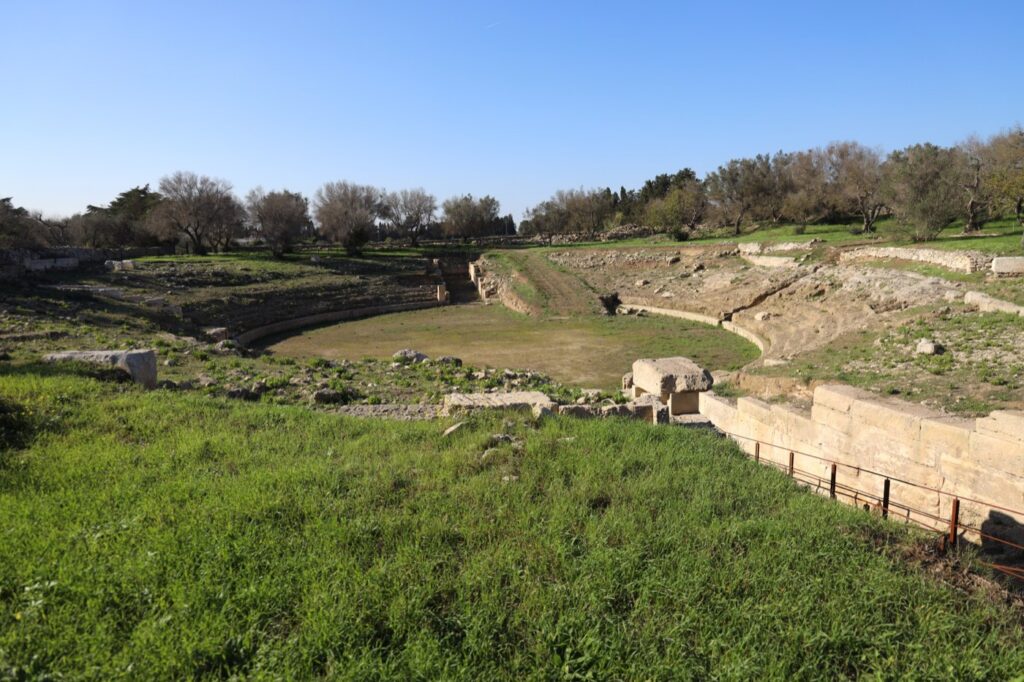
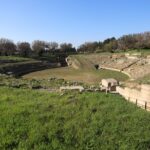
The Roman amphitheatre at Rudiae. Photo: Fabrizio Garrisi, Wikimedia Commons, licence CC BY-SA 4.0.
From Rudiae to Rome
Little is known about his youth. In 204 BC he was a soldier in Sardinia, and it was there that Cato met him and took him to Rome. In the city Ennius became a friend of Scipio Africanus and Scipio Nasica, and through a gift of land he obtained Roman citizenship. He was proud of it, and wrote so in a line that became famous: “Nos sumus Romani qui fuimus ante Rudini”, “we are Romans, who were once men of Rudiae”. He died in Rome in 169 BC.
The Annales: the history of Rome in verse
His most important work is the Annales, an epic poem in eighteen books that told the history of Rome from the arrival of Aeneas down to his own day. It was the first Latin poem written in hexameters, the metre of Greek epic, and after him it became the metre of Latin epic.
Ennius also wrote Saturae on assorted subjects, and philosophical works such as the Euhemerus, on the theory that the gods had once been men. His epitaph says that he lives on, passing to and fro through the mouths of men.
“Three hearts”, three languages
The detail that made him famous comes from the writer Aulus Gellius, in his Attic Nights: “Quintus Ennius tria corda habere sese dicebat, quod loqui Graece et Osce et Latine sciret”. Ennius said he had three hearts because he could speak Greek, Oscan and Latin. For the Romans the heart was the seat of the mind: three languages meant three ways of thinking.
Oscan, not Messapian. In many versions of the story online, Ennius’s three languages become Messapian, Greek and Latin. But the source, Gellius, writes Oscan. Ennius claimed his link with the Messapians in another way: according to the commentator Servius, he said he was descended from Messapus, the legendary king who gave his name to Messapia.
Rudiae was a city of the Messapians, the people who lived in the Salento before Rome, and whose traces you can follow on our tour the Messapians and their port. Place names remember it too: in antiquity “Calabria” did not mean today’s region, but the Salento.
The Hedyphagetica: a poet in the kitchen
Among Ennius’s works there is also the Hedyphagetica, roughly “good things to eat”. It was a collection of food advice in verse, freely adapted from a Greek poem of the 4th century BC, the Hedypatheia of Archestratus of Gela. Eleven lines survive, only because the writer Apuleius quoted them centuries later in his Apology. They are a catalogue of fish, each tied to a different place. Even then, good food had an address.
Rudiae today: the park and the amphitheatre
Rudiae was one of the largest Messapian centres in the Salento, around one hundred hectares. It was already inhabited in the 8th century BC, and in the 4th century BC it built a circuit of walls about four kilometres long. Today it is the Rudiae Archaeological Park, in the Valle della Cupa, on Via Mazzotta in Lecce, run jointly by the regional heritage office, A.R.Va, a spin-off of the University of Salento, and the City of Lecce.
At the centre of the park stands the Roman amphitheatre, brought to light by excavations of the University of Salento. It was built in the early 2nd century AD, under Trajan, in a natural hollow that the Messapians had already used as a cistern. It measures about 85 by 70 metres, with an arena of 50 by 35, and could hold almost 8,000 spectators. When Ennius was born it did not yet exist: it came more than three centuries later, in the city that had given Rome its first poet.
- Where: Rudiae Archaeological Park, Via A. Mazzotta, Lecce, about 2 km south-west of the centre.
- Visits: the park opens for guided tours and events, such as the European Heritage Days. Check the times before you go.
- Not only Ennius: according to tradition, Saint Orontius, patron saint of Lecce, was also born at Rudiae.
Frequently asked questions
Where was Ennius born? At Rudiae, a Messapian city that is now an archaeological park on the south-western edge of Lecce, in 239 BC.
Why is he said to have had three hearts? Because he said so himself: according to Aulus Gellius, Ennius claimed three hearts because he spoke Greek, Oscan and Latin.
What is his best-known work? The Annales, an epic poem in eighteen books on the history of Rome, the first in hexameters in Latin literature.
Can you visit Rudiae? Yes, the archaeological park, with its Roman amphitheatre, opens for guided tours and events. It is a few minutes from the centre of Lecce, a good base for exploring the rest of the Salento.