Folklore in Puglia is not a show put on for visitors: it lives in the people who take part in it. Processions on land and at sea, pilgrimages, patron saint festivals under great arches of light, carnival parades and great bonfires fill the squares of the region in every season of the year.
Puglia is a region with a living folklore. It is not a matter of costumes taken out of a cupboard once a year: local people still crowd into the events tied to the history and traditions of their towns, with huge popular participation and a genuine, contagious enthusiasm.
In recent years these events have found new energy. Tourism in Puglia has changed: many visitors no longer come only for the sun and the sea, and look instead for experiences close to local traditions, faith and culture. The old festivals have been the natural answer.
Folklore and faith
Look closely at the calendar of Apulian folk events and one thing stands out: in many cases they are bound up with the deep religious faith that still shapes daily life in this far southern corner of Italy. Think of the many processions, both through the streets and out at sea, the pilgrimages, the night vigils and the parades that are all part of local folklore.
These occasions are the best way to understand how close people here remain to their faith. That spiritual heritage is rich in stories of saints, legends and miracles which, now and then, slip from official religion towards older pagan beliefs, and even further, into the more mysterious world of magic.
On the road to the Holy Land. Puglia was a stopping point for pilgrims travelling to the Holy Land. It is easy to imagine them, lodged in the inns of the area, passing the evenings telling or acting out episodes from the lives of the saints, often woven together with events that had really happened. Many of the oldest local stories may well have been born this way.
Geography played its part too. Puglia is above all a region of the sea, long populated by fishermen, and it was only natural for them to honour the saints and ask for their help and protection before going out with the boats, leaving ex-votos of every kind as thanks.
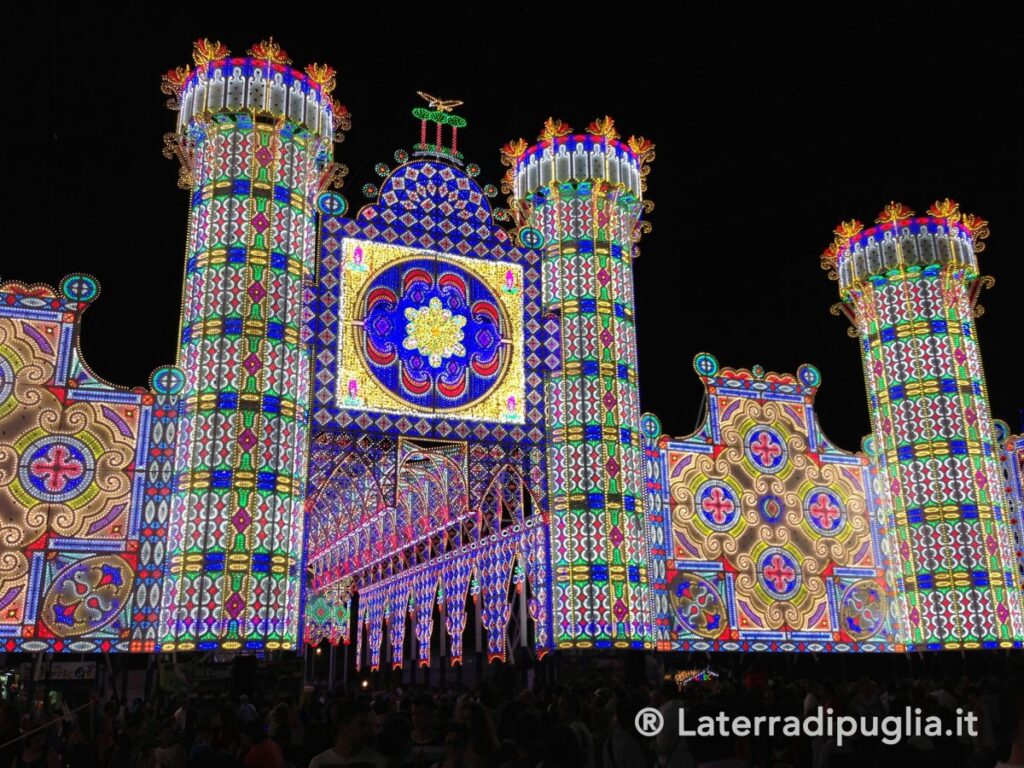
To grasp how strong this attachment is, even though it is shared by the rest of Italy, it is enough to look at the many patron saint festivals held across the region. For each one the town puts up its luminarie: spectacular arches and façades made of thousands of light bulbs, raised to honour the patron saint with all due ceremony. You can read about those of Scorrano, in the Salento.
Folklore and everyday life
Yet daily life in Puglia was never made of fishing alone, and it is not today. This is also a deeply rural region, and so, alongside religious folklore, another kind grew up over the centuries, following the rhythm of the fields and the seasons, and moments such as sowing, the harvest and the grape harvest.
Most of these festivals bring together processions and parades, old songs in dialect and allegorical verses. Others mark recurring dates in the year, such as the carnival parades, or the fòcare, the great festive bonfires. And then there are all the events that fill the squares, above all in the smaller towns, not only in summer but all year round. Music and dance belong here too: the pizzica of the Salento is the best-known example.
Puglia, in short, is not only sun and sea. It is folklore as well, across all four seasons of the year. More customs and festivals of the region are collected in our section on Apulian traditions, and the main events are listed under festivals in Puglia.