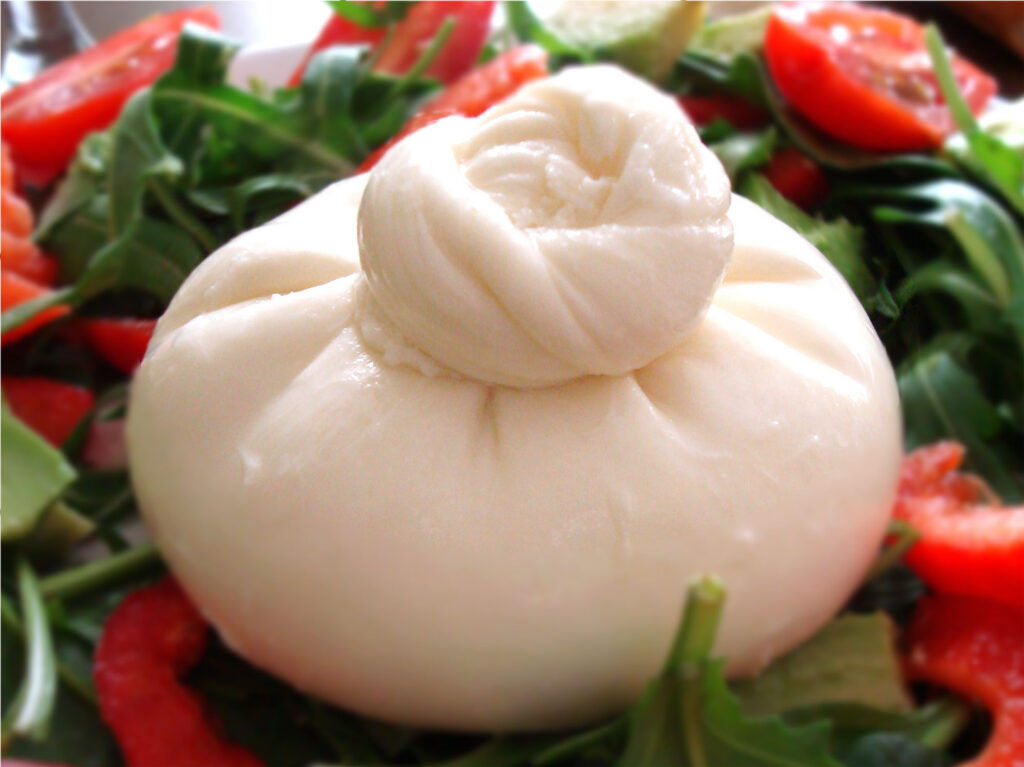
Burrata is a pouch of stretched cow’s-milk curd filled with stracciatella, shreds of mozzarella soaked in fresh cream. It was invented in 1956 on a farm near Andria, during an exceptional snowfall, and the Burrata di Andria has PGI status. It is at its best within 24 to 48 hours of being made.
Among the dairy products of Puglia, burrata is the one best known abroad. Of all the cheeses that carry the name of the region around Italy and the world, it holds the place of honour. They call it “the queen of Apulian dairy”, and the title is well earned.
Puglia or Basilicata?
Burrata is also made in neighbouring Basilicata, but the most famous is without doubt the burrata of Andria, which has been awarded Protected Geographical Indication (PGI) status, the European label that ties a food to its place of origin. Alongside it there are other versions from the Murgia, the limestone plateau inland of Bari, so much so that people often speak of burrata delle Murge, and from other parts of Puglia.
What burrata is
The name might make you think of butter, burro in Italian, but do not be misled. Apulian burrata is made from cow’s milk and stands out for its soft, stringy texture. Inside is the equally famous stracciatella, shreds of mozzarella mixed with fresh cream, while the outer shell is made of pasta filata, the stretched curd of mozzarella. Its shape is that of a little bag, closed at the top with a distinctive knot.
Burrata, stracciatella and mozzarella: three different things. They are often confused. Mozzarella is compact stretched curd, even in texture, with the delicate taste of fresh milk. Stracciatella is the filling of the burrata: stretched curd pulled apart by hand and mixed with fresh cream, rich and creamy. Burrata is the two together: a thin shell of mozzarella holding the stracciatella. Cutting it open and seeing the creamy heart spill out is one of the iconic moments of Apulian food. Stracciatella is also sold on its own, and it is wonderful on warm bruschetta or stirred into fresh pasta.
The history of burrata: born in 1956, out of necessity
Burrata was born in the middle of the last century, in 1956 to be precise. That year saw exceptional snowfalls on the Murgia, in the area between Andria and Castel del Monte. Lorenzo Bianchino, who worked at the Piana Padula masseria, one of the fortified farmhouses of the Apulian countryside, had a brilliant idea. With the roads snowed in and supplies hard to move, he did what was already done with manteca, another traditional cheese, and sealed the stracciatella inside a pouch of mozzarella curd. To keep the milk and what it produced from going to waste, Bianchino invented a new cheese. The queen of Apulian dairy was born.
The PGI Burrata di Andria: what the label protects. The Protected Geographical Indication protects both the production area, the Murgia between the provinces of Bari and Barletta-Andria-Trani, and the traditional artisan techniques, with fresh cow’s milk and stretching done by hand. Freshness is everything: burrata has a very short life, ideally 24 to 48 hours from production. After that the shell hardens and the stracciatella inside loses its creaminess.
How burrata is made
Burrata is made all year round, by artisan methods. The milk is warmed to 35 to 37 °C, then left to ferment with specific starters, or with citric or lactic acid, until it reaches a pH of 6.1 to 6.2. Then comes coagulation with rennet, the breaking of the curd, and a rest to drain off the whey. Next is the stretching in boiling water, sometimes salted. Part of the stretched curd is then shredded and mixed with liquid cream to make the stracciatella; another part is used to form the outer pouch.
How to eat burrata
To enjoy it at its best, first of all make sure it is fresh: burrata is not easy to find outside Puglia precisely because it travels badly. The classic pairings:
- With fresh tomatoes: the classic of classics. Ripe tomatoes, a drizzle of Apulian extra virgin olive oil, basil and salt. Nothing else.
- On warm bruschetta: the heat of the toasted bread warms the shell and lets the stracciatella run out; add sun-dried tomatoes or black olives.
- Savoury pies, pizza, fresh pasta: burrata always goes on at the end, never into the oven, because too much heat melts it and it loses its structure.
- With mortadella and pistachios: a modern pairing that has become hugely popular, where the fat of the mortadella, the creaminess of the burrata and the toastiness of the pistachio balance each other perfectly.
Burrata according to the Guardian
In September 2026 the British newspaper The Guardian ran a report on a dairy in Andria and on the province of Barletta-Andria-Trani, and in Italy it sparked a row over a sentence, “I don’t eat mozzarella outside Puglia”, that the paper never wrote. We read the whole article: what it really says, place by place.
For a shorter read, see our article on burrata; to visit the land where it was born, start from Andria and Castel del Monte. More cheeses and specialities are in our guide to Apulian food.