Apulian taralli or Turin grissini? It is not only a matter of taste: origin, ingredients, cooking method and food culture are all different. For us the tarallo wins, and here we explain why, point by point. Plus the traditional recipe to make taralli at home.
The question sounds trivial. Taralli or grissini? Both end up on the table at aperitivo, the Italian ritual of a drink and a nibble before dinner; both go with wine, both are perfect with cheese. But put them side by side and really look at them, at their history, ingredients and technique, and they turn out to be two completely different products, born centuries apart in traditions that have almost nothing in common.
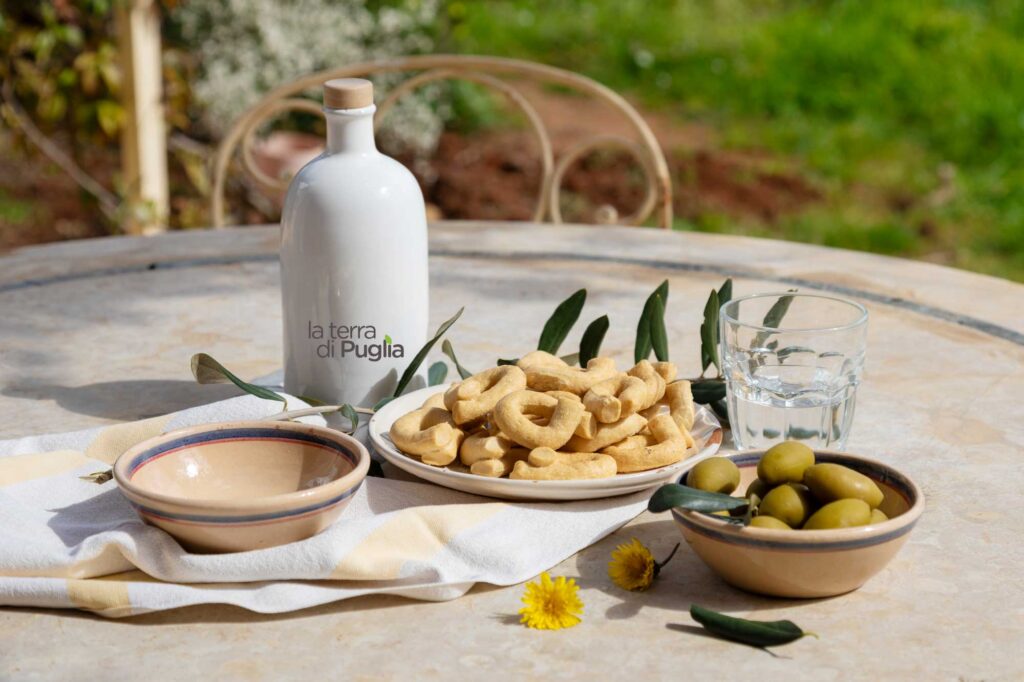
And the Apulian tarallo wins. Not out of local pride, but for concrete reasons that we go through one by one: the real differences, the story of the tarallo, why the double cooking matters, the regional variations, the best pairings and, at the end, the recipe.
Taralli vs grissini: the differences that count
First of all, let us be clear about what the two things are.
- Apulian tarallo: a ring of firm dough made from flour, extra virgin olive oil, dry white wine and salt. The double cooking is a must: first boiled in water, then baked. No yeast. From Puglia, and according to tradition dating back to the 15th century.
- Turin grissino: a thin, crunchy breadstick made from flour, water, yeast, oil (or lard in the traditional version) and salt. Baked in the oven. From Piedmont, in north-west Italy, documented since the 17th century. It is said to have been invented for the Duke of Savoy.
- 1400: the year the Apulian tarallo was born, according to tradition.
- 4: the ingredients of the original tarallo, flour, oil, white wine and salt.
- 2: the cookings, boiling and then baking, the secret of its crumbly texture.
- 0: grams of yeast in the traditional tarallo, which has no raising agent at all.
The story of the tarallo: born of hunger, now a symbol
Legend has it that the Apulian tarallo was born in the 1400s, during a famine. A mother with little in the larder, just flour, oil, salt and white wine, kneaded what she had and shaped it into small rings. She cooked them and gave them to her children. The result was so good that the women of the neighbourhood began to copy her, and from there the recipe spread from house to house, and then to the shared bakeries of the town.
The real story, beyond the legend, is that of a humble food that became a symbol of hospitality. Finire a tarallucci e vino, “to end with taralli and wine”, is still an Italian expression for settling a quarrel on friendly terms: taralli and wine were what you offered guests as a gesture of welcome and reconciliation. It is no accident that the saying has survived: it tells of a rural Italy where food was the social act par excellence.
Over the centuries the recipe evolved. The boiling before baking, today considered the secret of the crumbly texture, was introduced later to improve it. The flavourings, fennel seeds, chilli, onion, olives, sun-dried tomatoes, were added later, each tied to a particular part of Puglia.
Why the Apulian tarallo beats the grissino
We are not saying the grissino is bad. The Turin grissino is an excellent product, with its own history and its own reasons. But on several fronts the comparison does not hold.
The ingredients. The Apulian tarallo has four: flour, extra virgin olive oil, white wine and salt. No yeast, and in the artisan version no additives and no preservatives. The modern industrial grissino almost always has a much longer list: flour, water, yeast, seed oil (not always olive oil), salt, malt, emulsifiers. The difference is structural.
Extra virgin olive oil. The Apulian tarallo is made with extra virgin olive oil, not seed oil and not lard, and this completely changes the flavour. A tarallo made with oil from Coratina olives, the best-known Apulian variety, has an aromatic depth that no industrial grissino can match.
The double cooking. Boiling before baking gelatinises the starch on the surface, creating that thin crust that makes the tarallo crumbly in a different way from the grissino, which is evenly crunchy but tends to snap in a less satisfying way.
The artisan tarallo generally contains fewer additives, no yeast, and its fat comes from extra virgin olive oil, while the industrial grissino often uses cheaper seed oils and has a longer ingredient list. The artisan Piedmontese grissino is another story, but then the comparison is between two regional excellences, and it makes less sense.
The variations of the Apulian tarallo: each has its story
The classic tarallo is the one made with white wine, simple, perhaps with a pinch of pepper. But through the centuries Puglia has developed a whole family of variations, each worth a mention.
- Fennel seed tarallo: the most widespread and recognisable. Wild fennel seeds give a scent and a taste that have almost become “the” taste of the Apulian tarallo in people’s minds. Perfect with a dry white wine.
- Chilli tarallo: hot and bold, made for aperitivo. Very common in the Salento, the southern tip of Puglia.
- Onion tarallo: the sweetest and most fragrant version. The onion caramelises in the dough as it bakes, with a surprising result.
- Olive tarallo: chopped olives in the dough, intense and savoury, perfect with mature cheeses.
- Sun-dried tomato tarallo: the most modern version, with finely chopped sun-dried tomatoes in oil. Much in demand abroad.
- Sweet tarallo: a version typical of Bari, topped with sugar crystals. Less known outside the region, but loved by those who know it.
What to pair them with: not just aperitivo
The Apulian tarallo is often reduced to an aperitivo nibble. It does that job very well, but that is not all it is. In many Apulian families the tarallo also stands in for bread, ends a meal, travels as a snack and makes a food gift.
- With Apulian red wine: the classic pairing. Primitivo or Negroamaro with fennel or chilli taralli: the tannins of the wine and the character of the oil balance each other perfectly.
- With cheese: plain or fennel taralli with cacioricotta, burrata or caciocavallo. The crumbly tarallo is a pleasing contrast with the creaminess of fresh cheeses.
- With cured meats: capocollo, soppressata, Apulian pancetta. The most direct pairing of the tradition.
- On their own: the tarallo is one of those foods where one leads to another, the ideal snack.
The traditional recipe for Apulian taralli
Four ingredients, two cookings and a few precautions while you work.
The secret of the crumbly texture. After boiling, the taralli must dry for at least 2 hours before going into the oven, better still overnight. This drying is what decides how crumbly they will be: if you are in a hurry you get hard taralli, if you wait you get taralli that crumble perfectly at the first bite.
The quality of the oil makes all the difference. An intense Apulian extra virgin olive oil, Coratina or a local blend, gives the taralli a character that seed oil cannot reproduce. It is not a detail: it is why the taralli of an Apulian baker are different from those made with anonymous ingredients.
Ingredients for about 60 to 70 taralli:
- 500 g type 0 flour (not 00, which is finer: you need more elasticity)
- 130 g Apulian extra virgin olive oil
- 180 g dry white wine at room temperature
- 12 g fine salt
- Optional: 2 to 3 tablespoons of fennel seeds, or plenty of freshly ground black pepper
Method:
- Dough: heap the flour into a mound with a well in the middle, add the salt and mix. Pour in the oil and the wine slowly and knead until the dough is smooth, elastic and not sticky. With a stand mixer: 10 to 12 minutes at medium speed. By hand: at least 15 minutes of good kneading. Add the fennel seeds or the pepper if you want to flavour them. Cover with a damp cloth and leave to rest for 30 minutes.
- Shaping: take small pieces of dough and roll them with your hands on the board into sticks about 10 to 12 cm long and as thick as your little finger. Overlap the ends and press well to close the ring. Keep the finished taralli under a damp cloth while you shape the rest, or the surface will dry out.
- Boiling: bring a large pan of lightly salted water to the boil. Drop in the taralli a few at once. When they float to the surface (1 to 2 minutes), lift them out with a slotted spoon and lay them on a clean cotton cloth, well apart from each other.
- Drying: leave the taralli to dry on the cloth for at least 2 hours, better 4 to 6 hours or overnight. This step is essential for the crumbly texture.
- Baking: arrange the taralli on baking paper and bake at 190°C, conventional oven (no fan), for 20 to 25 minutes, until evenly golden. Switch off the oven and leave them inside for another 10 minutes with the door slightly ajar, to dry them further.
- Storing: wait until they are completely cold before closing them away. In airtight bags or tins they stay fragrant for up to 15 days.
For the other ways of making them, boiled, crumbly, with or without wine, see our page on Apulian taralli.
Artisan Apulian taralli: when you cannot bake them yourself
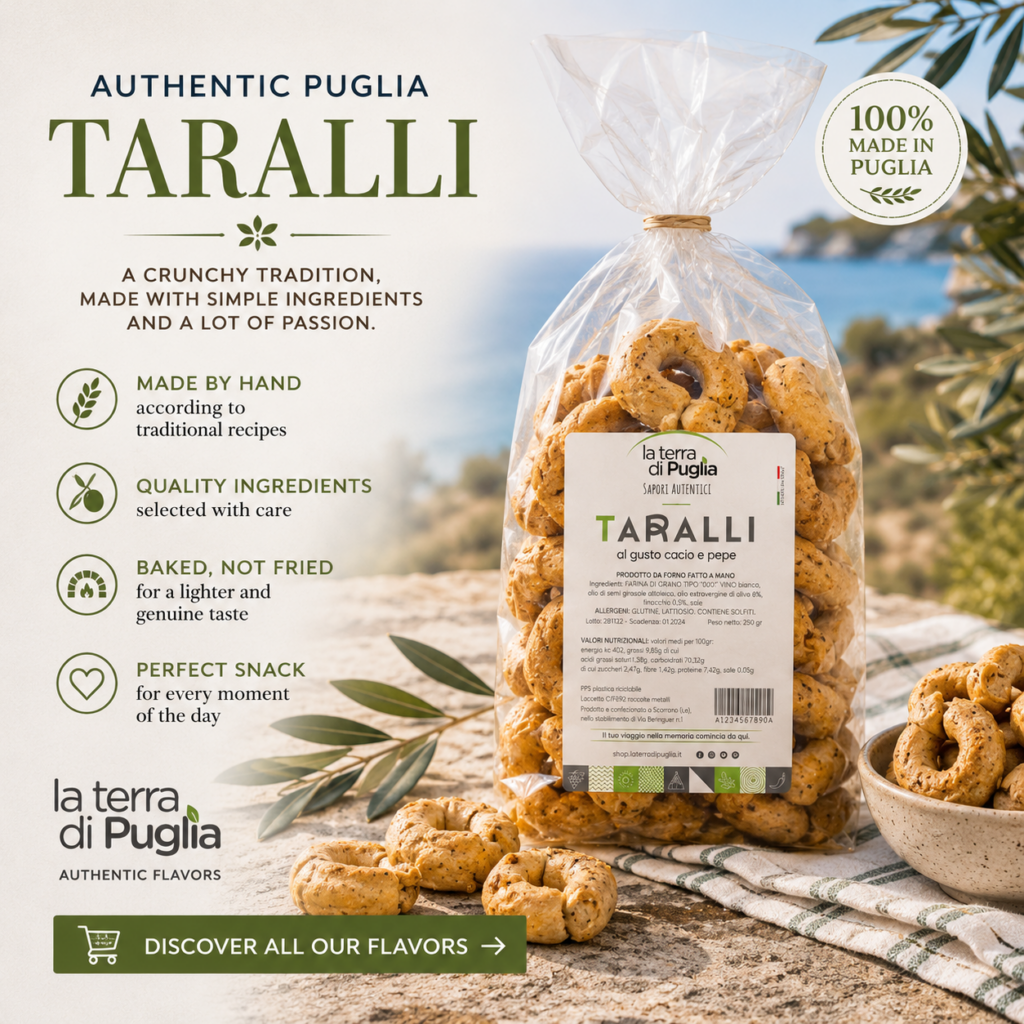
The recipe is simple but it is slow, above all the drying. If you want artisan quality without the work, the taralli in our shop are made with the same ingredients as the traditional recipe: flour, Apulian extra virgin olive oil, white wine and salt. No additives, no preservatives.
Apulian taralli in our shop
- Classic Apulian tarallini: flour, Apulian extra virgin olive oil, white wine. Simple, crumbly, unmistakable.
- Taralli with extra virgin olive oil: made with top-quality oil, and you can taste it.
- Taralli with raisins and onion: the surprising one, the sweetness of onion and raisins in a savoury ring.
- Sweet taralli with coconut and chocolate: the sweet side of Puglia, for a snack or to end a meal.
- All the savoury taralli: classic, fennel, olive, chilli and many more.
- All the sweet taralli: from the classic sugared version to more creative ones.
In short: why Apulian taralli are irreplaceable
- A real history: born, tradition says, in the 1400s from the poor kitchen of Puglia, not from a court recipe.
- Essential ingredients: flour, extra virgin olive oil, white wine and salt, nothing more.
- A unique technique: the double cooking, boiling and then baking, creates a crumbliness the grissino cannot match.
- Versatility: aperitivo, with meals, as a snack, instead of bread, as a food gift.
- Endless variations: fennel, onion, chilli, olives, sun-dried tomatoes, each with its own story and its ideal pairing.
The grissino is excellent. But the Apulian tarallo is something else: a piece of food history that crumbles between your teeth, carrying centuries of peasant cooking turned into excellence. It is not a contest, it is a story. And if you would like them at home, all our baked goods and taralli are in the shop.
The recipe in this article is based on the Apulian tradition handed down by word of mouth: ingredients and proportions can vary slightly from family to family and from place to place. The quantities given (500 g flour, 130 g oil, 180 g white wine, 12 g salt) are those of the classic recipe for about 60 to 70 taralli.




You must be logged in to post a comment Login