Caciocavallo is the pear-shaped stretched-curd cheese of southern Italy, and probably the oldest of the cheeses of Puglia. Its name has nothing to do with horses: the cheeses were hung in pairs “astride” a beam to mature. Here is where it comes from, the main types, why its flavour changes so much from one to another, and how it is eaten.
Apulian cheeses: getting to know caciocavallo
Among the cheeses of Puglia, caciocavallo is perhaps the oldest. It is an ancient cheese whose roots lie in several areas of southern Italy, where it is made in different varieties, so it will not always taste the same. Let us get to know it better, and see what sets it apart from the other cheeses of Puglia.
What is caciocavallo?
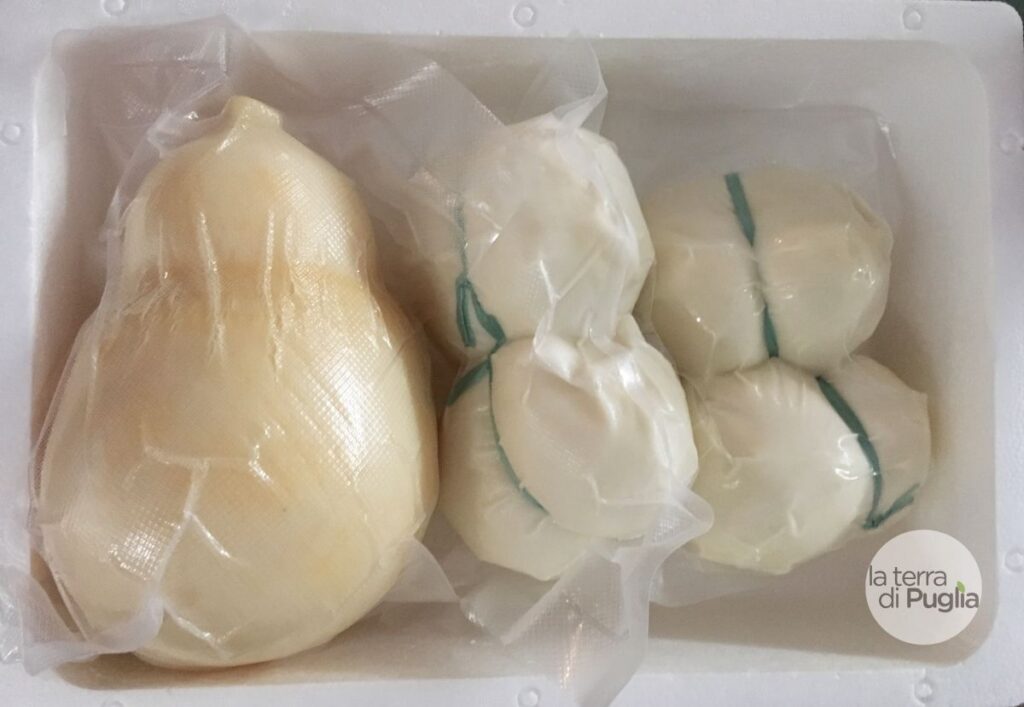
Caciocavallo is a typical cheese of Puglia, today made almost exclusively from cow’s milk; buffalo milk is also used, but in much smaller quantities. What sets it apart from other cheeses at first glance is its shape: it looks rather like a pear, a round body topped by a small head. That unusual outline is why in some parts of Sardinia it is known as peretta, “little pear”.
Where the name comes from
The name may make you think of horses (cavallo in Italian), but caciocavallo has nothing to do with them. It comes from cacio, an old word for cheese, and from the way the cheeses were left to mature: tied in pairs and hung a cavallo, astride a wooden beam. In Apulian dialect it is generally called cazzecavadde, with plenty of local variations.
One of the oldest cheeses of the Mediterranean. The first written description of caciocavallo dates from 1477, when the physician and humanist Pantaleone da Confienza described it in his Summa Lacticiniorum as a cheese made all over southern Italy. Its origins are probably much older: some scholars trace it back to the cheesemaking of nomadic peoples from the Balkans who crossed the Adriatic, bringing with them the technique of stretching the curd, the same technique behind mozzarella, provola and caciocavallo itself. Hanging the cheeses in pairs astride a beam, tied with string, has not changed for centuries, and it is still the method used by the small artisan producers of the Gargano.
The types of caciocavallo
Several kinds of caciocavallo are on the market. The best known:
- Apulian Caciocavallo Podolico: made from the milk of Podolica cows, a breed that has become rare, and matured for up to 10 years in the natural caves of the Gargano.
- Caciocavallo Silano PDO: protected designation of origin since 1996, made in Calabria and Basilicata.
- Caciocavallo Ragusano: typical of eastern Sicily, with a compact stretched curd.
- Local varieties such as those of Ciminà, Godrano and Agnone, each with its own character tied to the place where it is made.
Caciocavallo Podolico of the Gargano: rare and precious. It is considered one of the finest cheeses in Italy, and one of the hardest to find. The Podolica is a native cow of southern Italy that gives very little milk, 2 to 3 litres a day against the 30 to 40 of intensive dairy breeds, but of exceptional quality: rich in fat, protein and aromas that come from grazing freely in the forests of the Gargano. The cheeses are matured for years, in some cases up to ten, in natural caves, where they develop a thick, wrinkled rind and a compact, dry paste with an intense, complex flavour. It is a cheese to eat in shavings, with citrus honey or fig jam. If you find it at a market on the Gargano, buy it without a second thought: it is not easy to find anywhere else.
Why “recipes” in the plural
Caciocavallo is made from cow’s milk with rennet, lactic ferments and salt. So why do people in Puglia talk about caciocavallo “recipes”, in the plural? Because the flavour can be very different from one variety to the next, and producers get there partly by using different rennets, the enzymes that curdle the milk:
- liquid calf rennet gives a caciocavallo with a distinctly sweet flavour;
- lamb or kid rennet paste gives a decidedly sharp, piquant cheese;
- smoking over different kinds of wood adds a further layer of aroma.
How is caciocavallo eaten?
Caciocavallo can be grilled over embers, a delicious way to round off a barbecue of meat and vegetables.
Recipes with buffalo caciocavallo
- Griddled buffalo caciocavallo: grilled slices served with black pepper and fresh basil, a simple starter.
- Aubergine parmigiana with buffalo caciocavallo: a richer version of the classic, with layers of stretchy caciocavallo.
- Crostini with buffalo caciocavallo and honey: toasted rustic bread, caciocavallo, chestnut honey and chopped walnuts.
- Baked pasta with buffalo caciocavallo: creamy pasta with caciocavallo, tomato sauce and basil, a family lunch dish.
- Pizza with buffalo caciocavallo: crisp base, tomato sauce, caciocavallo and fresh basil.
- Aubergine and buffalo caciocavallo balls: vegetarian fritters, crisp outside and soft inside, as a starter or a main.
- Tomato and buffalo caciocavallo salad: ripe tomatoes, caciocavallo, basil and olive oil, fresh and summery.
Caciocavallo starts from the same stretched curd as fresh cheeses such as burrata, but it is the one that is made to last. The other foods of the region are on the page about Apulian food.