A six-day Gargano itinerary of history, faith and nature: from Foggia to the sanctuaries of San Giovanni Rotondo and Monte Sant’Angelo, from the Foresta Umbra beech forest to the clifftop towns of Vieste and Peschici, and on to the Tremiti Islands and the Romanesque cathedral of Troia. Every side of the promontory, at a pace that leaves room to enjoy it.
The Gargano is the part of Puglia that surprises people most. It is a limestone spur jutting into the Adriatic, with a beech forest nobody expects to find this far south, old towns perched on headlands above the sea, and two of the most visited sanctuaries in Italy. Six days are enough to cross it without rushing, on a route that starts in Foggia and loops back through the heart of the promontory.
Day 1: Foggia and the Tavoliere
Foggia is the natural starting point if you arrive by train or along the motorway. A city with an understated charm, it keeps an old centre with a thirteenth-century cathedral, palaces from the age of Frederick II and a few striking ipogei, chambers dug out beneath the streets. A walk through the old town is worth at least an afternoon, especially if you do not know this part of Puglia, which visitors often skip in favour of the coast.
Foggia is also the gateway to the Tavoliere delle Puglie, the second largest farming plain in Italy: fields of wheat that in spring turn into a green sea as far as the eye can see. If you arrive in the evening, have dinner and set off rested the next day.
Day 2: San Giovanni Rotondo and Monte Sant’Angelo
The second day is given over to the two great pilgrimage sites of the Gargano. San Giovanni Rotondo is the town where Padre Pio of Pietrelcina, the friar now venerated as Saint Pio, lived and died. The places linked to him (the seventeenth-century sanctuary, the new church designed by Renzo Piano, his cell and the Stations of the Cross) draw millions of visitors from all over the world every year. Even non-believers are struck by the atmosphere and by the quiet presence of this popular devotion.
In the afternoon the route climbs to Monte Sant’Angelo: a cave sanctuary dedicated to the Archangel Michael, carved into the limestone of the promontory. A UNESCO World Heritage Site since 2011 as one of the Longobards in Italy sites, it is one of the oldest Christian pilgrimage places in the West; Frederick II himself came here to pray before leaving on crusade. The cave has something no built church has: it is the place that comes before architecture, and holds it.
Day 3: Foresta Umbra, Vieste and Peschici
The third day changes register completely, from stone and faith to nature. The Foresta Umbra is the green heart of the Gargano National Park, a forest of centuries-old beech trees that in summer stays 10 degrees cooler than the coast. In autumn its colours bear comparison with Alpine woods. The trails are waymarked and need no special gear.
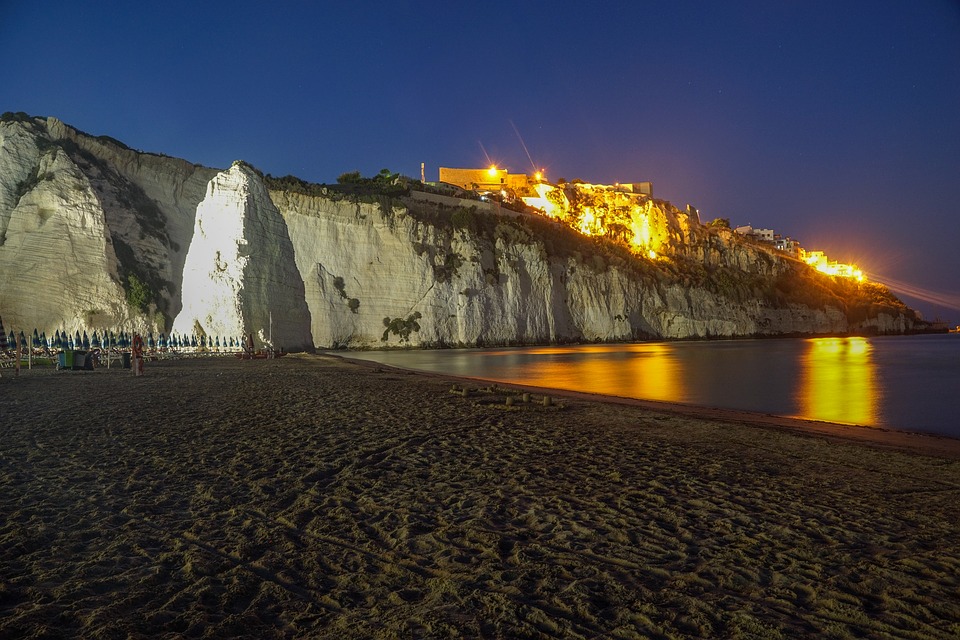
In the afternoon you head down to the coast. Vieste is the most photographed town on the Gargano: built on a headland, with the white sea stack of Pizzomunno and a Norman-Apulian cathedral looking out to sea. From here a short detour leads to Peschici, an old fishing village perched on a limestone spur: quieter than Vieste, with the same old-town charm.
Day 4: The Tremiti Islands
The Tremiti Islands are reached by ferry or hydrofoil from Vieste, Rodi Garganico or Manfredonia. The archipelago has three main islands, San Domino, San Nicola and Caprara, all inside a protected marine area. A motorboat trip around San Domino is the best way to see the sea caves, the limestone walls dropping straight into the water and the seabed with its untouched posidonia meadows. A lunch of fresh fish on the island is part of the experience.
If you have the day to spare, explore San Nicola too, with its eleventh-century Benedictine abbey and its castle: a small world of history on a few hectares of rock.
Day 5: Lucera and Troia
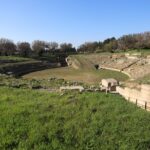
Lucera deserves more attention than it usually gets. It keeps a Roman amphitheatre from the first century BC, still well preserved, and the large Swabian-Angevin castle of Frederick II. It is also the home of Cacc’e mmitte, a DOC red wine with a curious dialect name, literally “take out and put in”, from the old way of making wine when the vats were never left idle.
In the afternoon you reach Troia, a little-known gem of the Daunian hills. Its eleventh-century Romanesque cathedral has a facade dominated by an eleven-spoked rose window that filters the light differently depending on the hour: one of the most beautiful in Apulian Romanesque, and probably the least photographed.
Day 6: Margherita di Savoia and back
On the last day, before returning to Foggia, you can stop at Margherita di Savoia, known for its spa and its salt pans, the largest in Italy. The pinkish salt basins, visible from the road, give this stretch of the Tavoliere a surreal colour that on some days looks too saturated to be real. The tour ends in Foggia.
Practical information
- Length: 6 days and 5 nights. It can be cut to 4 days by leaving out the Tremiti Islands and Margherita di Savoia.
- Where to stay: Foggia for the first two nights, then Vieste or Peschici for days 3 and 4.
- Getting around: a car is recommended; the San Severo to Peschici railway line covers part of the route.
- When to go: May to June and September to October. August is crowded, and ferries to the Tremiti need booking weeks ahead.
The same tour can be done by bike. Cycling in the Gargano covers the national park’s network, about 350 kilometres of marked routes, and the Peschici to Foresta Umbra loop, 61.2 kilometres with 1,714 metres of climbing.
More ideas for longer trips on our page of multi-day itineraries in Puglia.