Stracciatella is the creamy heart of burrata: shreds of fresh stretched-curd cheese pulled apart by hand and soaked in fresh cream. What it is, how it differs from burrata and mozzarella, where it comes from, how it is made and the best ways to eat it.
Apulian dairy: meet stracciatella
Our tour of the specialities of Puglia takes us once again to the Murge, the high limestone plateau inland from Bari, where a delicious cheese is born: stracciatella. It is also known in Basilicata, Campania and Molise, but in Puglia it has found its most refined form.
What stracciatella cheese is
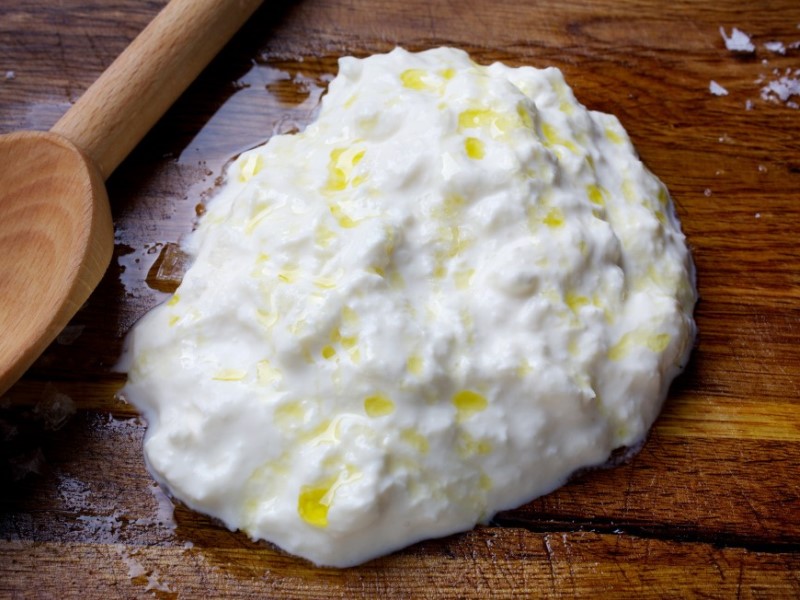
The name may remind you of the ice-cream flavour, but stracciatella cheese has nothing to do with dessert. Stracciatella is the softest, creamiest part of the far better known burrata. Buttery to look at, incredibly fresh and delicate in flavour, it is made from a snow-white stretched curd, pasta filata, the same dough as mozzarella, which is shredded by hand and mixed with fresh cream.
Stracciatella, burrata and mozzarella: three cheeses, one family. All three are stretched-curd cheeses, yet they are very different. Mozzarella is firm and even in texture, with the delicate taste of fresh milk. Stracciatella is mozzarella pulled into rags by hand, stracci in Italian, and mixed with fresh cream: the result is creamy, rich and fuller in flavour. Burrata is simply a shell of mozzarella with stracciatella inside, the little pouch that has made it famous around the world. Stracciatella is also sold on its own, without the shell, and in that form it is used to dress pizza, orecchiette, frise and bruschetta. People who do not know it tend to rate it below burrata, but those who taste it straight, with no shell, often prefer it.
If you want the story of the shell, the burrata itself, read how burrata was born.
A rich cheese
The name stracciatella comes from those straccetti, the little rags of curd it is made from. Because so much of it is cream, it is considered a fairly fatty cheese. A taste will do you no harm, though it is hard to have just one spoonful. It also brings protein and calcium, and like most fresh cheeses it contains salt: worth knowing if you have to keep an eye on the salt in your diet.
A short history of Apulian stracciatella
Like so many dishes of the Apulian kitchen, stracciatella has its roots in the rural Puglia of the past. It was born from the need not to waste the scraps left over from making burrata: the pieces of curd that could not be used to form the shell were shredded and mixed with cream. Necessity became a virtue, and the result is a speciality that is now loved all over the world.
How stracciatella is made
The essential ingredients are cow’s milk (buffalo milk in Campania), cream, rennet and salt. It is made all year round, although some say that the warm months give a better result. The finished cheese has no rind and no holes, and its texture is especially soft and creamy. Behind every good stracciatella there is always a high-quality mozzarella and very fresh cream, ideally the cream that rises to the surface of milk left to rest.
How to eat stracciatella
The ways to use stracciatella are countless. Here are the classics:
- Raw on pizza, added after baking with a thread of extra virgin olive oil, so the oven heat does not spoil its creaminess.
- On frise with cherry tomatoes: the frisa softened in water, fresh tomatoes and a generous spoonful of stracciatella, one of the best summer dressings in Apulian cooking. Here is how to dress a frisa.
- With orecchiette, stirred in raw with pasta just drained and a few basil leaves: creamy and fresh at once.
- In savoury pies, where it brings freshness and creaminess to the filling, especially with grilled vegetables or sun-dried tomatoes.
- Inside courgette flowers, instead of the usual mozzarella, for a creamier, tastier filling.
- On bruschetta and crostoni, with tomato, a thread of oil and oregano: the simplest antipasto and one of the best.
Stracciatella is one of the many fresh cheeses of Puglia: you will find the others on our page about Apulian cheeses, and the rest of the region’s produce under Apulian food.