The cardoncello (Pleurotus eryngii, known in English as the king oyster mushroom) is the mushroom of the Murgia, the high plateau inland from Bari: it grows in poor pastureland, tied to the roots of Eryngium, and appears in autumn and spring. Picking it is not a free-for-all: in Puglia you need a permit and a training course, there are limits on quantities and tools, and every mushroom picked should be checked, free of charge, by the mycology service of the local health authority. Here are the season, the rules and the festivals of October and November.
In autumn, on the Murgia, some people head out early in the morning with a basket and walk through pastures rather than woods. It is one of the few places in Italy where the most sought-after mushrooms grow not under trees but among short grass and stones, and the mushroom in question has a name everyone here knows: the cardoncello.
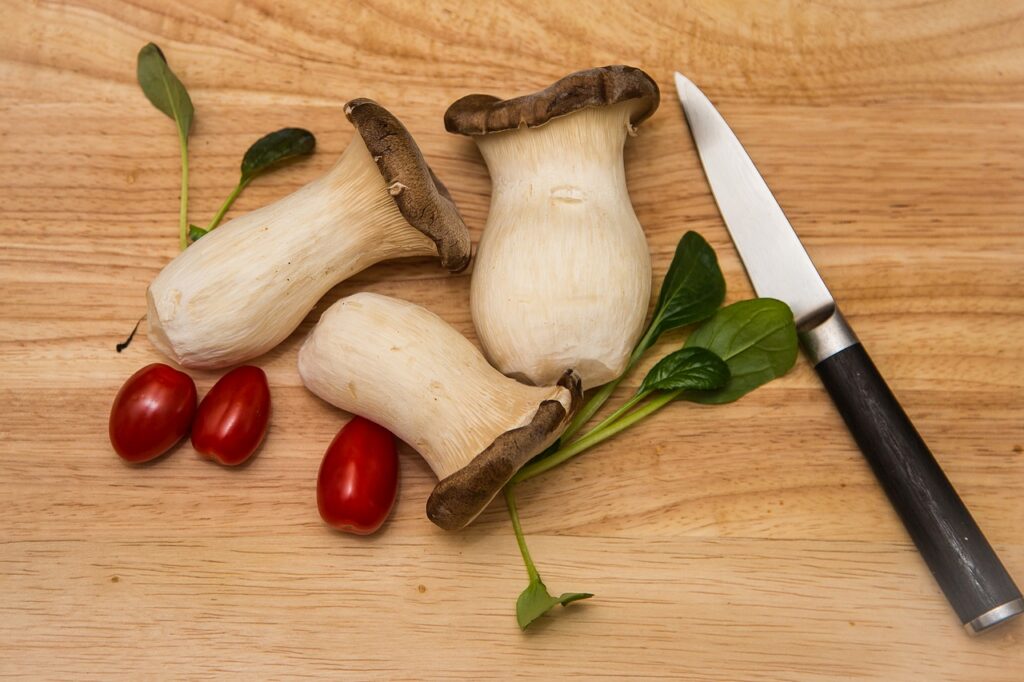
Fresh cardoncelli, ready for the kitchen.
What the cardoncello is
Its scientific name is Pleurotus eryngii, and the second word already tells you where to look: according to the Alta Murgia National Park, it grows on its natural host plant, field eryngo, Eryngium campestre (and also sea holly, Eryngium maritimum). The Puglia Region has put it on its official list of traditional food products, under the names used locally: cardoncello, carduncjdd, fungo ferula.
The same regional entry notes that it was already known to the Romans, and that in the Middle Ages and the Renaissance it was thought to be an aphrodisiac, to the point that the Holy Office put it on its index of forbidden things.
Where it grows, and when
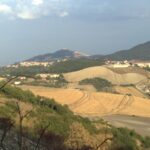
The park puts it plainly: the plateau of the Murgia is the cradle of this variety, and the mushroom finds its ideal habitat in poor, mixed grassland soils. The regional entry gives the production area as the provinces of Bari and Barletta-Andria-Trani, especially the Murgia around Bari, and the season as that of the wild mushroom: autumn and spring.
That is why the festivals devoted to the cardoncello are concentrated in the villages of the plateau, between October and November.
Why you cannot just go and pick it
In Puglia, picking wild mushrooms is governed by regional law no. 12 of 2003, amended several times since. The points that matter:
- You need a permit. It is a personal card issued by the town council and valid throughout the region. To get it you must have attended a course and obtained a certificate of competence, issued by the prevention department of the local health authority (ASL) or by a mycological association.
- Quantities are limited. For personal use, no more than three kilos a day per person over the age of fourteen.
- Mushrooms must be carried in rigid containers with holes. Plastic bags are banned.
- No rakes, no hooks, and no other tools that damage the soil, the mycelium or the roots.
- Protected areas have extra limits: before picking in a park or a nature reserve, check first.
For a visitor passing through, this comes down to one simple thing: the cardoncello is something to discover at the table, at the market and at village festivals, not by heading off into the fields alone.
The ASL check: free, and on every mushroom
In Italy, local health authorities, the ASL, have services where certified mycologists check the mushrooms people have picked. In the province of Bari, the ASL Bari service checks whether they are edible free of charge, from 1 September to 31 January every year, at four locations: Altamura, Molfetta, Bari (Lungomare Starita 6) and Putignano. Its advice:
- have every mushroom you picked checked, not just a sample;
- pick them whole, with every part intact, and keep them in the fridge;
- eat them well cooked and in moderate amounts;
- do not give them to children, pregnant women or people with certain medical conditions.
“Are cardoncelli poisonous?” It is one of the most common questions, and the honest answer is that it is the wrong question. The cardoncello is an edible mushroom, and Puglia has been putting it on the table for centuries. But whether what is in your basket really is a cardoncello is not decided by a photo, an app or a neighbour’s opinion: it is decided by the ASL mycologist. That is why you will find no identification tips here.
The cardoncello festivals, October to November
In Italy a sagra is a village food festival built around one product, with food stalls and music. This year the “Cardoncello on the road” circuit, run by UNPLI Puglia, the regional federation of Pro Loco (the volunteer associations that keep village life going), stops in six towns of the Alta Murgia:
- Poggiorsini, 17-18 October;
- Minervino Murge, 24-25 October, for the 31st edition of its festival;
- Spinazzola, 7-8 November;
- Ruvo di Puglia, 14-15 November;
- Gravina in Puglia, 21-22 November;
- Cassano delle Murge, 28-29 November.
In the kitchen
Once checked, or bought at the market, cardoncelli lend themselves to all sorts of dishes; one of the classics is cardoncelli mushrooms au gratin.
Out of season. When the pastures are bare, the taste of the Murgia stays in the pantry: our cardoncelli mushrooms in oil.
You must be logged in to post a comment Login