Foggia is the capital of Puglia’s northernmost province, set in the middle of the Tavoliere, the second largest plain in Italy. Shaken by the earthquake of 1731 and bombed in the Second World War, it keeps a Frederick II archway, a baroque cathedral built around a thousand-year-old icon, two patron saint feast days and, a short drive away, the buried Roman town of Herdonia.
Foggia, capital of Puglia’s northernmost province
Foggia lies in the heart of the Tavoliere, the second largest plain in Italy, flat farmland that stretches between the Gargano promontory and the Daunian mountains. Its position explains its economy, which rests on agriculture: since 1949 the city has hosted the International Fair of Agriculture and Livestock.
In the Second World War Foggia played a leading role as a major railway junction, moving troops, weapons and men from north to south. Little of the old city survives, however: first the earthquake of 1731, then the partial destruction of the city by Allied bombing towards the end of the war. That is why many of its monuments belong to recent history. But let us get to know Foggia better.
The historic centre
Foggia still has a sizeable historic centre, with notable palazzi, churches and monuments from the age of Frederick II, the thirteenth-century emperor who loved this land: among them the archway of his imperial palace, rebuilt beside the civic museum. Walking through the centre you come across wide tree-lined avenues, airy squares and buildings of historical and architectural interest. Completing the picture is the Teatro Umberto Giordano, built in 1825 and now named after the composer born in Foggia, which was in its day one of the most important theatres in southern Italy. If you are following Frederick II across the region, see our guide to his castles in Puglia.
The cathedral and the Iconavetere
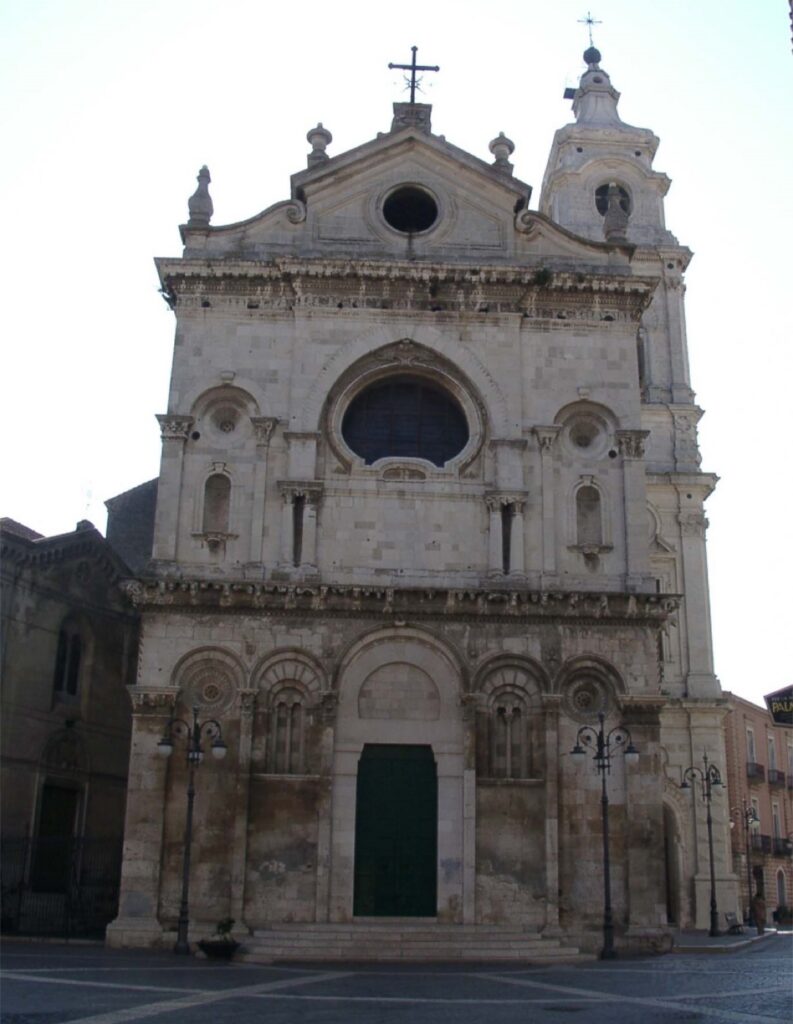
The history of Foggia is closely tied to its cathedral, the church of the Blessed Virgin Mary Assumed into Heaven, known simply as Santa Maria di Foggia, and to the painting of the Iconavetere, the “ancient icon” it has guarded for almost a thousand years. The church stands in Piazza De Sanctis, also called Piazza Duomo or Piazza Cattedrale, right in the centre, close to the old Via Arpi and next to Piazza del Lago. These two squares have become the meeting place of Foggia’s young people, who gather there in the evening and stay out late among pubs, pizzerias and bars. The cathedral owes its origin to the finding, in 1062 (or in 1073, according to other sources), of the icon known as the Madonna dei Sette Veli, the Madonna of the Seven Veils.
How the cathedral grew, and the devotion of the people
The icon drew pilgrims, and it also caught the attention of the Norman duke Robert Guiscard, who in 1080 had the Palatine Church of Santa Maria da Fovea built on the spot where it was found, to house the Sacro Tavolo, the holy panel. The church was enlarged in 1172 by King William II of Sicily, known as “the Good”, and later altered by Frederick II, who entrusted the work to the architect and sculptor Bartolomeo da Foggia. The result was a building in the Apulian Romanesque style, with Pisan influences.
Over the centuries the church grew, and the city with it. It was dear to the Norman, Swabian and Angevin kings, and later to the Aragonese, the Spanish and the Bourbons, and more than one ruling prince chose it for his wedding. King Charles of Anjou, who died in Foggia in 1285, asked that his heart be buried in this church.
The earthquake and the two feast days
The terrible earthquake of 1731 badly damaged the cathedral, which was then restored in the baroque style you see today. After the earthquake the icon was moved to the church of San Giovanni Battista. On 22 March of that same year the apparitions of the Madonna began, and they went on until 1745.
Two patron saint feast days, for a dramatic reason. In Foggia the patron saint festival comes round twice a year, on 22 March and on 15 August, in memory of the apparitions of the Madonna of the Seven Veils to the people of Foggia, who prayed to be saved from earthquake and plague. It is not devotion repeated for its own sake: the two dates recall two different fears, in a city that lived through both in the eighteenth century. More dates across the region are in our calendar of patron saint festivals in Puglia.
Reworked several times between the sixteenth and eighteenth centuries, the cathedral now presents itself in baroque dress, together with its eighteenth-century bell tower. The cornice still carries sculptures from the Middle Ages, the work of Bartolomeo da Foggia. Typically baroque, and dating from the end of the seventeenth century, is the Latin-cross plan with a single nave and two side chapels, decorated with altars by Neapolitan masters.
The high altar is from the eighteenth century, decorated in polychrome marble with two large angels carved by Giuseppe Sanmartino. The main chapel of the Iconavetere is closed by a bronze gate, with a rich marble altar from the late seventeenth century. The Sacro Tavolo of the Madonna of the Seven Veils is covered with richly decorated cloths, with an oval opening, covered in black fabric, where the face of the Virgin lies. The crypt dates from the Middle Ages and holds an urn of gilded wood with the dead Christ, statues of the Passion and the tombs of some of Foggia’s bishops.
Herdonia: the buried Roman town of the Tavoliere
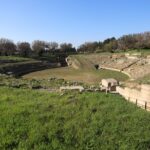
A few kilometres from Foggia, hidden under the fields of the Tavoliere, lies one of the most remarkable archaeological sites in Italy: Herdonia, the ancient Roman town of Ordona. Forum, basilica, baths, amphitheatre, walls and necropolis: a whole town, of which 80% has not yet been excavated.
Rediscovered in 1962 by a team of Belgian archaeologists from the University of Louvain, Herdonia was the scene of two decisive battles of the Second Punic War and reached its peak under the Empire thanks to the Via Traiana, the Roman road that ran right through it. Today the site can be visited free of charge, just 25 km from Foggia, and it is sometimes called the Pompeii of Puglia: a place still waiting to be discovered by the wider public.
Foggia is the gateway to the north of the region: from here the road climbs onto the Gargano, with its forests, sanctuaries and white seaside towns.