Cycling in Puglia is easier than the map suggests: the region is flat almost everywhere, and the only real climbing is on the Gargano and the Murgia. What catches people out is the heat — there is no shade. The regional plan lists 16 cycle routes for some 2,300 km, but what you can actually ride today is a different thing from the plan. On this page: which cycling tracks exist and which are still on paper, the four areas and how they differ, when to come, and the thing almost nobody knows — bikes travel free on Puglia’s regional trains, which is not the rule elsewhere in Italy.
A region built for cycling, and hardly anyone knows it
Look at a map of Puglia — four hundred kilometres of it, heel to spur — and you might expect hard work. The opposite is true: Puglia is the flattest region in southern Italy. The only serious climbing is on the Gargano, a mountainous promontory sticking out into the Adriatic, and on the Murgia, which rises gently inland. Everything else — the Tavoliere plain, the coast, the Salento — is touring-bike country, manageable even with children.
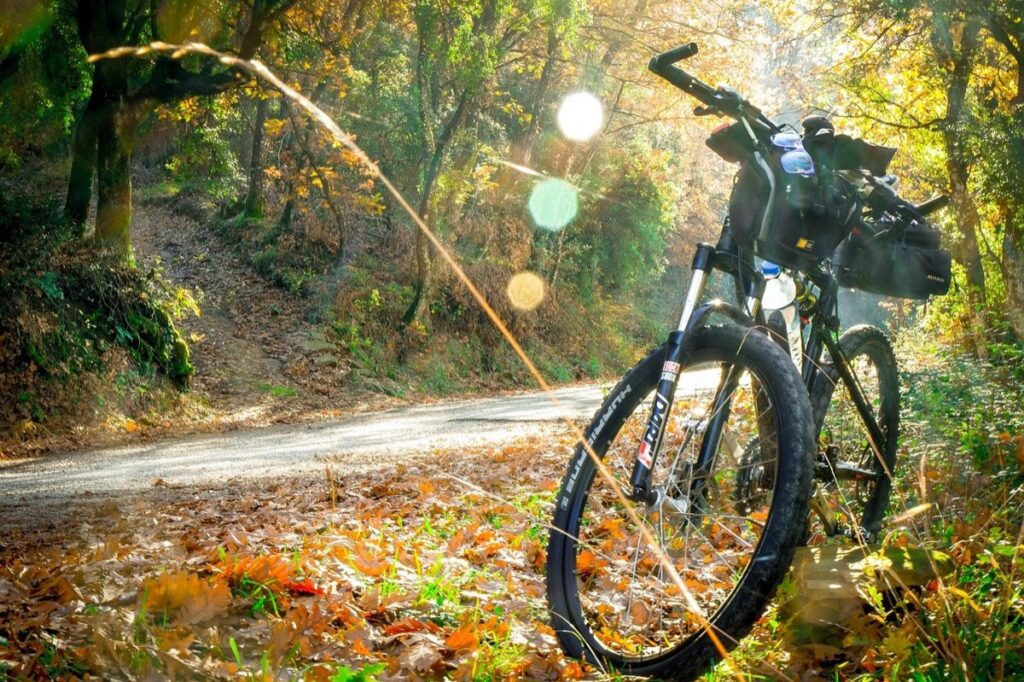
The problem here is not gradient, it is sun. From June to September the interior regularly passes thirty-five degrees and shade is scarce — olive trees give none, dry stone walls give none. That is why the cycling season in Puglia is not summer but spring and autumn, which happens to be when accommodation is cheaper and the roads are empty.
Which cycling tracks actually exist, and which are still a plan
This distinction is worth making straight away, because online the two get mixed up constantly. Puglia adopted its regional cycling mobility plan in February 2020: it identifies sixteen cycle routes making up a network of roughly 2,300 kilometres, tied into the European EuroVelo network and the Italian Bicitalia one.
That plan is a map of intentions, not of tarmac. The genuinely built, continuous routes are still few; the rest of the network runs on existing low-traffic roads — minor provincial roads, farm tracks, old drovers’ paths. Which, given how Puglia is made, is often better than a cycle path: straight roads between olive groves where three tractors pass in a day.
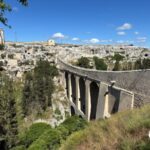
A comparison worth having in mind. If your reference point is a fully surfaced, continuously signposted route — the Danube path, the Loire, a British national cycle route — Puglia is not there yet. The Apulian Aqueduct Cycle Route, which comes closest, is a white road: compact crushed stone, fast to ride, but it wants a gravel bike or a tourer on wide tyres. Knowing that before you book avoids the only real disappointment on offer.
Bikes travel free on the trains here
Across Italy, taking an assembled bicycle on a regional train normally costs a supplement. In Puglia it does not. Trenitalia says so on its regional page: on Regionale trains marked with the bicycle pictogram, bike carriage is free.
It comes from an agreement between the regional government, the regional transport agency and the five operators that run the services: Trenitalia, Ferrovie Sud Est, Ferrovie del Gargano, Ferrovie Appulo Lucane and Ferrotramviaria. In practice: present yourself to the on-board staff before boarding, and the guard issues a zero-cost supplement.
Two caveats that make the difference between a good day and a wasted one. The free carriage applies only to trains carrying the bicycle pictogram, not to every regional service — check the timetable first. And there are few bike spaces on board; on spring weekends they fill up.
This changes how you plan a trip: fly into Bari or Brindisi, take a regional train with the bike, ride one stage and come back in the evening. For getting to Puglia in the first place, see arriving in Puglia by bike.
The four areas, and what changes between them
You do not ride the same way everywhere. We have split this section into four pages, one per landscape, because the questions a traveller asks are different in each.
- The Apulian Aqueduct Cycle Route — the greenway crossing the region north to south along the aqueduct canal: what is open, the surface, and the nine stages with their climbing.
- Cycling in Salento — the Ciclonica, an official 304 km loop, the classic circuit from Lecce, and the coast road between Otranto and Leuca.
- Cycling in the Gargano — the National Park’s twelve marked sections, the Foresta Umbra, and the only area where you need legs.
- Cycling in the Valle d’Itria and the Murgia — trulli, dry stone walls, and the Roman Via Traiana.
- The Adriatic Cycle Route in Puglia — the four official sections along the sea, with real distances and the Gargano choice.
The Ofanto Valley route, the only one you ride downhill
It deserves its own paragraph because nothing else here is like it. The Ofanto Valley cycle route follows Puglia’s only real river from the interior to the sea: on the track, 95.8 kilometres from Rocchetta Sant’Antonio, on the Campanian border, down to Barletta.
The oddity is in the profile: +332 metres of climbing against 952 of descent, because you start at 662 metres and finish at sea level. It is the only long route in the region that is ridden mostly downhill — ninety-six kilometres with that profile are within reach of anyone with a free day.
The Ofanto Valley profile: you start at 662 metres and finish at the sea. The line coming down is why this route is within almost anyone’s reach.
When to come
The two good windows are April–May and September–October. In April the countryside is green, which in Puglia does not last long, and you ride at twenty degrees. In September the heat breaks around the middle of the month, the sea is still August-warm, and the coast roads empty out overnight. October is the olive harvest: you ride past working mills, which is worth the trip on its own.
March and November are possible and deserted, but the tramontana wind on the Adriatic is a serious factor and in November the light goes at five. July and August only work if you start at dawn and stop by eleven: they are the months when Puglia is at its most beautiful and least rideable.
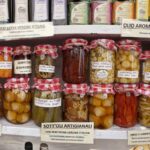
What to put in your pockets. The two things local cyclists have always carried are taralli and frise: they do not crumble, they do not melt, and they survive hours of heat. They were invented for work in the fields, and for cycling they work for the same reasons.
What this section does not promise
Puglia’s cycling network is under construction, and under construction means some announced sections are not open yet and some open sections are interrupted. On these pages you will find the kilometres somebody declared and the date they declared them, kept separate from the ones that have actually been ridden. Where we could not find a reliable source, we have not written a number.
Elevation gain is published by nobody: the figures here are measured on GPS tracks, and each page says so. A track measures what one person rode on one day, not a certified route — but on the question of how much you climb, it is the only thing that exists.