After the 29th Notte della Taranta, the same argument came round again: few local people on the staff, decisions taken elsewhere, the square emptying halfway through the concert. The diagnosis is right, but the culprit everyone names is the wrong one. The Salento has been selling what it has cheaply for five hundred years: first the forests, then the oil, then the sun. Now the dance — and this time nobody even had to talk us into it.
Every year, as soon as the Concertone ends, the discussion starts again. Those defending the musical director. Those outraged that the local people on the staff can be counted on one hand. And those who report that this year, more than usual, the square emptied halfway through: people turning their backs on the stage to go and dance their own ronda, away from the cameras.
My answer fits in one sentence: there is nothing to be outraged about, because it is too late to go back. Here is why.
The diagnosis of those protesting is correct. A stage that keeps getting bigger, decisions taken further and further away, local professionals still asked to work for nothing because taking part “is an honour”, and village people reduced to extras beside the show’s dance company. I have no reason to doubt any of it.
But the culprit everyone points to is the wrong one. It is not television. It is not Milan. It is us — and not since this year.
The 29th edition: the scale, first
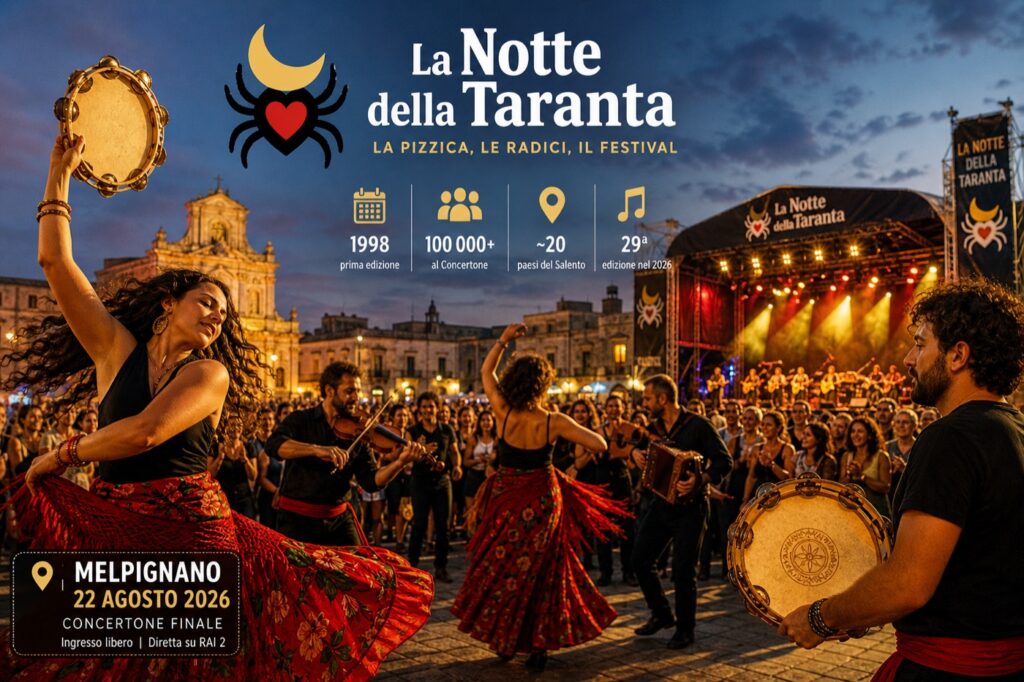
On Saturday 22 August, Melpignano hosted the 29th edition of the Concertone, on the theme “the routes of the Mediterranean”. Ermal Meta, the maestro concertatore, built the show around his own story: he arrived in Puglia from Albania in 1994, crossing the same sea he now speaks about from the stage. In the square, around 150,000 people according to reports the following day. Live on Rai 3 and Radio 2, and for the first time on the Eurovision network. Between the website and social media, the festival’s digital operation passed 43 million views.
These are the numbers of a European television production, not of a village feast. 2027 will be the thirtieth edition, an anniversary the Foundation promises to “build together with the territory”. Together with whom, we shall see.
What the press release does not say
People who have worked backstage in recent years describe things that appear in no press release. That the Salentini on the staff can almost be counted on one hand. That some local professionals are still asked to work unpaid, because being there “is an honour”. That the most delicate artistic decisions are taken elsewhere, and what is left here is to rubber-stamp them.
And then there is what anyone standing in the crowd can see: more and more people who, at some point, stop watching the stage and go off to dance their own ronda, the way it was danced at Torre Paduli long before a sound system ever arrived here.
I had written about this before, a few days before the Concertone, describing the ronda as the moment when the Notte della Taranta most resembles what existed before the Notte della Taranta — the most genuine part of the whole evening. I still think so. But when that ronda grows until it empties the space in front of the stage, it is no longer only proof that the culture survives at the margins. It is also the audience walking away in silence, while the cameras go on filming a full square.
This is not the first time. It is at least the fourth
Regular readers already know the argument: the Salento has been selling itself cheap for five hundred years, and always to the same pattern.
- 🌳 The forests → charcoal for Europe
- 🫒 The olive trees → lamp oil for London and Paris
- ☀️ The sun → solar panels, with 85% of the electricity leaving the region
- 🥁 The pizzica → the biggest stage in Europe, and decisions taken ever further away
The olive groves of Puglia were not planted for the landscape. They were planted for lamp oil, the oil that lit half of Europe before gas and electricity. Before them, the forests had been cut for charcoal. Today it is the countryside filling up with solar panels. Every time the same thing: somebody else decides, somebody else collects, and the Salento sells for next to nothing what it has — landscape, energy, or now its own music.
First we sold the forests. Then the oil. Then the sun. Now we are selling the dance — and we call it an honour.
The difference this time is that nobody even had to talk us into it. With the solar panels there is at least a fight going on: twenty-one local associations objecting, a debate open at regional level. With the Taranta the handover is almost voluntary. It is called visibility, it is called the pride of standing on the biggest stage in Europe, and for many people that is worth more than a properly paid contract.
The real problem is not who takes. It is who never asks for anything back
Here is the point: we do not get out of this because we cannot find the collective nerve to negotiate as equals.
This is not about ill will on the part of anyone in Milan, nor about Ermal Meta, who spent months stitching tradition and television together with more respect than he is given credit for. It is that every time someone arrives from outside with money, cameras or visibility, the role accepted here is that of raw-material supplier — folklore, landscape, energy, it makes no difference — without ever sitting down at the table to negotiate better terms. It has always been done this way, and a habit several centuries old does not change in one edition.
That is why I say it is late: the course of the Taranta as a large television operation was set years ago, and no editorial — mine included — will change it in time for 2027.
What can still be asked for
Not everything is settled, though. On energy, for the first time in five hundred years the Salento moved before it was too late: twenty-one associations, a formal appeal, a demand for rules instead of the usual “that is how the world works”. It has won nothing yet, but at least it asked.
On the Taranta that has not happened yet. 2027 is the thirtieth anniversary, and the Foundation promises to build it together with the territory. That is the opening — probably the last good one before the machine grows too big to be questioned at all — to ask for something concrete: more local people paid on the staff, more decision-making weight here, less work done “for the honour”.
The rite itself, the real one, will go on living in the ronde and at Torre Paduli, with or without cameras. The question is whether the Salento wants to settle for that once again, or whether this time it tries to ask for something more than an embrace broadcast to the world.
Sources for this article
The figures for the 2026 edition (date, edition number, musical director, audience, live broadcast on Rai 3 / Radio 2 / Eurovision, social media views) come from the press releases of the Fondazione La Notte della Taranta and from reporting by LeccePrima, Askanews, Leccenews24 and Libero. The figures on the energy colonisation of the Salento come from our July 2026 investigation.