In short. Before there were cars, people in Puglia went to the sea on 15 August on the back of a lorry — the neighbour’s lorry, which carried olives to the mill in winter and three families to the coast on the feast of the Assumption. Sides up, mattresses thrown on the flatbed, children sitting on the dishes. Here is how Ferragosto became a mass holiday — it starts in 1931, with cheap trains — and how you got to the sea when the whole of Italy had fewer than two million cars.
Ask any Apulian over sixty how they got to the sea as a child, and nine times out of ten the answer contains no car. It contains a lorry. The neighbour’s, the brother-in-law’s, the landowner’s: in winter it took olives to the mill, and on 15 August it took three families to the shore. Sides up, two mattresses thrown on the back, the women sitting on the dishes so the parmigiana would not tip over. Nobody called it uncomfortable. It was called going to the sea.
Ferragosto is the Italian 15 August: the Assumption, but above all the day the entire country stops. What follows happened sixty years ago, and a whole generation of Apulians still remembers it.
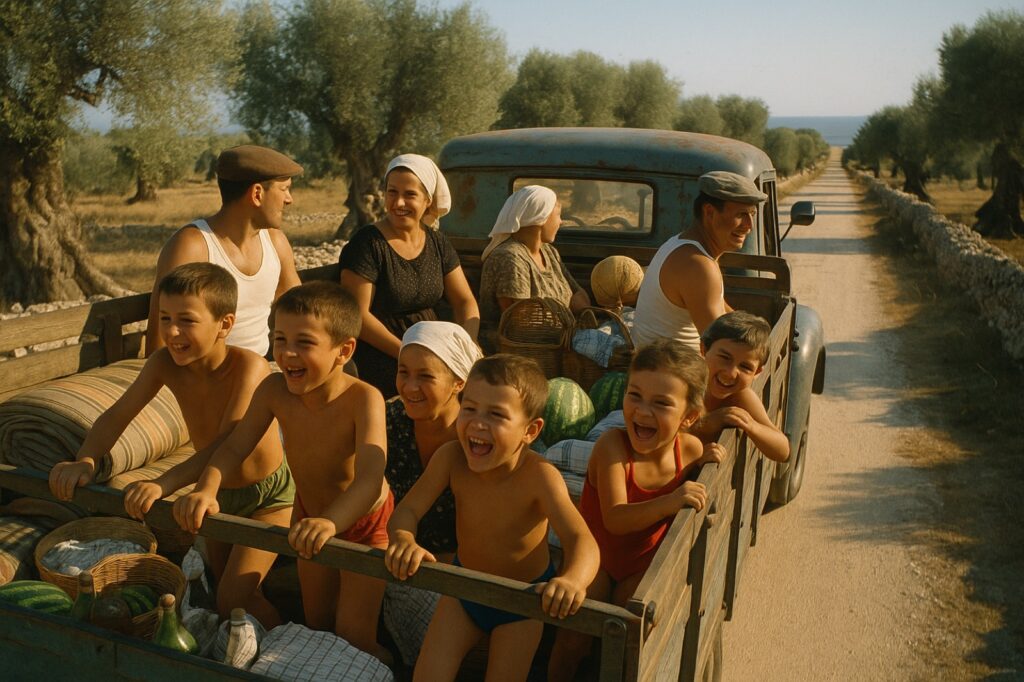
Sides up, mattresses, baskets and watermelons: the 15 August outing as told by the people who were children in the sixties. Illustration made with artificial intelligence: it is a reconstruction of the scene, not a period photograph.
🚂 Mass Ferragosto starts in 1931, and it starts on a train
The 15 August day trip is not an ancient tradition: it is a twentieth-century invention, and it has a precise date. In 1931 the Italian ministry of communications created the Treni popolari, train tickets discounted by 50 to 80% and valid on the 13th, 14th and 15th of August.
There were two versions, and they say more than any essay about how small the world was then. The one-day excursion covered a radius of 50 to 100 kilometres; the three-day excursion reached 200. In the first summer alone, close to half a million people took them up. For a very large number of Italian families it was the first time they had seen the sea. And because food was not included in the price, another national institution was born in those same days: the picnic.
🚚 Why a lorry, of all things
The numbers explain the rest. In 1950 there were 340,000 cars on Italian roads; by 1955 there were 800,000, and by 1960 two million. That sounds like a lot until you remember there were already fifty million Italians. Only in 1970 did the figure pass ten million: mass motorisation in Italy is something that happens entirely in the sixties, and in the agricultural south it arrives last of all.
Meanwhile the sea was already there. And the way of getting to it was whatever the family or the neighbourhood happened to own: the delivery van, the three-wheeler, the tractor and its trailer. Working vehicles, lent for one day to the holiday. You left before dawn and came back after dark, and in between lay the one day of the year when nobody went to the fields.
Today that journey would be illegal. Article 82 of the Italian highway code forbids carrying people on the bed of a goods vehicle: it requires a special authorisation, and anyone without one risks having the vehicle registration suspended for one to six months. Nobody wants those safety standards back. But it is worth remembering that for an entire generation, access to the sea came that way.
🍉 What people took: everything except what you buy today
There was no parasol, no sun lounger, no cool box, no sun cream. There were sheets, usually worn-out bed sheets, and shade was something you looked for under the rocks or behind a dune. Lunch left the house ready, made the day before, because on 15 August the oven was lit at dawn or it was not lit at all.
- The dishes — aubergine parmigiana, stuffed peppers, pitta or focaccia, covered with a cloth and balanced on people’s knees the whole way.
- The watermelon — lowered into the well the evening before, or tied with string and left to soak in the sea until it was time to eat it. That was the fridge.
- Wine and water — in re-used glass bottles wrapped in wet newspaper: home-made air conditioning that worked by evaporation.
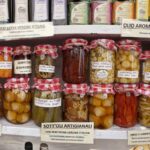
- Bread and preserves — vegetables in oil, sun-dried tomatoes, cheese. Exactly what is sold today wrapped as a speciality, and which then was simply what was in the pantry.
🏖️ The seaside colonies, the first lidos, then the industry
For the children of the time there was another road to the sea, and it did not run through the family: the seaside colonies, of which there were many in the Salento. You went for weeks at a time, in twos, in uniform, with the supervisor’s whistle. Those who went remember it in the same divided way: it was the sea, but it was also an institution.
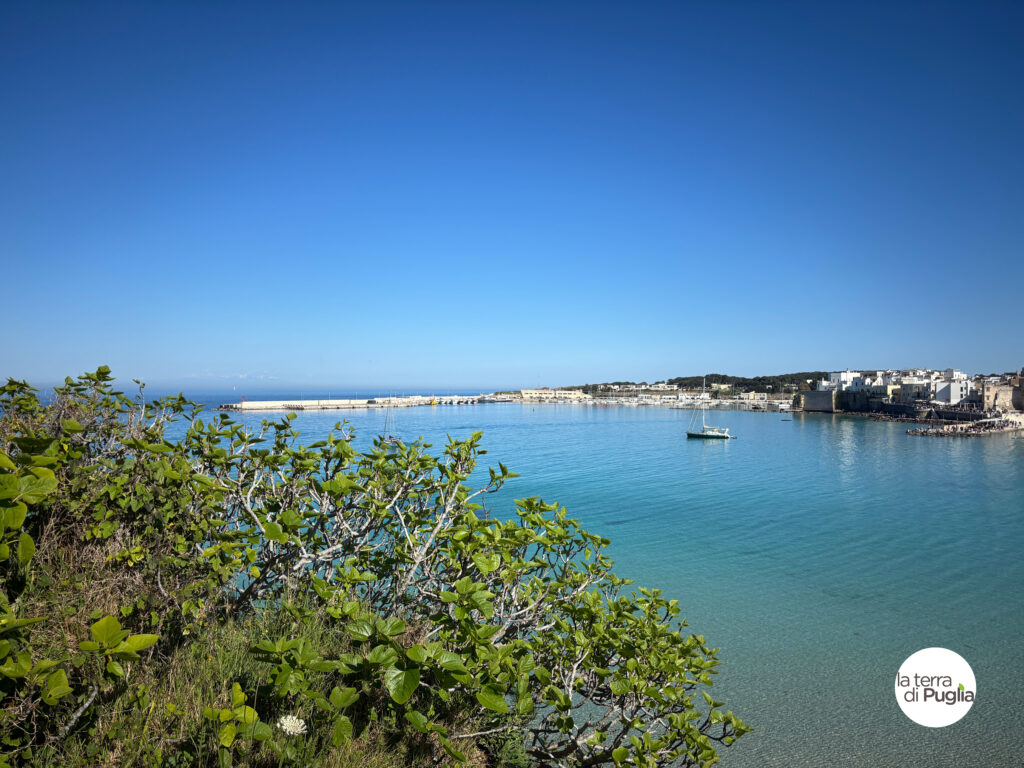
The turning point comes later. In the seventies and eighties Club Méditerranée opened at Otranto and hotels began to go up along the coast. That is when the Apulian sea stopped being simply the place you went on a Sunday and became an economy. In two generations we went from the borrowed lorry to the sun lounger booked online — and that is a much longer distance than those fifty kilometres.
🥘 What is left of that Ferragosto
Not the lorry, thankfully. But something has survived everything, and you can still see it in every Apulian marina on 15 August: people eat in groups, eat too much, and eat food made at home. The dishes are still there. The table still gets longer. And the arrangement is still to meet in the same place as last year, which is the real 15 August tradition in Puglia: not a dish, a place.
For what happens on the day itself — the processions, the concerts, the fireworks — it is all in our guide to Ferragosto in Puglia.
The preserves people used to carry to the sea in those dishes are in our shop today: Apulian preserves, olives, salted taralli and frise — which at the seaside were already, back then, the meal of anyone without a dish to carry. The same pantry, eighty years on.
The figures on the 1931 popular trains and on the spread of the motor car in Italy are documented. The travelling memories — the lorry, the dishes, the watermelon in the well — belong instead to oral and collective memory, and are told here as such: they change from village to village, and every family has its own version. If you have one, tell us in the comments.