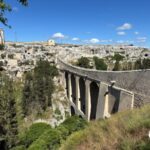
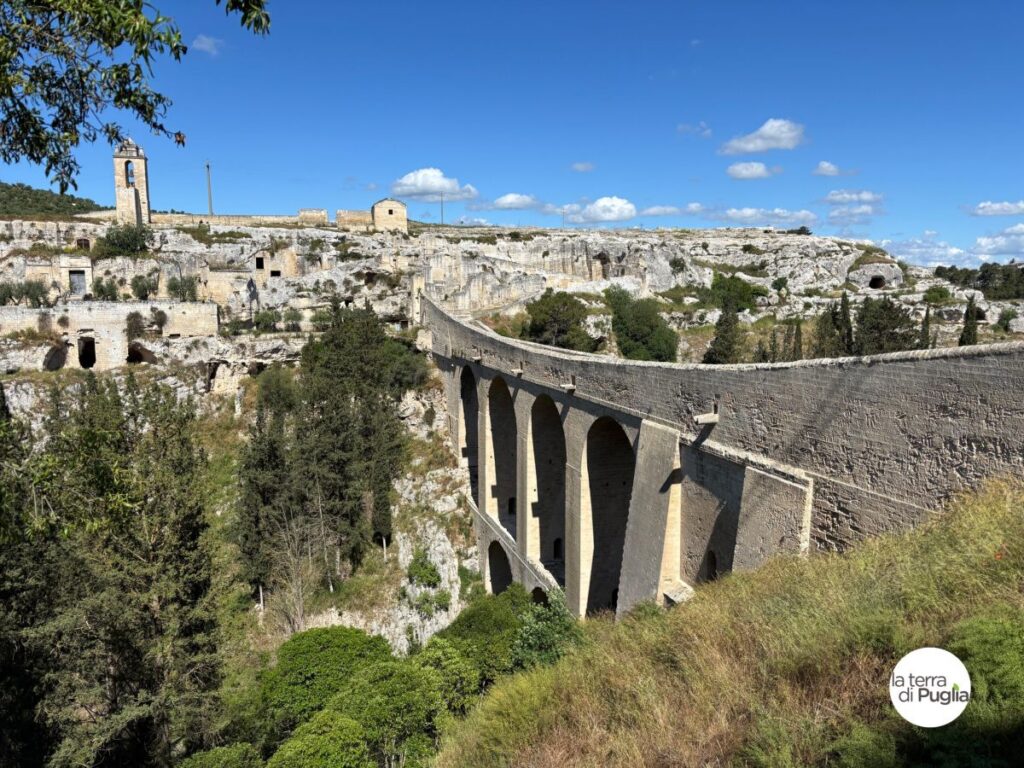
In short. Gravina in Puglia stands at over 350 metres on the western edge of the Murgia, along the rim of the deep karst ravine that gives it its name. It has been lived in since the Neolithic, it was a station on the Appian Way under the name Silvium, and the rock below and around it is honeycombed with caves used as houses, churches and tombs.
A town built along the edge of a canyon, with a second town cut into the rock underneath it. That is the short version, and it is accurate.
Where it is
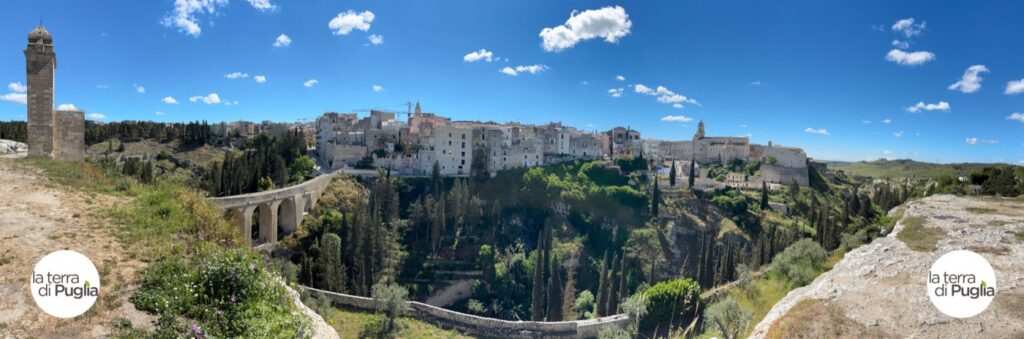
Gravina sits in the western part of the province of Bari, on the boundary with Basilicata — the municipality borders it directly. The town developed along the margins of its own gravina, the deep karst ravine that names it, and the position made it a landmark between the two regions.
How old, honestly
Is Gravina the oldest city in the world? No — and the claim circulates enough to be worth answering. Jericho has been inhabited since around 9000 BC, Byblos since 5000 BC, and Damascus continuously for more than eleven thousand years; Aleppo and Varanasi are in the same conversation. What is true is that Gravina is one of the oldest towns in southern Italy, inhabited since the Neolithic, with the caves, tombs and finds to show for it.
The natural and cut caves along the ravine were used as dwellings, places of worship and burial from the Neolithic and the Bronze Age onwards. The area amounts to an open-air museum of Apulian prehistory: Peucetian necropoleis, hypogeum tombs, ancient tuff quarries, and the Botromagno archaeological park.
Silvium, on the Appian Way
A staging post on the road to the East. In Roman times Gravina was Silvium, a strategic and commercial centre on the line of the Via Appia — the consular road from Rome to Brindisi. Its position on the plateau made it a place to stop and resupply for travellers, merchants and legions marching east. Remains of villas, cisterns, coins, tombs and paved stretches of the Appia itself have all been found here. Silvium belonged to Regio II Apulia et Calabria and was administratively tied to nearby Venusia, today’s Venosa.
The town went on growing in the centuries after, keeping an agricultural and military role, with an economy built on grain, oil and wine — and on the tuff quarries, which the Romans worked too.
In the Middle Ages Frederick II came here to hunt and built a castle, and every so often the town puts on its history in costume: in 2026 Historia, the gathering of historical pageants, runs from 18 to 20 September.
Around it
Altamura is twenty minutes east, and the two make an obvious pair — the same plateau, the same prehistory, two different towns. Castel del Monte is about forty minutes north.
Gravina is the western edge of the Murgia, and where Puglia runs out into Basilicata.