In short. Altamura has megalithic walls built by the Peucetians, a city founded by Frederick II in 1232 and deliberately divided into Jewish, Saracen, Latin and Greek quarters, a karst sinkhole half a kilometre across on its doorstep, and — in a cave outside town — the most complete Neanderthal skeleton ever found. It is also the bread capital of Italy.
For a town most foreign visitors have never heard of, Altamura carries an improbable amount. Two hundred thousand years of continuous human presence, and a loaf with a European protected designation.
The walls, and the city Frederick built
The megalithic walls go back to the Peucetians: originally around 3.6 kilometres long and four metres high. Sections are still visible inside the later medieval circuit, notably within the Palazzo de Angelis Viti.
The city as it stands was founded in 1232 by Frederick II, who built a basilica here dedicated to Santa Maria Assunta and then set about filling the place.
Four quarters, on purpose. To populate his new town Frederick II invited communities in — Greeks and Jews among them — and offered them franchises and reductions on duties. Altamura was divided into four quarters: Jewish, Saracen, Latin and Greek. That was not town planning, it was a political statement. In thirteenth-century Puglia, where conflict between communities was normal, Altamura was designed as the exception: a place where Jews could practise their faith, Greeks keep their own liturgical rite and Saracens live without persecution. Nor was it abstract idealism — Frederick ruled the most cosmopolitan kingdom in Europe and knew that different communities brought different skills, in trade, medicine and philosophy. The city was literally built on that mixture.
Later it passed through Aragonese and Spanish hands. In 1647 it took an active part in the anti-feudal revolts inspired by Masaniello’s rising in Naples; it welcomed the ideas of the French Revolution and paid for it under the Bourbon reaction; and its risings for Italian unity in 1848 were also put down by force. It is a town with a long habit of resistance.
The Man of Altamura
The most complete Neanderthal ever found. In 1993 cavers exploring the Lamalunga cave outside Altamura found a skeleton, and it turned out to be unique in world palaeoanthropology: the only Neanderthal individual whose skeleton survives almost complete, skull intact. It has been dated to between 128,000 and 187,000 years ago. What makes it more extraordinary still is that the bones are partly fused into the limestone of the cave by mineral concretion built up over the millennia — which makes extraction almost impossible without damage, so researchers have preferred to study it in place with non-invasive methods.
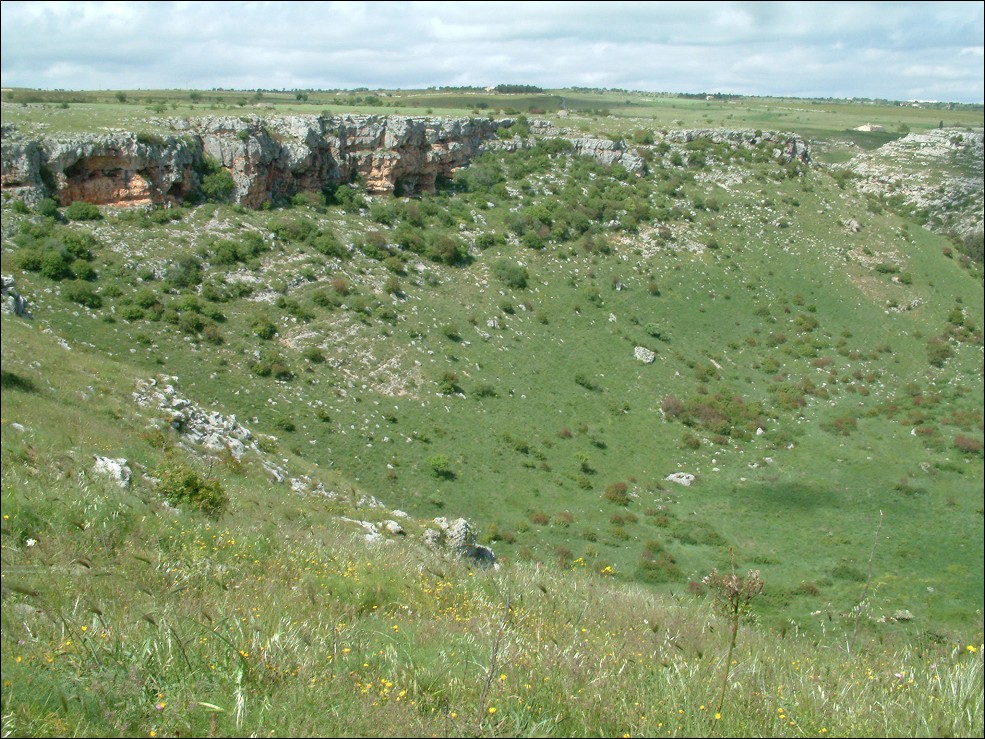
There is a longer piece on him: the Man of Altamura. The town’s other prehistoric site is the Pulo, a karst sinkhole roughly 500 metres across and 75 metres deep, which has produced a great deal of prehistoric material of its own.
The bread
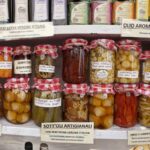
Altamura is known across Italy for one thing above all: its bread, the first in Europe to be granted DOP status, made from local durum wheat semolina and baked in a form that keeps for days. It is the base of a whole way of eating here.
Why it lasts. The full story — the wheat, the sourdough, the wood ovens and the reason a loaf survives a week — is here: the bread of Altamura. And it ships: see the shop.
Around it
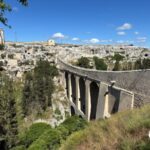
Gravina in Puglia is twenty minutes west, on the edge of its ravine. Castel del Monte is about half an hour north across the plateau. Bari is an hour away.
Altamura is the largest town of the Murgia, and the one with the longest memory.