In short. The Murgia is the limestone plateau running down the middle of Puglia: bare, sharp rock worked from underneath by water into sinkholes, ravines and caves. Almost nobody puts it first on an itinerary, which is the argument for going. It holds Castel del Monte, the most complete Neanderthal skeleton ever found, and the bread that gives its name to a DOP.
This is the inland Puglia — no coast, no trulli, no crowds. What it has instead is stone, and the things people have done with stone here for the last two hundred thousand years.
The plateau
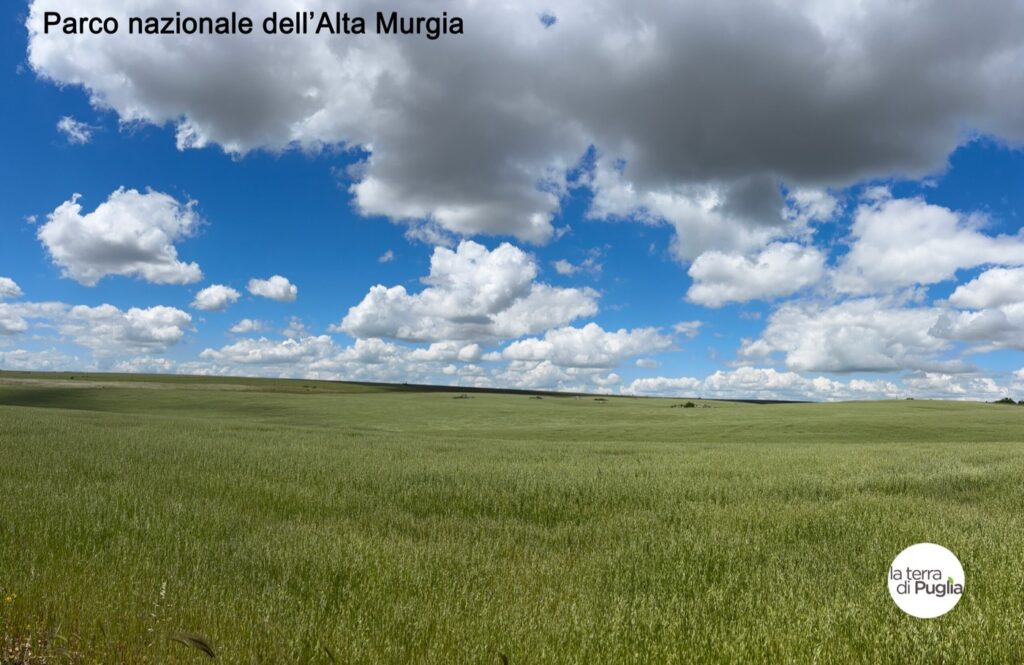
The Murgia forms the central band of the region and touches four provinces — Bari, Barletta-Andria-Trani, Taranto and Brindisi. Two terraced ridges run diagonally north-west to south-east, reaching the Adriatic in the east and the Bradanic trough in the west, with the Ofanto valley at the top and the Salento and the Ionian arc at the bottom.
It divides in turn into the coastal Murgia, the land of the ravines, the Valle d’Itria, and the Taranto and Salento Murge.
Murex: the pointed stone. The name comes from the Latin murex, which meant the spiny sea snail and, by extension, any sharp stone or jutting rock. Walk on the Murgia and the sense of it is immediate: the exposed limestone is jagged, irregular and edged. That morphology shaped more than the landscape — it shaped the architecture, the farming, and even the traditional footwear of the people who worked here.
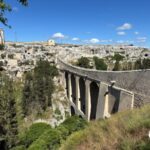
Because the rock is limestone, water has worked it from below and left the whole repertoire of karst: sinkholes, gravine — deep ravines — lame, swallow holes and caves.
Castel del Monte
The building the whole area is known for stands alone on a hilltop in the territory of Andria: Castel del Monte, octagonal, built by Frederick II, a UNESCO World Heritage Site since 1996 and familiar to every Italian because it is on the one-cent coin. It is not a town and it is not in one — it has its own page here: Castel del Monte, the castle nobody can explain.
The emperor who built it left castles all over the region, from the Gargano to Oria: they are gathered, with a three-day route, in Frederick II’s Puglia.
The towns
- Altamura — the bread, the megalithic walls, and the most complete Neanderthal ever found.
- Gravina in Puglia — a town on the edge of its own ravine, inhabited since the Neolithic.
- Andria — the town Castel del Monte belongs to, and the city of three bell towers.
- Canosa di Puglia — one of the great cities of Roman Apulia, with the tombs to prove it.
- Ruvo di Puglia — a Romanesque cathedral, and two thousand Greek vases in a nineteenth-century house.
Who was here first
The Peucetians. Puglia had three ancient peoples, and the Murgia belonged to the middle one. The Peucetians held the centre of the region — Gravina, Altamura, Bitonto, Ruvo — and are considered the ancestors of the inland Bari population. North of them, in the Gargano and the Tavoliere, were the Dauni, whose capital was probably Arpi near Foggia and who left richly decorated tombs and distinctive pottery. South, in the Salento, were the Messapians, proud fighters who resisted Rome for a long time, with their capital at Rudiae near Lecce.
What to eat, and what to take home
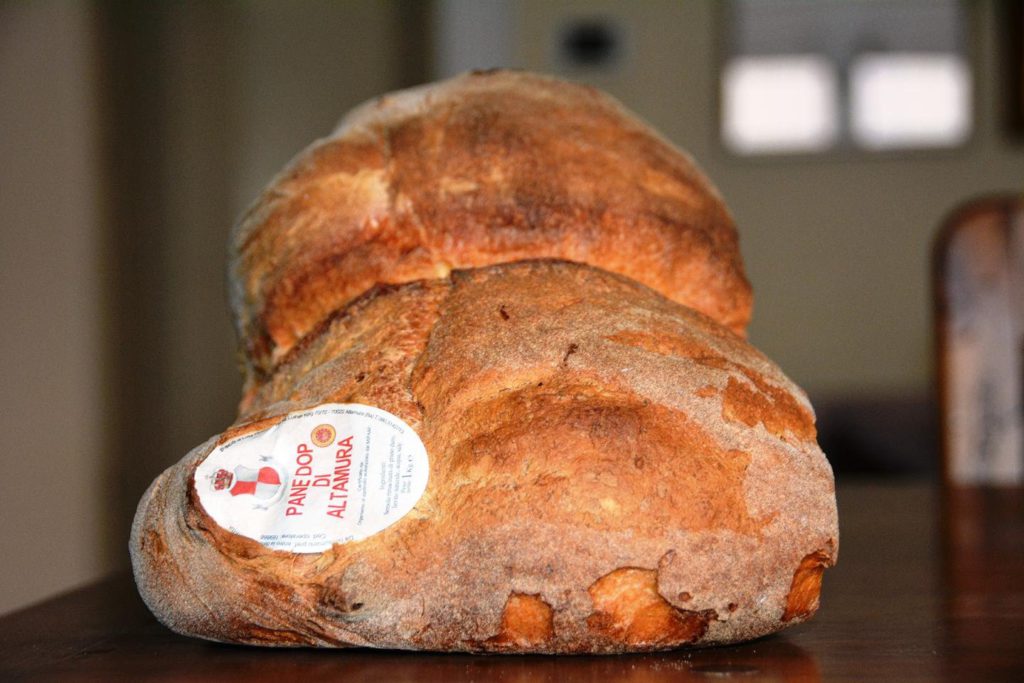
The one thing everybody knows from this plateau is the bread of Altamura, made from local durum wheat semolina and the first bread in Europe to be given DOP status. It keeps for a week and it is the base of half the cooking in the region — the bread of Altamura explains why.
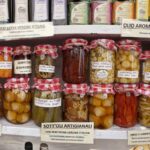
It travels. The oil, the pulses and the preserves of the Murgia ship directly from Puglia: see the shop.
The Murgia is one of the six areas of Puglia covered in this guide. To see how it sits against the rest, go back to where to go in Puglia.