In short. The Tremiti islands lie about twelve nautical miles north of the Gargano: five islands, two of them inhabited, with a fortress-abbey on one, Aleppo pines and sea caves on another, and a marine reserve around all of them since 1989. Just over four hundred people live there, and they speak something close to Neapolitan.
Sailors have called them the pearls of the Adriatic for as long as anyone has been writing things down — a handful of white rocks thrown into blue water. They are still largely unspoilt, which on this coast is rare enough to be the point.
The five islands
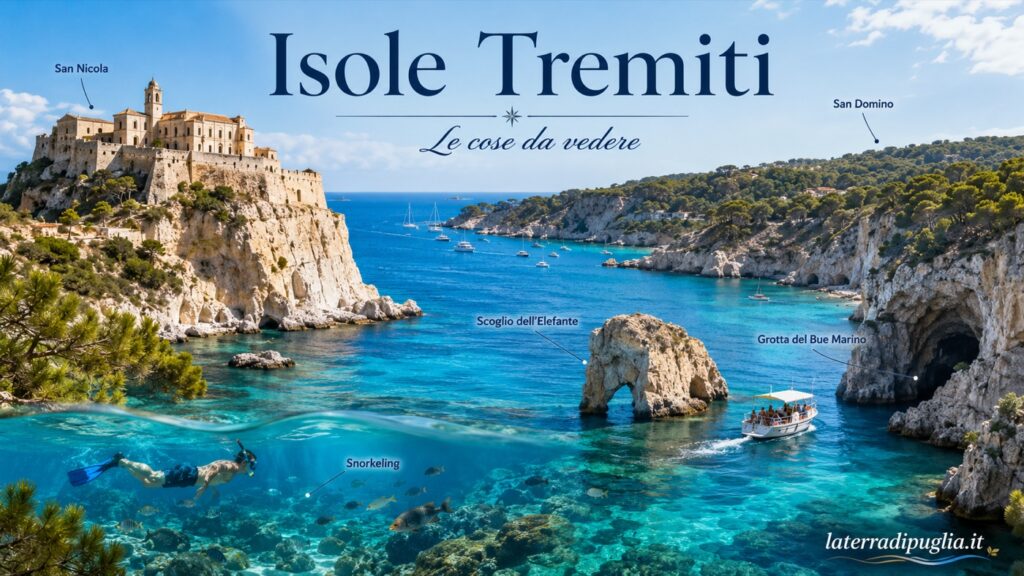
- San Nicola — 42 hectares, the historic and administrative heart. The fortress-abbey, the lanes, and the supposed tomb of Diomedes. Four kilometres of coast, rising to 75 metres.
- San Domino — 207 hectares, the largest and the green one: Aleppo pines, coves, scrub. They call it the Garden of Paradise.
- Cretaccio — 3.4 hectares of ochre clay rock between the two, uninhabited.
- Caprara — 45 hectares, entirely rock, uninhabited, and known for its sea caves.
- Pianosa — 11.4 hectares, 22 kilometres from the rest of the group: the most isolated and the wildest.
Why they sound Neapolitan. The dialect of the Tremiti is surprisingly close to Neapolitan, and it is not an accident of the sea: in 1843 families from Ischia were settled on the islands, and the language came with them. Two islands are inhabited; the other three can be visited only on guided trips or by boat.
What you do here
The gulls’ cave. The Grotta dei Gabbiani, on Caprara, can be reached only from the sea — and once you are inside you can swim in it, among the stalactites. It is the one people remember.
You go out on the water. A boat round the islands takes in the Scoglio dell’Elefante, the rock stacks the islanders call the pagliai, and the caves — the Grotta del Bue Marino, the Grotta delle Rondinelle, the Grotta delle Viole. The marine reserve, in place since 1989, is why the water is what it is, and why the snorkelling is the best on this side of Italy.
The abbey, and the legend under it
The religious history starts in the ninth century, when Benedictine monks from Montecassino established themselves on San Nicola.
Inside the complex there is also a museum telling the history of the islands, and from the walls the whole archipelago is laid out below you.
What grew there is a fortress and an abbey at the same time — a monastery that had to defend itself — and it still dominates the island.
Diomedes. The legend says that Diomedes, king of Argos, threw three great stones into the sea that he had carried from Troy, and that they surfaced as islands: San Nicola, San Domino and Caprara. The Romans called the group the Insulae Diomedeae. His supposed tomb can be visited on San Nicola, which is either moving or absurd depending on the day you are having.
Lucio Dalla
The islands wrote some of the best Italian songs. Lucio Dalla first came here on holiday in the 1950s and never really left. On San Domino, above Cala Matano, he had a house with his own recording studio, Casadilucio: the album Luna Matana (2001) was made there and named after that cove, and pieces of Italian musical history — 4 marzo 1943, Piazza Grande, Com’è profondo il mare — took shape on these islands. He kept a second refuge on San Nicola, an apartment inside the fortress-abbey of Santa Maria a Mare. His heirs sold both properties between 2024 and 2025 — but for the islanders the connection, as they put it, remains a matter of the heart.
Getting there
Ferries run from Rodi Garganico, Peschici, Vieste, Manfredonia and Termoli. There is also a helicopter link from Foggia. Sailings are seasonal and weather-dependent — check before you build a day around them.
The Tremiti are the offshore end of the Gargano, and the only islands in this guide.