In short. San Giovanni Rotondo is where Padre Pio lived for more than fifty years, and it is now one of the most visited pilgrimage destinations in Europe. The sanctuary holds his tomb; the new church beside it was designed by Renzo Piano. Behind the pilgrimage there is still a Gargano hill town, and it is worth walking.
This is not a sightseeing town and it does not pretend to be. People come here for one reason, and the town has organised itself around receiving them — while keeping, in its older streets, the ordinary life it had before.
Padre Pio, and why here
Born at Pietrelcina on 25 May 1887, Francesco Forgione — Padre Pio — arrived in San Giovanni Rotondo in 1916 and stayed for the rest of his life. He died on 23 September 1968 and was canonised in 2002. The town today receives millions of visitors a year because of him.
What there is to see
The centre of it is the Sanctuary of San Pio, among the most visited in Europe. The complex has grown in layers:
- Santa Maria delle Grazie — the historic church where Padre Pio celebrated mass for years, with the old Capuchin friary attached.
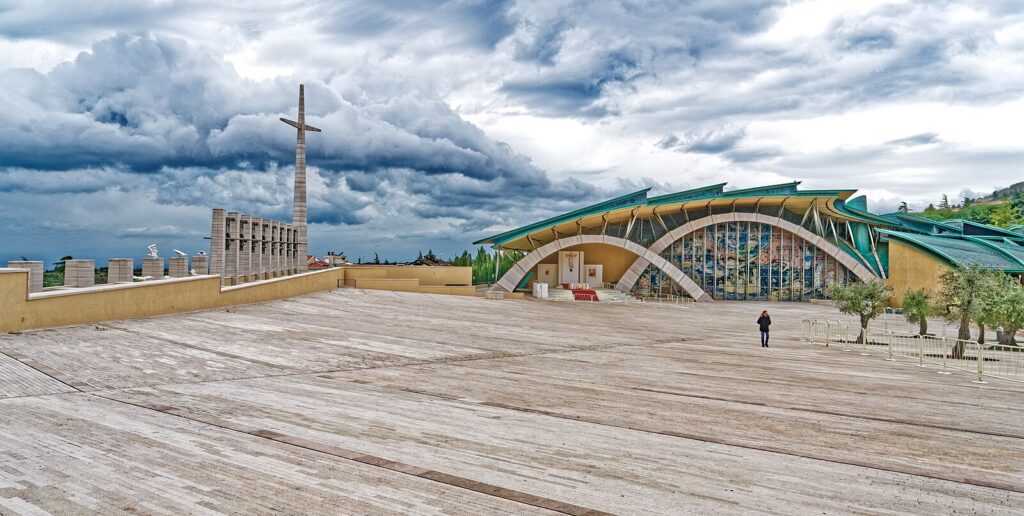
- The new church of San Pio da Pietrelcina — designed by Renzo Piano, and a genuinely modern building on a pilgrimage site.
- The tomb, in the crypt, where thousands of people come every day.
- His cell, the spirituality centre, the museum and the friary.
- The monumental Via Crucis, outdoors and on the hillside.
23 September. On the anniversary of his death the town fills with people from every part of the world for the official celebrations. If you want to understand what this place is, that is the day — and it is also the day to book months ahead, or to stay away if crowds are not what you came for.
The town behind the sanctuary
Away from the pilgrimage route there is an older San Giovanni Rotondo: a historic centre of stone lanes, old houses and small churches, which for centuries lived on farming, transhumance and craft. It is quiet, it is not staged, and it takes half an hour to walk.
The local cooking follows the same logic — pulses, hand-made pasta, oil, and the sweets that belong to particular feasts. Much of the town’s hospitality is family-run, which is unusual for a place that receives these numbers.
Around it
The town sits inside the Gargano National Park, surrounded by hills, woods and old olive groves, so the walking starts at the edge of it. Monte Sant’Angelo is half an hour away — the other, far older pilgrimage of the promontory — and San Marco in Lamis is closer still. The coast at Vieste is about an hour and a half.
San Giovanni Rotondo is the modern pilgrimage of the Gargano, and the reason a large share of the promontory’s visitors are here at all.