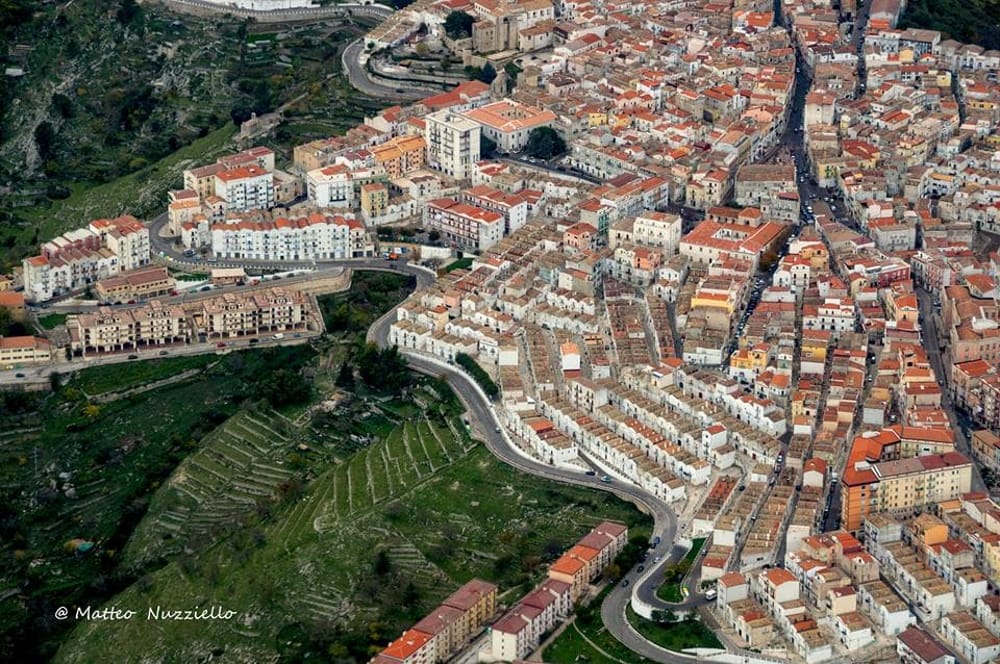
In short. Monte Sant’Angelo stands at almost 800 metres, the highest town on the Gargano, and it is the only comune in Italy with two separate UNESCO World Heritage listings. Under it is a natural cave where, by tradition, the Archangel Michael appeared in 490 — and pilgrims have been coming ever since, along a line of sanctuaries that runs from the British Isles to Jerusalem.
The view goes from the Gulf of Manfredonia across the whole Tavoliere. But nobody comes for the view. They come for what is eighty-six steps below the church floor.
Two UNESCO sites in one town
Unique in Italy. Monte Sant’Angelo holds two distinct World Heritage listings: the Sanctuary of San Michele Arcangelo, inscribed in 2011 as part of the serial site “Longobards in Italy: Places of Power”, and the Foresta Umbra, added in 2017 among the “Ancient and Primeval Beech Forests of the Carpathians and Other Regions of Europe”. Stone and forest, faith and nature, in one municipality.
The sanctuary
The entrance is plain — a Romanesque front with a thirteenth-century Angevin bell tower beside it — and gives no hint of what is underneath. The heart of the sanctuary is a natural cave in the Gargano limestone, reached down a stairway of 86 steps cut into the rock.
Fifteen centuries of continuous pilgrimage have left marks everywhere: inscriptions in runic characters, ex-votos, bronze statues, and floors worn down by the knees of people who arrived after days of walking. Tradition records three apparitions of the Archangel — in 490, the one known as the apparition of the Bull, then in 492 and 493.
“Terribilis est locus iste.” The inscription at the entrance reads Terribilis est locus iste. Hic domus Dei est et porta coeli — “Awesome is this place. This is the house of God and the gate of heaven.” Saint Francis of Assisi came here on pilgrimage and stopped at the threshold without going in, judging himself unworthy to enter a place the Archangel had touched.
The line of Saint Michael. This is not an isolated shrine. It is one of seven sanctuaries dedicated to the Archangel Michael that fall along a line across Europe — from the British Isles down to Jerusalem, passing through Mont Saint-Michel in Normandy and the Sacra di San Michele in the Val di Susa. Monte Sant’Angelo sits at the centre of it, geographically and symbolically. Legend says the line traces the sword-stroke with which the Archangel drove the devil out.
The castle
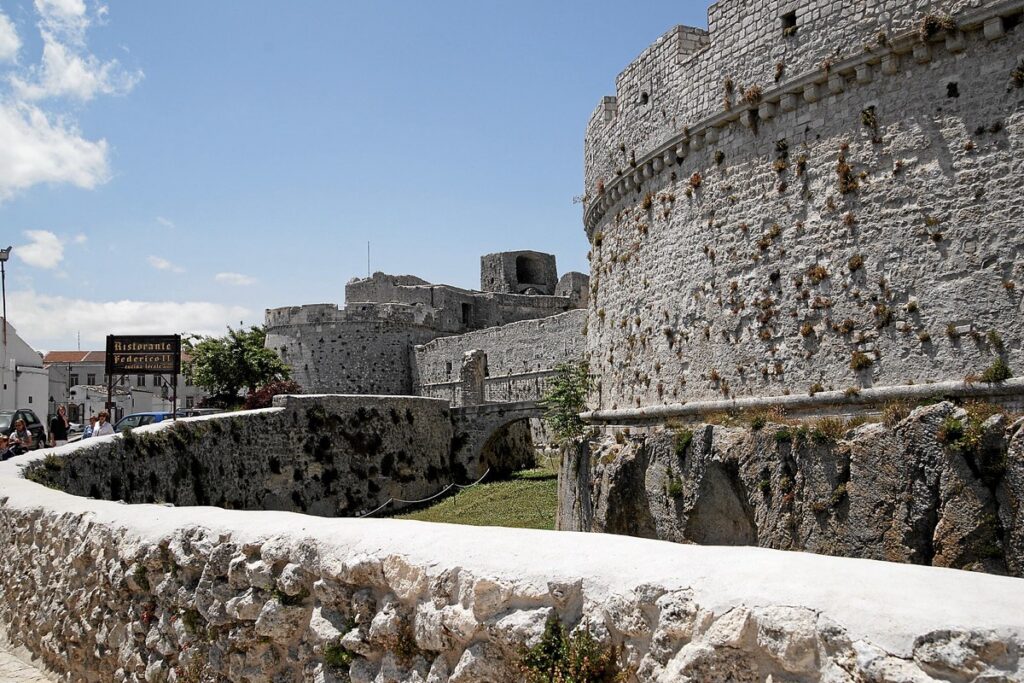
First built in 837 at the order of the bishop of Benevento, then enlarged in turn by the Normans, the Swabians and the Angevins — which is why it carries all three names. Charles I of Anjou finished it in 1274 with the two cylindrical towers that still dominate the old town. It now houses the National Museum of the Gargano: medieval stonework, Lombard finds and sculpture from across the promontory.
The Rione Junno
The oldest quarter of the town is a maze of white stone lanes and stairways that looks like a nativity scene. The houses are small — thirty square metres, and they once held families of ten, sometimes with an animal as well. Some are guesthouses now; many still have that suspended, ordinary quality that makes the Junno the most photographed corner of the Gargano.
In the same quarter stand the Apulian Romanesque church of Santa Maria Maggiore and the Tomb of Rotari, a cylindrical early Christian baptistery of the eleventh century.
The forest
The Foresta Umbra begins a few kilometres out of town, in the middle of the Gargano National Park: 10,500 hectares of beech, Turkey oak, oak, maple and holm oak, many of monumental size. The name comes from the shade — the canopy lets almost no light through. Green in spring, ochre and red in autumn, and there is a natural history museum at the Villaggio Umbra in the middle of it.
Around it
Half an hour away is San Giovanni Rotondo, the other pilgrimage of the Gargano and a completely different one — fifteen centuries apart. The coast at Vieste is about an hour by road.
Monte Sant’Angelo is the high point of the Gargano, and the oldest reason anyone had for coming here.