In short. Brindisi is where the Appian Way ended and the East began. Most visitors pass through its airport and never look at the city, which is a mistake: under a modern theatre there is a whole quarter of Roman Brundisium, on the waterfront there are the columns that marked the end of Rome’s most important road, and in the museum there are bronzes lifted off the seabed. It is also the gateway to the white towns of its own province.
Brindisi has been called the door to the East for two thousand years, and the phrase is geography rather than poetry. Its position made it the port through which trade between West and East was organised, and that role left it with layer upon layer of history — periods of great wealth alternating with periods of poverty, each leaving something behind.
The port Rome could not do without
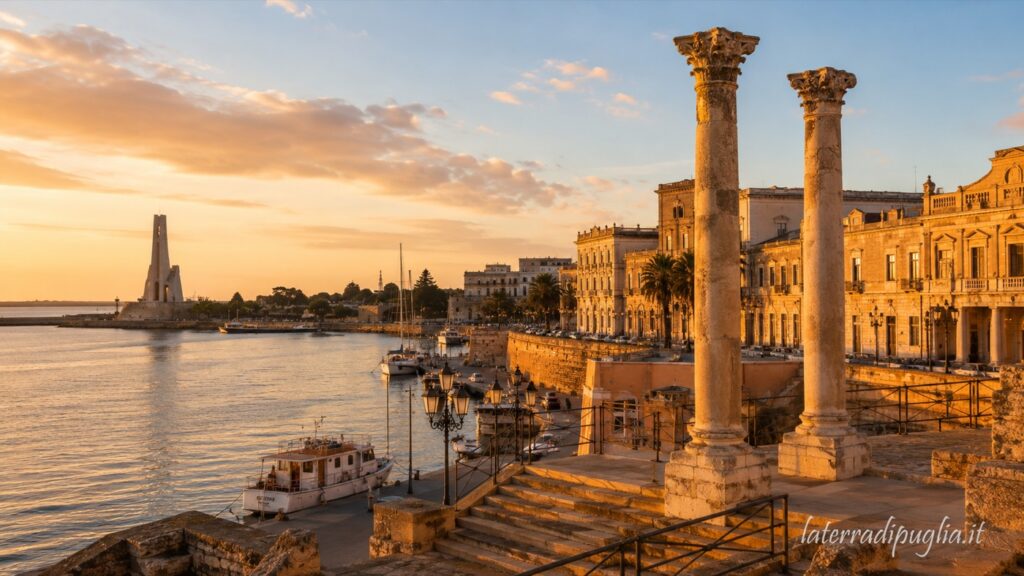
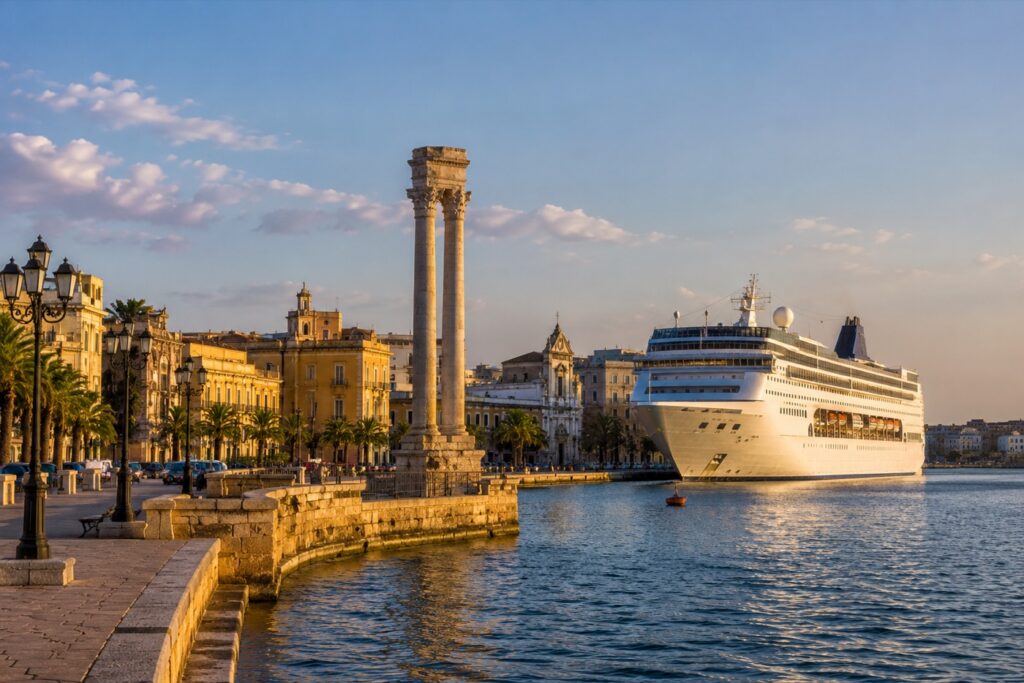
Brundisium: the end of the Appian Way. For the Romans this was not simply a port — it was the port. The Via Appia, the most important road in the empire, ran the length of the peninsula from Rome and finished exactly here. The Roman columns still standing above the harbour were its terminus: the sign that Italy had ended and the East began. From Brundisium sailed the military fleets, the merchants, the pilgrims bound for the Holy Land and the crusaders after them. Virgil died here in 19 BC, on his way back from Greece.
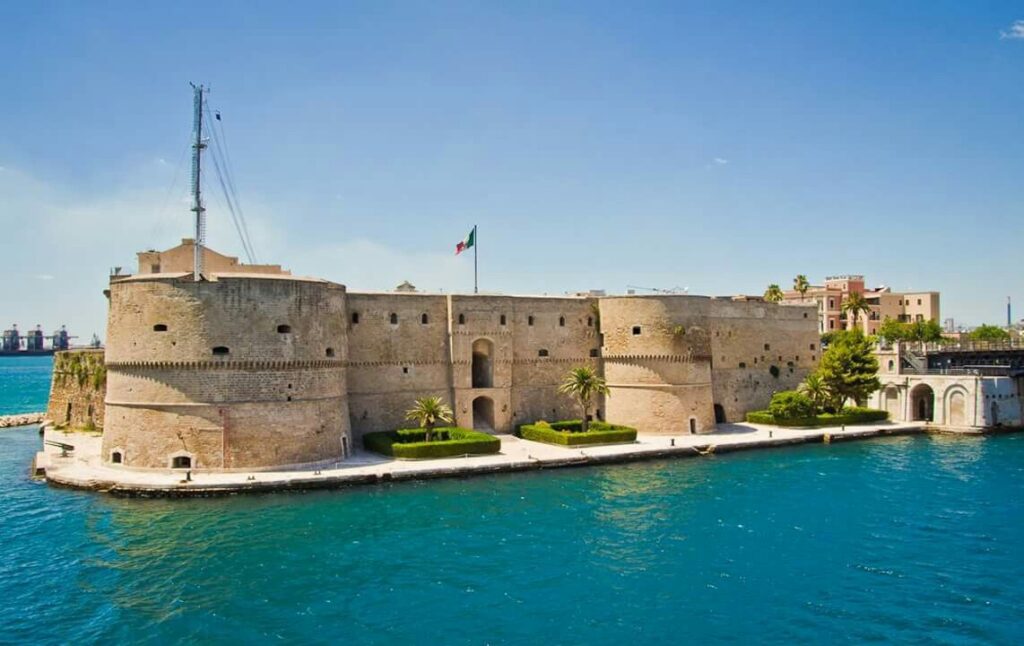
The columns look down on the staircase named after Virgil and over a natural harbour shaped, as the locals put it, like a pair of deer antlers. From there the view takes in the Monument to the Italian Sailor, 53 metres tall and dedicated to the dead of the world wars, and the Aragonese castle — the “Forte a mare” — built on an islet at the mouth of the port.
The city under the city
Walking through Brindisi you come across something unexpected: the archaeological excavations of San Pietro degli Schiavoni, hidden underneath a modern steel theatre. Thermal rooms, paved streets, shops and elegant houses — a section of the ancient city preserved whole.
Found by accident, in the 1990s. The dig happened because someone was building a theatre. What came up was an entire portion of Roman Brundisium: baths, mosaic floors, drainage channels, stretches of ancient street with the ruts of cart wheels still cut into the paving. The Roman city and the modern city sit on top of each other with an almost improbable precision. Visiting the excavation means literally descending through time — and understanding that Brindisi was not built yesterday.
Piazza del Duomo and the museum
A short walk from the columns is the cathedral square, where the city keeps its most representative buildings: the eighteenth-century cathedral, which retains fine Romanesque elements; the Palazzo del Seminario, home to the Diocesan Museum; and the Portico dei Templari, a loggia standing in front of the entrance to the archaeological museum.
The Ribezzo Archaeological Museum is the one stop that ties the whole city together. Prehistoric finds, statues in Roman dress, cargo recovered from wrecked ships — and the fact, told plainly in the displays, that part of this heritage was destroyed by bombing during the world wars.
The bronzes of Punta del Serrone, brought up from the seabed. The museum’s bronzes were recovered from the water off Brindisi — the wreckage of ships carrying Greek and Roman statues westward. It is a recurring phenomenon in this harbour: centuries of heavy traffic have left an extraordinary quantity of material on the bottom. The pieces on display — portraits, athletic figures, decorative fragments, the oldest going back to the fourth century BC — are sculpture of the highest quality. Like the Riace bronzes in Calabria, they record the long journey of Greek art towards Rome through the ports of Puglia.
Two more churches close the circuit: the Norman Tempio di San Giovanni al Sepolcro in the centre, and Santa Maria del Casale out towards the edge of town.
The province, which is why most people come
Talking about tourism in Brindisi means talking about its province more than its city. Over the last twenty years the inland towns have found a foreign audience taken with the whiteness of their historic centres — Cisternino, Ostuni, Ceglie Messapica — and with the old masserie, fortified farms converted into country houses for travellers who want comfort and elegance without giving up the rough stone.
When Puglia became the world’s stage. Borgo Egnazia, at Savelletri in the province of Brindisi, was chosen as the venue for the G7 summit of June 2024. A converted masseria hosting the heads of the largest economies on earth: the images went round the international media and settled Puglia’s reputation as a destination of the first rank. The choice was not accidental — the rural, authentic, hospitable Puglia that Borgo Egnazia stands for is exactly the face the region wants to show.
Beyond the towns, the province runs from holiday villages and campsites to luxury resorts, with nature reserves, hills of olive groves and farms, and clean water along the coast.
Practical
- The airport — Brindisi is the airport for the whole south of the region: about 35 to 45 km from Ostuni and Martina Franca, and the nearest one to Lecce.
- In the city — start from corso Garibaldi and walk down to the columns; the old centre is compact.
- Ferries — the port still runs the crossings east that it has run for two thousand years.
Brindisi is the northern gateway to the Salento. Lecce is forty minutes down the road, and most visitors land here first without realising the city is worth a day of its own.