In short. The trulli were built dry — no mortar, no cement, just stacked limestone slabs. That was not rustic simplicity: it was a tax dodge. And the marks painted on the roofs are the other half of the story — scholars have catalogued 200 different symbols, and there is still no single key to reading them.
Trulli are warm in winter and cool in summer, easy to build with the karst stone lying about everywhere — and, crucially, easy to take apart.
💰 The tax trick that made a UNESCO site
In the Kingdom of Naples, permanent dwellings were taxable, and the Crown’s collectors came round to assess them. A trullo built without mortar could be taken down in a hurry: pull out the keystone at the top of the cone and the whole roof collapses, leaving a building that is not habitable and therefore not taxable. The inspectors kept arriving to find nothing intact and properly built.
What began as peasant tax resistance became a UNESCO World Heritage Site in 1996.
The trullari. The men who built them were a trade of their own, and their knowledge was passed on by mouth and by hand — no manual, no technical drawing. They judged by eye the curve of the chiancarelle, the pitch of the cone, the placing of the keystone. There are very few left, and the technique is now an intangible heritage at real risk of disappearing.
🔺 The pinnacles
On top of most trulli sits a pinnacle — known locally as the key of the trullo, the cucurneo or the tintinule. Scholars have argued about them for a long time, and there are three standing theories, none of which excludes the others:
- An attempt to reach further towards the sky, as Gothic architecture did — here tied to the cult of the sun and of the gods that governed the farming year
- Small works of art by the master builders, who liked to carve the top of a trullo and leave something of a signature
- A family mark: all the trulli of one bloodline carrying the same pinnacle
The recurring shapes are few: the sphere, the disc — which experts consider very old — and pinnacles that are tetrahedral, wedge-shaped, cruciform or star-shaped, plus the variations each builder invented.
✍️ The symbols, in six families
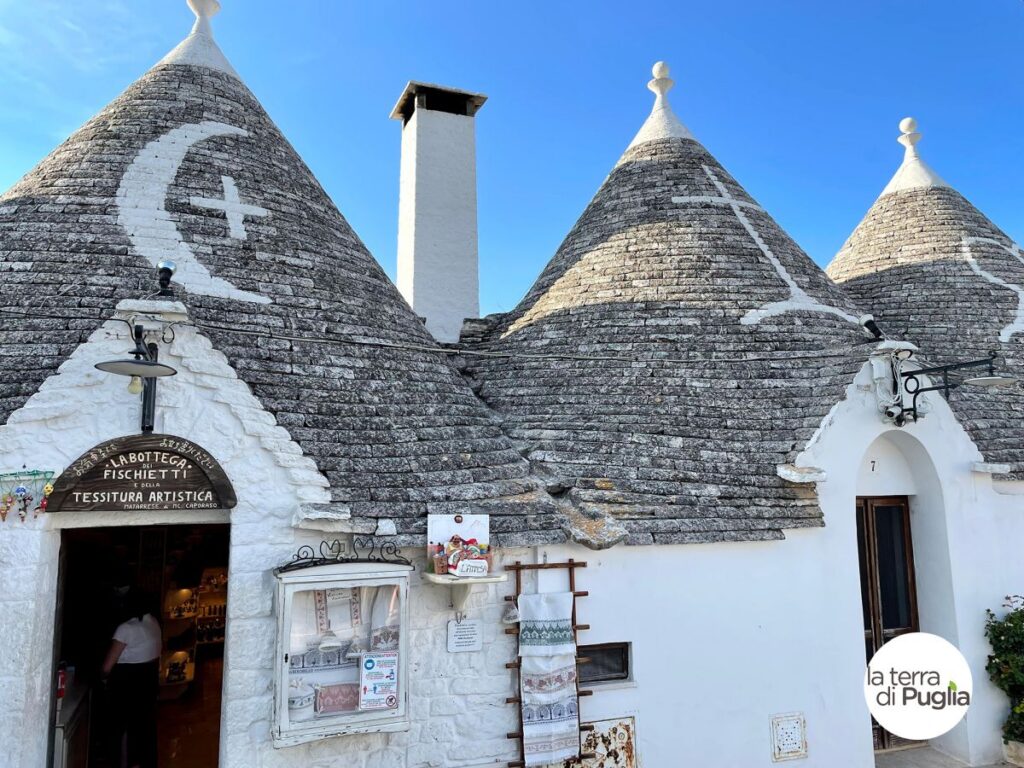
On the front slope of the roof, on the flat slabs of the self-supporting cone, come the painted marks. In 1940 scholars agreed a conventional division into six kinds — primitive, Christian, magical, pagan, ornamental and grotesque — and catalogued about two hundred distinct signs.
- Primitive — graphically rudimentary, many of them also found on ancient Apulian pottery and tombs, including the numbers 3, 5 and 7.
- Magical — astrology, the zodiac, the planets. The sun and the moon above all; the zodiac signs carry specific wishes — the Bull good luck for the household, the Twins for brothers, Cancer for parents, Leo for children, Libra for a married couple.
- Pagan — from the Roman cult of animals. The eagle is the soul rising; a horse’s head means work, an ox’s head wards off misfortune, a dog’s head stands for the family, a cockerel for vigilance, a snake for prudence.
- Christian — the most common of all: the eucharistic chalice, the radiant host, the pierced heart of Mary, and borrowings such as the seven-branched candelabrum and the six-pointed star.
- Ornamental and grotesque — the builder’s imagination: initials, a hoe or a sickle, an almond, a bunch of grapes, hearts and stars.
The swastika, 5,000 years before Fascism. Finding one on a trullo roof is startling and has nothing to do with Nazi ideology. It is one of the oldest symbols in human history — India, northern Europe, China, Mesopotamia — and it means cyclicity, the movement of the sun, life renewing itself. On these roofs it is a wish for a good harvest. The twentieth century appropriated a sign that was already five millennia old.
One detail worth knowing: the moon is always drawn with its back to the east, which is what distinguishes it from the Turkish crescent — a symbol of damnation in this vocabulary.
🪧 A roof as an identity card
Putting your initials or the tools of your trade on your own roof was not vanity. In a time when most farmers could neither read nor write, a symbol was the only way to say this is mine, this is my family, this is my work. The trullo with the hoe belongs to the farmhand, the one with the bunch of grapes to the vine grower, and the initials cut into stone were a signature — and, in their way, a kind of immortality.
Look up in Alberobello. The best place to see the painted symbols is Rione Monti, where the trulli stand side by side and you can compare a dozen roofs in one street. Do not expect them to be crisp: the slab surface is uneven, and the drawings are legible rather than sharp.