Until a few decades ago, in many towns in Puglia, bread was kneaded at home and baked in the village oven, once a week. In Laterza the ovens were run by women; in Santeramo the dough was made in the evening and the loaves in the morning; in Altamura and Laterza every loaf carried its family’s mark. This is the story of that bread; the recipe for making it today is on our bread page.
In the evening the kneading trough stayed open longer than usual. Inside was the piece of dough kept back from last time, which had waited all week; on top, once the dough was made, a wool blanket, because in winter the kitchen was cold and the bread still had to rise. Early in the morning the loaves left the house on a wooden board, under a cloth, and crossed the town to the oven.
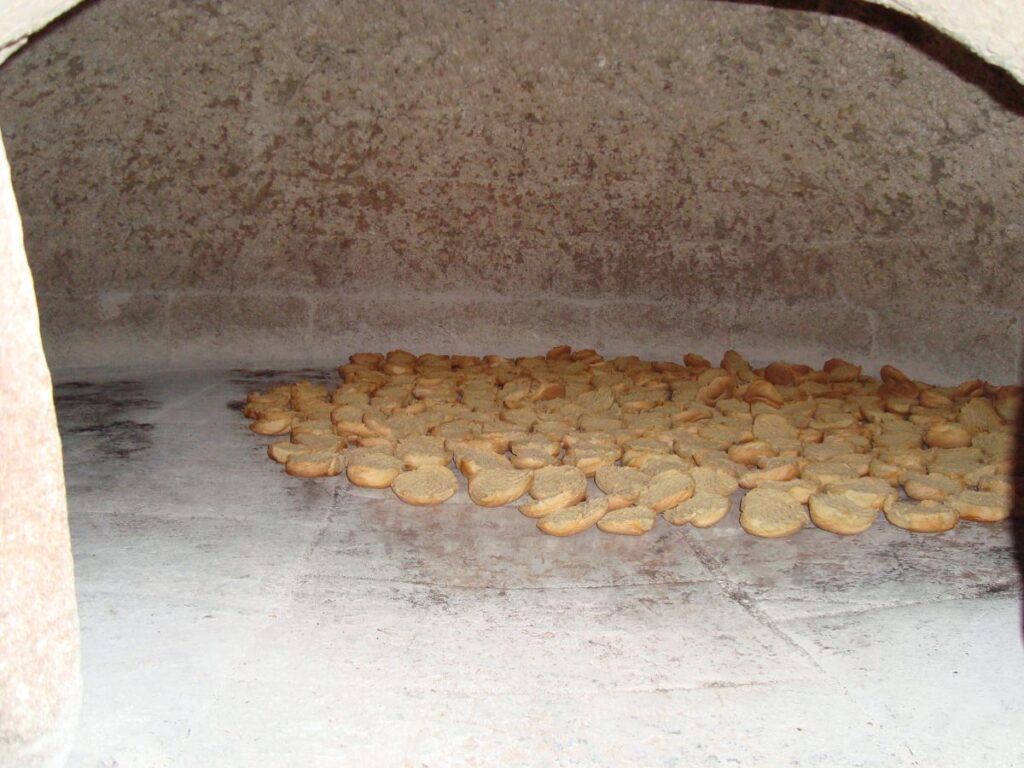
Friselle in a wood-fired oven: a stone oven heated with wood, like the one where every family’s bread was once baked.
A week’s bread
In Santeramo in Colle, in the province of Bari, the Puglia Region’s record of traditional food products says that until a few decades ago almost every family made a whole week’s bread at home, and some still do. The dough was prepared late in the evening so it could rise overnight; in the morning it was shaped into loaves of half a kilo or a kilo and taken to bake in one of the town’s wood-fired ovens.
In Monte Sant’Angelo, on the Gargano, the rocky promontory that forms the spur of the Italian boot, families bought bread only once a week, which is why loaves could weigh 12 kilos or more. The same record notes that for centuries bread making was one of the main tasks of women, who spent whole nights at it; making it and eating it came with gestures, prayers and ritual words. The sourdough starter there has a name of its own: lu crescente.
The village oven
In Laterza, near Taranto, according to the Slow Food Ark of Taste, until the 1960s the town’s ovens were run only by women. In charge of each oven was the fornaia, the woman baker, called à furnele in dialect, who usually rented the oven and looked after the baking. With her worked three women helpers, the fraschere: they got the firewood ready, went round collecting the dough from the women of the town, carried the bread back to each family and took the payment.
The oven was built from stones called chianghe and heated with wood from the woods or from olive trees, or, depending on the season, with apricot stones or almond husks. Once it reached about 400 degrees Celsius, the wood and ash were swept out with wet hemp rags, and the bread baked for almost three hours on the heat left in the stones.
Village ovens have a long history on paper too. In Santeramo, the regional record says, the town archives list a single oven in 1763; from 1803 the documents distinguish a «big oven» and a «small oven». In Altamura the town statutes of 1527 already deal with the oven duty, a tax on baking.
Did you know? In the village oven, loaves from many families baked side by side, so they had to be told apart. In Laterza each loaf carried the initials of the head of the family, or a symbol such as a walnut or a sprig of mastic. In Altamura too, the Qualivita Foundation explains, bread kneaded at home and baked in the public ovens was recognised by the initials of the head of the family marked on the loaf.
What the oven left behind
The stone oven was also used for a bread baked twice: the frisella. According to the regional record it is baked, cut in two and put back in the oven to dry out; before eating it you dip it in water and dress it. The same record describes it as the travelling bread of sailors, softened with sea water and dressed with olive oil.
The ovens that stay lit
Today home bread and oven bread have gone their separate ways, but some towns have kept their tradition. In Monte Sant’Angelo, Slow Food writes, the stone-lined ovens, often very old, are put out only on Christmas Day and New Year’s Day; work starts at around half past two in the morning, with sour dough kept from the day before, and many bakers display their loaves outside their shops. In Laterza in 1998 the town council and a group of bakers founded the Pane di Laterza consortium. The bread of Altamura has had PDO status since 2003, and its rules still call for an oven fired preferably with wood or gas, reaching 250 degrees Celsius.
To make it at home. This is the story; for Puglia’s breads, durum wheat and frise, see our page on bread, wheat and frise.
How this piece was written. The facts come from the Puglia Region’s records of traditional food products (bread of Santeramo in Colle, bread of Monte Sant’Angelo, friselle), from the Slow Food Ark of Taste (bread of Laterza, bread of Monte Sant’Angelo), from the Qualivita Foundation and from the rules of the PDO bread of Altamura. The opening scene, with the kneading trough, the wool blanket and the board carried to the oven, comes from oral memory and is told as such. If the oven in your family’s town had another name, or the mark on the loaf was different, write to us: we will add it.