The name Pane di Altamura does not belong to every loaf baked in Altamura: it is a PDO, a Protected Designation of Origin registered in 2003, and only bakers who follow its product specification may use it, from the durum wheat grown in five towns of the Murge to the minutes in the oven. Below: what it requires and how to spot the certified loaf.
At the end of September a critic posting on social media called Altamura bread “overrated”, after tasting three loaves bought from three different bakeries. Bakers and the producers’ consortium replied, and one of the bakers pointed out that the first thing to check was whether those loaves were PDO at all. We will not argue about taste: everyone has their own. But the baker’s question is the right one, because “Altamura bread” and “bread made in Altamura” are not the same thing.
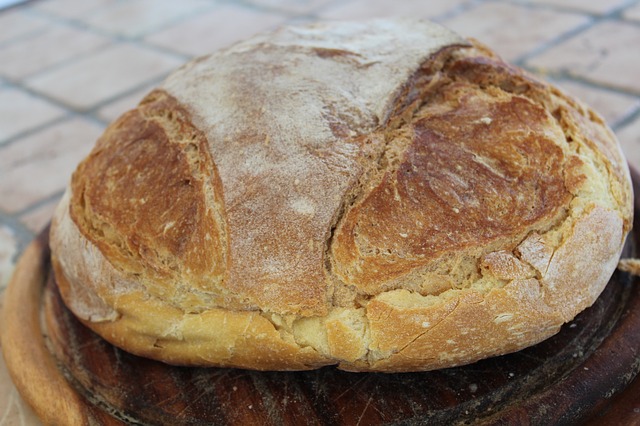
A thick golden crust: but the name “Pane di Altamura” is not given by looks, it is given by the specification.
Why we no longer sell it
We took Altamura bread out of our online shop: we wanted to showcase small craft bakeries that make it in Altamura without certification, but the PDO rules limit how the name can be used commercially and make it hard to sell bread that sits outside the certified system. So we chose simply to write about it. More on its story in our article on the bread of Altamura.
A reserved name
Pane di Altamura is a Protected Designation of Origin, the European label linking a food to its place and method, registered under Regulation (EEC) No 1291 of 18 July 2003. Article 1 of the specification is blunt: the designation “is reserved” for bread that meets the requirements of the European regulation and the rules of the specification itself. A baker who does not follow all of them, even one working in the heart of Altamura and baking superb bread, cannot use that name.
A great deal of bread is baked in Altamura, and much of it is very good; but a loaf only becomes “Pane di Altamura” if it comes out of a precise, inspected supply chain that starts in the fields, not in the oven.
Before the oven: the wheat and the semolina
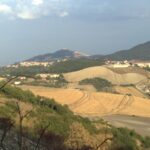
The production area covers five towns in the north-western Murgia, the high plateau inland of Puglia: Altamura, Gravina in Puglia, Poggiorsini, Spinazzola and Minervino Murge. The durum wheat has to be grown there, and the mills have to be there too.
The raw material is re-milled durum wheat semolina, milled twice so that it is finer. At least 80% must come from the varieties appulo, arcangelo, duilio and simeto, alone or together; the rest can be other varieties, as long as they are grown in the same area. The specification even describes the milling: metal rollers turning at about 300 revolutions a minute, at a temperature no higher than 40 °C. It also sets minimum values for the wheat and the semolina, which must be certified.
How it is made, step by step
- The mother dough. The natural starter is built up with at least three refreshments of water and semolina, and goes into the dough at 20% of the weight of the semolina.
- The dough. For every 100 kilos of semolina: 20 kilos of natural starter, 2 kilos of sea salt and about 60 litres of water at 18 °C. It is kneaded for 20 minutes in a plunging-arm mixer.
- The first rest. The dough is covered with a thick cotton cloth and rests for at least ninety minutes.
- Two rounds of shaping. It is weighed and shaped by hand, then rests for thirty minutes; it is shaped again and rests for at least fifteen more.
- Baking. The loaf is turned over and eased into the oven, which must reach 250 °C: wood-fired, or gas with indirect heating; if the oven is direct-fired, the wood must be oak. For the first fifteen minutes the oven mouth stays open, then it is closed for another forty-five.
- Out of the oven. The oven mouth is left open for at least five minutes to let the steam out and dry the crust; then the loaves are laid on wooden boards.
The loaf that reaches the table
- it weighs at least half a kilo;
- its crust is at least 3 millimetres thick;
- its crumb is straw yellow, with even holes throughout;
- it has a characteristic aroma;
- its moisture is no more than 33%.
Two shapes, with their dialect names. The specification allows two. The traditional one, tall and folded over on itself, is known locally as skuanète and has “kissing marks” on its sides, the spots where loaves touched each other in the oven. The low one, without those marks, is called a cappidd d’prèvte, “priest’s hat”.
How to recognise the certified loaf
PDO Pane di Altamura is sold with an identifying mark carrying the name. The specification describes the emblem: a shield topped by a crown, divided into four quarters, two red and two white, and in the middle of an oval the words “PANE DOP DI ALTAMURA” on three lines. DOP is simply the Italian for PDO.
The loaf may be wrapped in micro-perforated film with a label giving ingredients, producer, use-by date and logo; or sold unwrapped, with a sticker of biological material on the bread itself, showing the same details and the words “Pane di Altamura”. Behind it are registers of the wheat growers, the millers and the participating bakers, kept by the inspection body.
In short: no mark, no PDO. The loaf may still be excellent, but it is something else, and anyone tasting it to judge Pane di Altamura ought to know that.
Where this information comes from. Requirements, quantities, times, characteristics and the mark come from the production specification of the “Pane di Altamura” PDO, in the text sent by the Italian Ministry of Agriculture to the European Commission in 2004 and published in the EU register eAmbrosia. The September row was reported by the Italian outlets Virgilio InItalia (23/09/2026) and Telenorba (24/09/2026).