You can cook with sea water, but only with food-grade sea water: microfiltered, purified and sold in bottles. Water scooped from the shore or from a boat is a different story. Here is what it is used for in the kitchen, how to dilute it, which products already use it, from tomatoes in sea water to beers, and why in Puglia the frisella dipped in the sea is a tradition to tell rather than to copy.
Cooking with sea water is not a chef’s invention. Fishermen always used it to cook fish on board and to soften dry bread: it was salt ready to hand, and it saved fresh water. Today it is back in a new form: treated, packaged and sold as an ingredient.
How salty is sea water?
The Mediterranean is one of the saltiest seas: between 36 and 39 grams of salts per litre, and the Ionian Sea off Puglia sits at around 38. For pasta, the rule in Italian kitchens is about 10 grams of salt per litre. So sea water is three to four times saltier than the water in the pot, which is why it is never used neat.
What it is used for in the kitchen
- Cooking pasta, rice and vegetables: instead of salted water, always diluted. The Spanish chef Joaquín Baeza, in Alicante, cooks his rice this way with no added salt.
- Fish stocks: Ferran Adrià was among the first to use it in fine dining, precisely for fish stock.
- Shellfish and seafood: boiled in sea water, as fishermen did on board. It is also used to purge clams.
- Bread and pizza dough: sea water carries the salt into the dough, and some bakers use it for bread with no added salt. Among the pizza makers who use it is Guglielmo Vuolo.
- Brines and marinades, meat included.
- Seafood sauces and stews: acqua pazza, Italian fish poached in “crazy water”, is said to come from fish cooked at sea by sailors.
How to use it: always diluted
The rule is simple: follow the label, because each producer gives its own dilution. If there is none, the most quoted ratio is one part sea water to two parts fresh water, which brings the saltiness close to that of pasta water. Taste and adjust, as you would with salt.
Is it healthier than salt? Not really. Producers say that sodium chloride is about 86% of the salts in sea water, against 98% in sea salt, the rest being magnesium, calcium and potassium. But nutritionists point out that the sodium is still high: sea water is salt in another form, and it should be measured like salt.
The frisella dipped in the sea: a tradition to tell
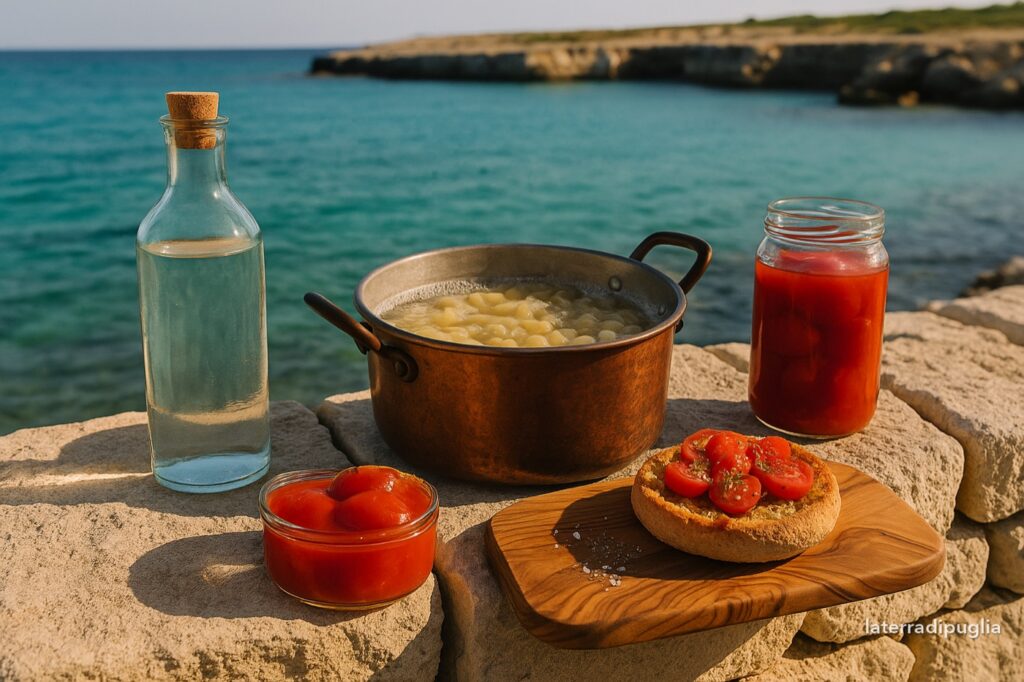
In Salento, the heel of Italy, anyone who has spent a summer on the beach has seen a frisella dipped in the sea and eaten on the sand with tomatoes and olive oil. The habit comes from fishermen, who stayed out for hours or days and softened their dry bread with the only water they had. The frisella, a bread baked twice, is meant to be soaked: you will find the classic topping in our seasoned frise, and its story in frisella, the summer bread.
Today, though, it is best avoided. Water near the shore or behind a boat can contain faecal bacteria such as E. coli and enterococci, viruses such as norovirus, hydrocarbons and bilge discharge. In August 2024 the Italian infectious disease specialist Matteo Bassetti called the social media trend of boiling pasta in water taken from the boat “nonsense”. Boiling does not solve it: it kills many microbes, but removes neither hydrocarbons nor salt.
For the beach flavour, soak your frisella at home in cool water with a pinch of salt, or in bottled food-grade sea water. The same idea, water, salt and bread, is behind cialledda, the peasant dish of Puglia also called acquasale, “salt water”: the inland version of the same gesture. And for more on Apulian bread, see bread, wheat and frise.
Tomatoes in sea water
Among the newest products in Italy are tomatoes preserved in sea water: peeled tomatoes, red datterini, small yellow tomatoes. The idea is simple: the covering liquid, usually salted water, becomes food-grade sea water. The tomato stays the same; what changes is the juice, which is more savoury and goes straight into the sauce.
To choose good peeled tomatoes, in sea water or not, the rules do not change: the variety, the firmness, few ingredients on the label. For home preserving, on the other hand, sea water is not used: stick to water and salt.
Beers brewed with sea water, Puglia included
- Margose by Birranova, a brewery in Triggianello, near Bari: a Gose, a lightly salty beer style, in a limited edition, at 4.6%, with the savoury note of sea water.
- Aquamaris by the Tarì brewery in Modica, Sicily, launched in 2019.
- Baladin beers for MSC Cruises: three beers brewed on board with desalinated sea water.
Frequently asked questions
Can I cook pasta in water taken from the sea?
No. Water taken from the shore or from a boat can contain bacteria, viruses and hydrocarbons, and boiling does not remove chemical pollutants. Use only food-grade sea water sold in bottles.
How much sea water goes in the pot?
The amount given on the label. If there is none, one part sea water to two parts fresh water, then taste.
Where can I buy sea water for cooking?
In delicatessens and online, in bottles, cartons or 5-litre packs. In Spain it has been common for years, and since 2026 it has also reached some Italian supermarkets.
Is boiled sea water safe to drink?
No. Boiling does not remove the salt: it concentrates it. To drink it, it has to be desalinated.
Can I dip a frisella in the sea?
It is a Salento tradition, but today it is not recommended, for the same reasons as pasta. Better to soak it at home in water with a pinch of salt.