Pasta di Gragnano is the most famous pasta in Italy. Apulian pasta is what families in Puglia have eaten every Sunday for centuries. This is not a contest: they are two different traditions, with different wheat, different shapes and different histories. Here is what really sets them apart, and why both are worth knowing.
Talk about artisan Italian pasta with anyone who knows the subject and the first name you will hear is almost always Gragnano. The PGI label, the town near Naples whose streets were redesigned in the nineteenth century so that the wind could blow through them and dry the pasta, the tradition of the pasta makers going back to the sixteenth century: Gragnano has a story and a reputation that no other place has built with the same consistency.
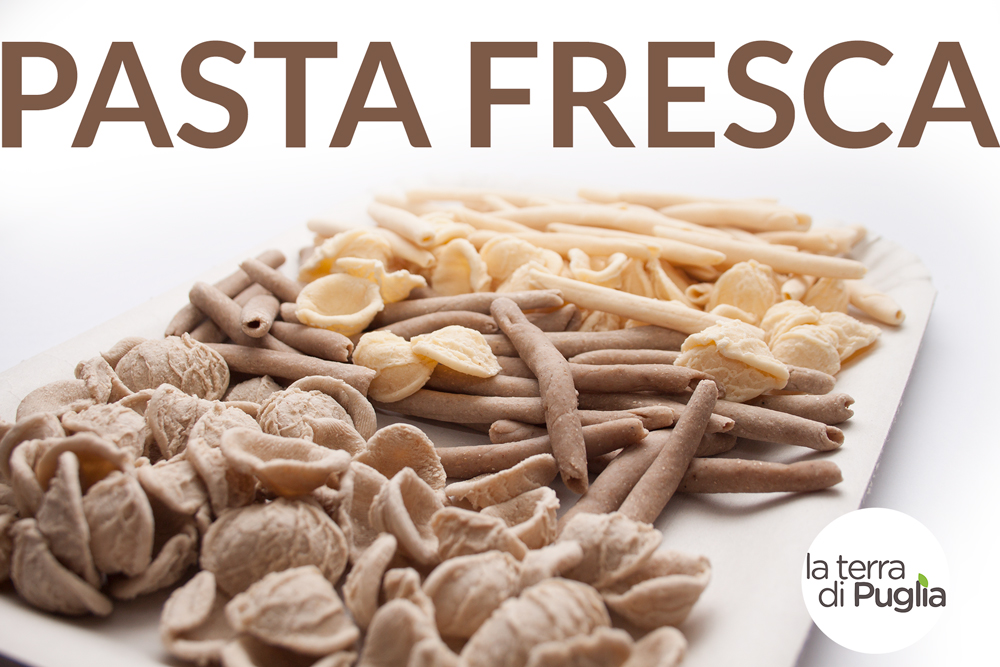
And yet Puglia, Italy’s leading producer of durum wheat, the hard wheat that dried pasta is made from, has a pasta tradition just as old and completely different in character. Orecchiette shaped by hand in the alleys of Bari Vecchia, troccoli from the Gargano, sagne ‘ncannulate from the Salento: these are pastas that have never chased a label and have no protection consortium, and many Apulian families still make them with the same hands as five generations ago.
In this article: the history and the secrets of PGI Pasta di Gragnano, the Apulian pasta tradition and its shapes, the technical differences between the two, and why it makes no sense to choose one and give up the other.
Pasta di Gragnano: a town built around pasta
Gragnano is a small town in the province of Naples, at the foot of the Lattari mountains and a few kilometres from the sea. Its climate is unusual: the wind comes down from the mountain and meets the damp sea air, creating ideal conditions for drying pasta slowly in the open. Production dates back to the end of the sixteenth century, when the first family-run pasta workshops appeared. In 1845 Ferdinand II of Bourbon granted the Gragnano pasta makers the privilege of supplying pasta to the royal court, the act that officially made Gragnano the City of Pasta.
The remarkable part is that pasta mattered so much to the town that it shaped the town itself. In the middle of the nineteenth century, when a new urban plan was drawn up, the width of the streets and the height of the buildings were planned so that the wind could flow freely and help the pasta dry. A town literally redesigned to make better pasta.
Since October 2013 the name “Pasta di Gragnano” has been a Protected Geographical Indication (PGI) under European law. To carry the label, the pasta must be produced only within the municipality of Gragnano, from durum wheat semolina and water from the local aquifer, extruded through bronze dies and packed within 24 hours of production.
What makes Gragnano pasta special
Three technical points define the quality of Gragnano pasta, and you will find them in any serious artisan pasta, not just the pasta of Campania.
Bronze dies. Pasta dough is pushed through a die to give it its shape. Bronze dies grip the dough as it passes, leaving tiny rough patches on the surface: once cooked, the pasta catches and holds the sauce, and offers more surface to the palate. Pasta pushed through Teflon dies, the industrial kind, comes out smooth and even, and the sauce slides off. Bronze-cut pasta feels rough and uneven to the touch, and the sauce stays on it.
Slow drying. The pasta is dried gradually at a temperature between 40 and 85°C, for anything from 4 to 60 hours depending on the shape. Fast drying at high temperatures, as in industrial pasta factories, gelatinises the starches differently and gives a pasta that holds up less well in the pot and tastes flatter.
Local water. The PGI rules require water from the Gragnano aquifer. It is not a folklore detail: the mineral content of the water affects the dough, the elasticity of the pasta and the final flavour.
- 16th century: the first records of pasta workshops in Gragnano, more than 500 years of history
- 2013: the year the PGI was recognised at European level
- 60 hours: the longest drying, for the largest shapes, against the 2 to 4 hours of industrial pasta
- 24 hours: the maximum gap between production and packing
Apulian pasta: a tradition without a label
Puglia is Italy’s main producer of durum wheat. That is not a minor detail: it means that the raw material of Apulian pasta is often grown a few kilometres from the pasta maker, with local varieties whose aromas differ from the standardised wheat of the global market.
Apulian pasta has no collective PGI label. It has something different and harder to certify: a tradition handed down within the family, shape by shape, village by village. The orecchiette of Bari Vecchia, made by women sitting outside their front doors in the old town, are not produced in a factory following written rules: they are made with a gesture learnt in childhood, a press of the thumb on a marble board that no machine has yet copied with the same result.
- Orecchiette: the iconic shape of Puglia, whose name means “little ears”. A disc of pasta with a thicker rim and a centre pulled thin into a small hollow. They are eaten with cime di rapa (turnip tops, a bitter green close to broccoli rabe), with cherry tomatoes or with ragù, the slow-cooked meat sauce. The dried artisan version is different from the fresh one: harder, with more bite.
- Troccoli: square-edged spaghetti from the Capitanata and the Gargano, made with the troccolaturo, a grooved rolling pin that cuts the sheet of dough. Traditionally served with meat ragù or tomato sauce.
- Sagne ‘ncannulate: long, wide strips of flat pasta twisted around themselves, typical of the Salento. The most striking shape of the Apulian tradition, they stand up to rich sauces: ragù, pulses, concentrated tomato sauce.
- Cavatelli: found all over the south, but with a specifically Apulian version, smaller and pressed differently. Served with turnip tops, with rocket or with cardoncello mushrooms.
- Minchiareddhi and laganelle: shapes little known outside the region, typical of specific areas, and made almost only by artisans or at home.
The differences you can taste
Beyond history and geography, the differences between Gragnano pasta and Apulian artisan pasta are very real once you sit down to eat.
The wheat. PGI Pasta di Gragnano uses durum wheat semolina with no rule on where the wheat comes from: it may be from Puglia and Basilicata, as some careful producers state, but the rules do not require it. Apulian artisan pasta almost always uses durum wheat grown locally, from native varieties with a different protein and aromatic profile from commercial wheat. The flavour is more intense, less neutral.
The shapes. Gragnano excels at the long and short shapes of the Neapolitan tradition: spaghetti, paccheri, rigatoni, fusilli, tortiglioni. Puglia has shapes that exist nowhere else: the orecchietta, the troccolo, the sagna ‘ncannulata. There is no overlap: they are two families of shapes with different logics.
The texture. Gragnano pasta aims for an even roughness on the surface and a precise al dente bite. Hand-made Apulian pasta has an irregular texture, with uneven thickness and rough edges, an “imperfection” that becomes a quality, because each part of the shape cooks slightly differently and gives several textures in the same mouthful.
So which one wins?
The question is badly put, and we will say so straight away. This is not a choice between a pasta from Campania and one from Puglia as if they were rivals. They are different traditions answering different needs.
If you want paccheri with Neapolitan ragù, rigatoni all’amatriciana or spaghetti with clams, the long and short shapes of the Campanian tradition, PGI Gragnano pasta from a serious producer is probably the best choice you can make. Bronze-cut roughness, slow drying and the history behind it: it is the right combination for those dishes.
If you want orecchiette with turnip tops, troccoli with wild boar sauce or sagne ‘ncannulate with borlotti beans, Apulian artisan pasta has no substitute. Not because it is “better” in absolute terms, but because those shapes do not exist in the Gragnano tradition, and the particular texture of a hand-made Apulian orecchietta is something else from any copy produced elsewhere. If you want to try, here is how to make orecchiette at home.
Italian cooking is big enough for both. And if you are at the table with someone who insists that Gragnano pasta is objectively better than everything else, let them taste a plate of orecchiette made by hand by a lady in Bari Vecchia, with turnip tops and new-season extra virgin olive oil. Then we can talk again.
Would you like Apulian artisan pasta at home? Orecchiette, troccoli, sagne and other traditional shapes, shipped straight from Puglia. Discover Apulian pasta in our shop.
Pasta di Gragnano obtained PGI status with Commission Regulation (EU) No 969/2013, published in the Official Journal of the European Union on 11 October 2013. The Consorzio Gragnano Città della Pasta formally became the protection consortium in 2019.
You must be logged in to post a comment Login