The trulli of Alberobello are the most iconic buildings in Puglia, and probably in the whole of Italy. But what exactly are they, how are they built, why do they exist and where can you see them? This page covers what you need to know about the Apulian trulli, including the legend of the tax dodge, and the similar country huts of other parts of Puglia: furneddhi, pajare and caseddhi.
What trulli are
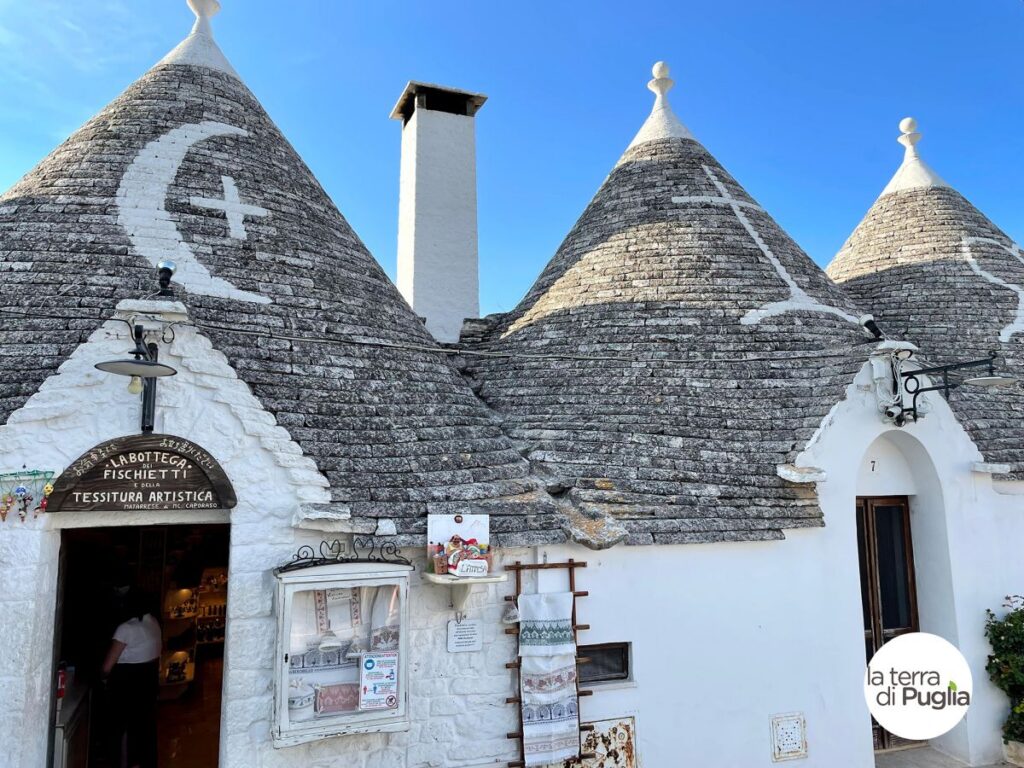
The word trullo comes from a Greek word meaning dome. Trulli are country buildings, probably of very ancient origin, made of dry stone, that is stone laid without mortar, with a circular plan and a conical roof.
The first trulli are thought to date back to the Bronze Age, but the ones still standing in Puglia today are all fairly recent: they bear witness to the habit of pulling the structure down and rebuilding it whenever it was damaged. Among the oldest are some from the Renaissance, in the Murge area. The best known and most visited are the trulli of Alberobello, which UNESCO has declared a World Heritage Site.
How a trullo is built
Architecturally, a trullo is made of a central circular module, around which further circular modules can be added: in that case the trullo takes on its typical many-peaked look.
The rough stone blocks used to build trulli are called chianche or chiancarelle in Puglia. They give the building its characteristic appearance and also keep it reasonably watertight. The walls are particularly thick, so a trullo that looks big from the outside turns out smaller inside than you would expect.
Details worth noticing on a visit: there are almost no openings apart from the front door, and a small window near the top lets the air change. Thanks to this, inside a trullo you do not suffer from the heat in summer or the cold in winter: passive climate control, long before the term existed.
The roof is a self-supporting cone, made of inner stones (chianche) and covered on the outside with thin slabs laid in concentric circles (chiancarelle). At the very top, the keystone is often finished with carved motifs of a protective, esoteric or spiritual kind: the decorative pinnacles that give each trullo its own identity.
Where to see trulli in Puglia
Trulli are not found all over the region. The area that matters is the Murge, the limestone plateau where these buildings have probably stood since ancient times. More precisely, you will see them in the Valle d’Itria and above all in Alberobello (province of Bari), whose old town is a UNESCO site. Other places: Putignano, Locorotondo, Martina Franca, Ostuni, Fasano, Cisternino and Ceglie Messapica (province of Brindisi).
What a trullo was for
The trullo was the home of the cozzaro, the peasant who worked land belonging to a landowner. Here he kept his tools and, when needed, slept with his whole family. The alcoves inside became small rooms separated by curtains, with straw beds. A few wooden beams, from which tools and crockery were hung, completed the furnishings, more for practical use than for the structure.
With the exception of the Trullo Sovrano in Alberobello, the only one with two floors, all trulli are built on a single level.
The legend of the tax dodge
Legend has it that the trulli helped peasants avoid paying taxes. The system was simple: when they saw the landowner coming to collect, they quickly pulled out one stone from the roof to bring it down and give the impression that the place was abandoned. Once he had gone, they only had to rebuild the roof. The peasants warned each other with smoke signals sent up through the hole at the top of the roof. It is a story that is hard to verify historically, but it fits perfectly with dry-stone building, and with the Apulian character.
The symbol on the pinnacle. The motifs carved on the keystone are not purely decorative: they are Christian religious symbols, astrological figures or protective signs handed down by word of mouth. Nobody has ever catalogued them all, and every trullo has its own. What they mean is explained in our piece on the symbols on the trulli.
For a visit to the town itself, its districts of trulli and the chance to sleep in one, see our article on Alberobello and the trulli.
Furneddhi, pajare and caseddhi: the other country huts of Puglia
In other parts of Puglia, both in the north of the province of Bari and in the Salento, there are country buildings similar to trulli, made of stone and used by shepherds and farmers to store tools, shelter from bad weather or rest. In the Salento they are called furneddhi.
Around Torricella, Lizzano and Sava you find the pajare (also called caseddhi, pagghiari or furni). They were built with the limestone cleared from the fields when the land was reclaimed for farming, and they are shaped like a truncated cone. Over the years they grew into small two-storey buildings with a hearth, used for drying tomatoes, peppers and figs. How well they were built depended on the stone at hand: flat slabs, rounded stones, blocks that were more or less easy to work. Each area has its own version.
Looking for a real souvenir of Puglia? Trulli, pumi and other good-luck charms in handmade ceramics, made in Puglia: you will find them among our gift ideas. More traditions of the region are collected on our Traditions page.