
The inland villages of Puglia are the region’s new frontier, and the 2025 figures prove it: overnight stays up by 38.9% in Lucera, 27.9% in Putignano, 21.1% in Conversano, while the coast is full. Where to go in the Murge, the Valle d’Itria, the inland Gargano and the Salento away from the sea, why now rather than in three years, when to go and what to bring home.
There is a Puglia that the August crowds never see. It is not by the sea, or at least not only. It is inland, in the villages of the interior: the white towns of the Murge, the stone streets of the Gargano, old lanes from the Middle Ages that no guidebook has yet worn out. And in 2026 this Puglia officially became the region’s priority. Not as a fashion, but out of necessity, and because the numbers say so.
Let us say it plainly: seaside Puglia is at its limit. Polignano a Mare in August is a beautiful postcard from the outside and a logistical nightmare from the inside. Alberobello has more selfie sticks than real trulli. Otranto in July is one long queue from the harbour to the cathedral.
This is not a criticism, it is a fact. And the Region of Puglia knows it very well: at the BIT 2026 in Milan, Italy’s big international tourism fair, the regional president Antonio Decaro put it clearly: “Today two tourist Puglias live side by side. One is saturated, the other still unexplored. That is where the vision for the coming years opens up.”
That unexplored Puglia has a precise name: the interior. The inland villages. And the 2025 figures confirm that the change is already under way: it is not about to arrive, it has arrived.
In this article: the real figures on the growth of tourism in the inland villages, the places that are taking off (and those still under the radar), why it pays to go now rather than in three years, and what to bring home from each area.
The numbers: inland Puglia is growing faster than the coast
In 2025 Puglia recorded 6.7 million arrivals and 22.7 million overnight stays, the highest figures ever recorded. But the figure that changes everything is not the total: it is where those visitors went.
Never before has it been so clear: growth is not concentrated only on Bari and Lecce. Foggia, Taranto, Brindisi, the province of Barletta-Andria-Trani and the inland towns are all growing fast. The figures from the Observatory of Pugliapromozione, the regional tourism agency, are plain:
- +38.9% overnight stays in Lucera in 2025
- +27.9% overnight stays in Putignano in 2025
- +21.1% overnight stays in Conversano in 2025
- +18.1% overnight stays in Martina Franca in 2025
And more: San Ferdinando di Puglia +89.1%, Castelnuovo della Daunia +79.1%. These are percentages the big coastal resorts have not seen for years. The Apulian interior is growing at a pace the coast can no longer afford.
This is not just a tourist trend: it is a structural redistribution of visitors, backed by a regional strategy with 156 million euros of investment already being spent on infrastructure, walking routes, the restoration of villages and better access. Whoever arrives now finds places still intact. Whoever waits three years will find the next Alberobello.
Why the inland villages now, and not in three years
There is a window that opens and then closes. It happens with every destination on the rise: first it is authentic, then it is “discovered”, then everyone discovers it and it loses half of what made it special.
The inland villages of Puglia are in that first phase. The numbers are growing, but the places are not yet saturated. The restaurant owner still wants to tell you where the flour for the bread comes from. The masseria, the fortified farmhouse of the Apulian countryside, opens its doors because it wants to, not because it has six tours a day to run. The old lane does not yet have a queue for the photo.
“Unexpected Puglia” is the Region’s official priority for 2026 to 2030. The regional tourism councillor, Starace, said so explicitly at the BIT 2026: “The inland areas are at the centre of our story for 2026. Making these places reachable and accessible, turning walking routes, villages and community cooperatives into stories that are recognisable and competitive all year round.”
In other words: they are investing to bring these places within easier reach and to put them on the map. The moment to go is now, while their character is still intact and prices have not yet followed popularity.
The Murge: stone, silence and canyons
The Murge are the geological heart of Puglia, a limestone plateau that looks like nothing else in the region. No sea, no trulli, no ancient olive groves. Just stone, open sky, ravines and villages that seem suspended outside of history.
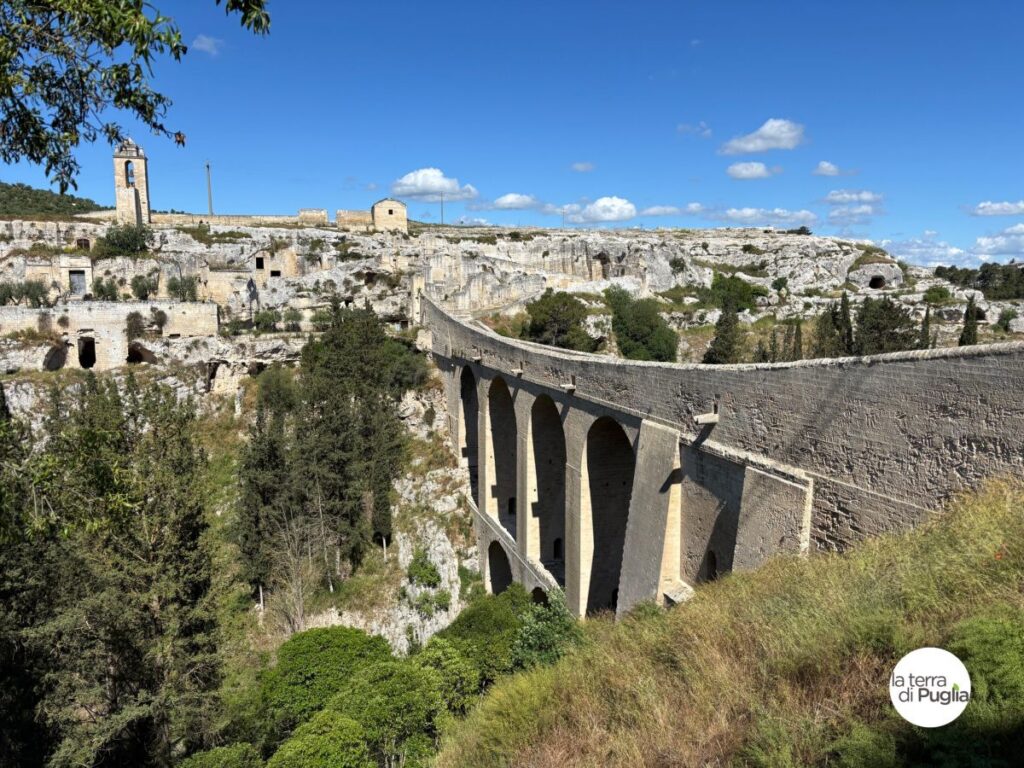
- Gravina in Puglia has a canyon. A real one, with an aqueduct bridge spanning it and a town that has grown around it for thousands of years. It is probably the most underrated place in all of Puglia, and that is not just an opinion: it is what everyone says after a first visit, unable to understand how they had never heard of it.
- Altamura: the most famous PDO bread in Italy, a Norman cathedral that takes your breath away, and an old town that works like a real town, not a film set. Add the Man of Altamura, the prehistoric skeleton found in a limestone cave, and you have a place worth the journey on its own.
- Castel del Monte: the octagonal castle of Frederick II, a UNESCO World Heritage Site, on a hill that dominates the whole Murgia. It is not “just a castle”: it is one of the most mysterious buildings of the Middle Ages in Europe. The visit takes half an hour; the landscape around it stays with you for ever.
- Spinazzola and Minervino Murge: two villages of the high Murgia, still almost entirely off the radar of organised tourism. Masserie, olive oil, silence. The kind of place where you stop for lunch and get up three hours later.
The Valle d’Itria without the crowds: villages that work all year
Alberobello is on the UNESCO list and in August it is almost unmanageable. But the Valle d’Itria is not just Alberobello, and that is exactly what hurried visitors miss.
Locorotondo, Cisternino, Martina Franca, Ostuni, Fasano: each of these villages is a destination in its own right, with a distinct personality, its own cooking and a social fabric that resists mass tourism because it is big enough and lively enough not to be swept away.
- Locorotondo: the round white houses, the balconies full of flowers, an old town that in spring looks like a film set. The local DOC white wine, fresh and crisp, is one of the best in Puglia and still costs very little bought straight from the winery.
- Cisternino: its butchers, who grill bombette (little rolls of pork stuffed with cheese) to order, have become famous, but the village itself has stayed authentic. Narrow lanes, little improvised squares, old men playing cards while you eat outside. It is not folklore: it is real life.
- Martina Franca: Apulian Baroque at its best, without the crowds of Lecce. The Palazzo Ducale, the Collegiata di San Martino, the noble palaces of the centre. And the Festival della Valle d’Itria, which every summer brings opera of international standard to one of the loveliest settings in Italy.
- Conversano: +21.1% overnight stays in 2025. A Norman castle, a compact old town, a handy position between Bari and the Valle d’Itria. Still little known, still easy to manage. Still authentic.
The Gargano and the Daunia away from the sea
For most visitors the Gargano, the promontory that forms the spur of Italy’s boot, means beaches: Vieste, Peschici, the Tremiti Islands. True, but that is half the story. The inland Gargano is another world: thick forest, villages perched on rock, and a spirituality that goes back to the Lombards and has nothing to do with beach tourism.
- Monte Sant’Angelo: a UNESCO World Heritage Site and one of the oldest shrines in Europe, the Cave of the Archangel Michael, a place of pilgrimage for 1,500 years. The old town clings to the rock, the streets are narrow and paved, the air smells of resin and history. It is not a place “to see”: it is a place to feel.
- San Giovanni Rotondo: +14.9% overnight stays in 2025, and 63,347 more arrivals. The shrine of Padre Pio draws huge numbers of visitors, but the old village, separate from the modern religious complex, has stayed almost intact. Few people really explore it.
- Lucera: +38.9% overnight stays in 2025, one of the strongest rises in the whole of Puglia. A Roman amphitheatre, a Swabian castle, a Gothic cathedral: the history of the Mediterranean packed into a town of 30,000 people that hardly anyone outside Puglia can name.
- Bovino and Castelnuovo della Daunia: two villages of the Daunia, the most inland and least visited corner of Puglia. Castelnuovo was up 79.1% in 2025, a number that says everything about how low it started and how quickly things are changing.
The Salento away from the sea
The Salento, the heel of the boot, automatically suggests crystal-clear sea, coves and summer. But there is an inland Salento that works all year round and has something the coast cannot offer: silence, the honey-coloured pietra leccese stone, open country and a strong identity. These too are inland villages in every sense, less known and more authentic.
- Galatina: the basilica of Santa Caterina d’Alessandria, its walls entirely covered in frescoes, is known as “the Sistine Chapel of the Salento”. One of the most extraordinary churches of the Middle Ages in southern Italy, and practically unknown outside Puglia.
- Nardò: Piazza Salandra is one of the most beautiful Baroque squares in Puglia, with a cathedral overlooking an almost perfect urban space. Nardò is a few kilometres from the sea but has a life of its own: markets, crafts, real local cooking.
- Corigliano d’Otranto: in the heart of the Grecìa Salentina, the area where people still speak griko, a dialect of Greek origin that has survived for two thousand years. An Aragonese castle, old lanes, a culture you will find nowhere else in Italy.
- Specchia and Presicce-Acquarica: two villages of the lower Salento that look like travel posters but do not yet have the prices to match. Specchia above all, with its tower, its square and its houses of pietra leccese, is the kind of place you see and then wonder why you had never heard of it.
What to bring home: the produce of the interior
The inland villages do not only produce scenery. They produce food, olive oil, wine and crafts: the real things, not the ones packaged for coastal tourism.
- Extra virgin olive oil from the Murge. Coratina olives: intensely fruity, with a marked bitterness and a peppery kick. The oil of the millers, not of the souvenir shops.
- Pane di Altamura DOP. Twice-milled durum wheat semolina, sourdough starter, a wood-fired oven. It keeps for a week and is a meal in itself with a drizzle of oil.
- Primitivo di Manduria and Negroamaro. The red wines of the Ionian hinterland. Full-bodied, intense, with a personality you do not forget. Bought at the winery they cost a third.
- Lampascioni in oil. The wild bulbs of the Murge, a kind of tassel hyacinth. Bitter and intense: those who love them seek them out for years after the first taste.
- Artisan pasta (orecchiette, troccoli). Made from local durum wheat and drawn through bronze dies. Nothing like the supermarket kind.
- Preserves in oil. Aubergines, artichokes, cardoncello mushrooms, crunchy dried peperoni cruschi. The most direct way to bring the interior to your table.
When to go: the right season for the interior
Inland Puglia is a destination for the whole year, at its most beautiful in spring and autumn in a way the coast cannot match.
- March to May: green countryside, perfect temperatures for walking between villages, no crowds. The morning markets are busy, the spring sagre, the village food festivals, liven up the towns, and local producers still have the patience to stop and talk.
- June and July: the days are long and the heat inland is drier and easier to bear than on the coast. Festivals, summer sagre, old towns open late into the evening.
- September to November: the grape harvest, the olive harvest, cardoncello mushrooms, the markets of the new oil. The interior in autumn is pure gastronomy, and the colours of the Murge and the Gargano turn into something completely different.
- December: in 2025 overnight stays in Puglia in December passed 500,000, a figure unthinkable ten years ago. The inland villages with their Christmas markets and living nativity scenes are one of the loveliest experiences this region has to offer.
The inland villages of Puglia: why go now
- Double-digit growth: Lucera +38.9%, Conversano +21.1%, Martina Franca +18.1%. The interior is moving faster than the coast.
- Still authentic: the inland villages have not yet been turned into theme parks. The right moment is now.
- Affordable prices: places to stay, restaurants and local produce still cost what they cost, not what mass tourism decides.
- All year round: they do not depend on the beach season, and they work in spring, in autumn and in December.
- A regional strategy for 2026 to 2030: 156 million euros invested in the interior, walking routes and villages. In a few years it will all be more visible, and more crowded.
- Real produce: Coratina oil, Pane di Altamura DOP, Primitivo from the winery. The interior produces the things that really matter.
Seaside Puglia will always be magnificent. But the Puglia that stays with you, the one that really changes something in the people who go there, is the one inland. The one that is not on the postcards, that has no QR code at the entrance, that pours you a glass of wine you did not order.
That Puglia still exists. For how much longer, nobody knows.
And if you want to go and live in an inland village, not just spend a weekend there, you will find the figures and the towns selling houses for one euro in our guide to buying a house in Puglia in 2026.
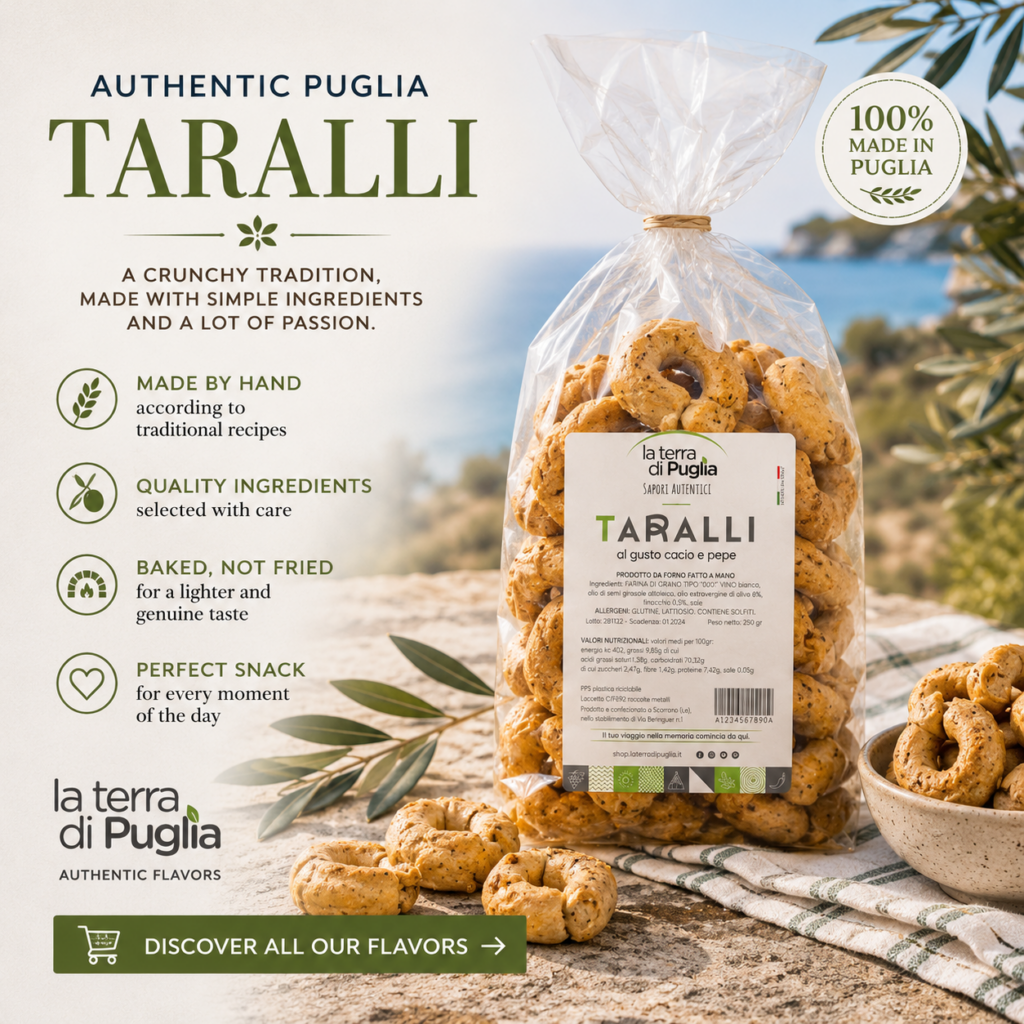
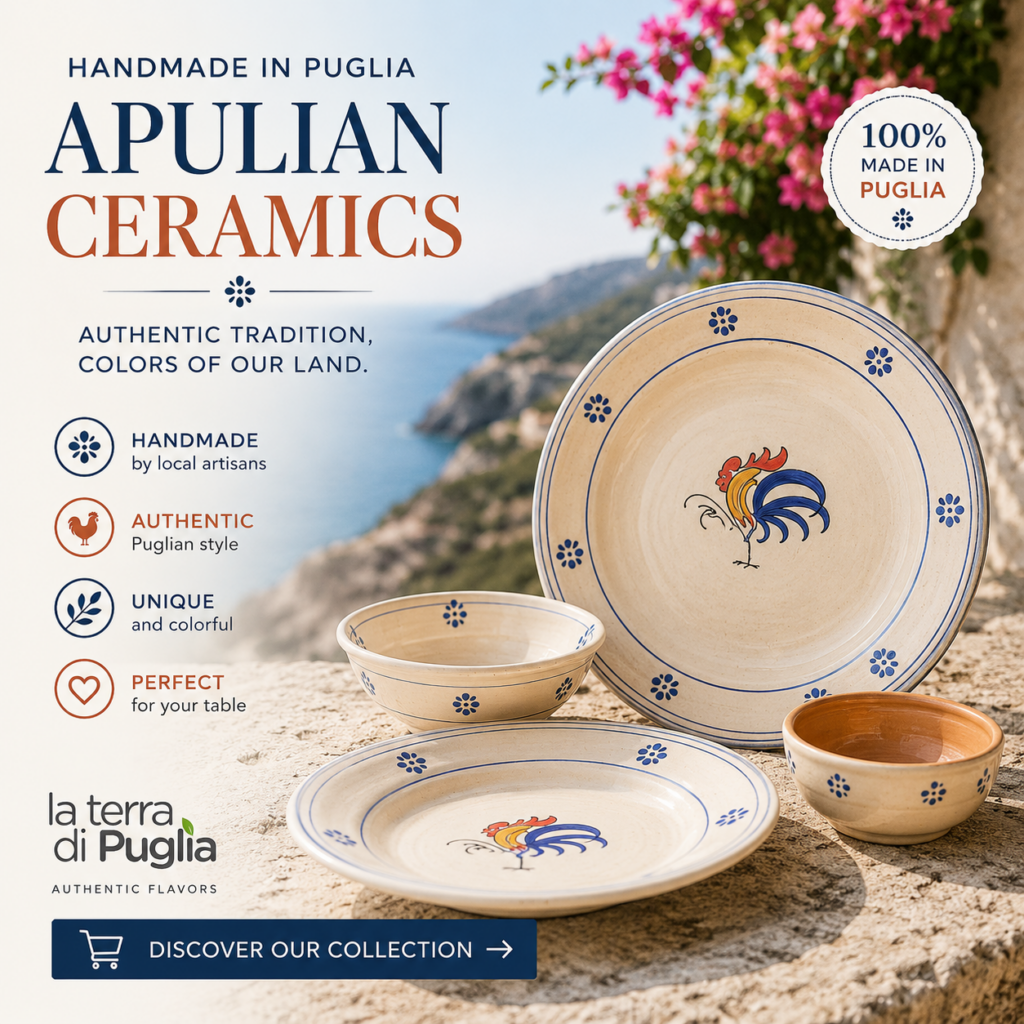
Can’t go just yet? Bring the flavours of the interior home. Extra virgin olive oil, artisan pasta, lampascioni, preserves: shipped straight from Puglia. Visit the shop.

You must be logged in to post a comment Login