
In Puglia, pulses are harvested in summer and eaten in winter: dried in the sun, they keep in the larder all year and go back into the pot when the weather turns cold. Broad beans, chickpeas and grass peas are the base of the autumn soups, and three of them have a story worth knowing: the Carpino broad bean and the black chickpea of the Murgia, both Slow Food Presidia, and the grass pea, an ancient pulse protected by the region. Here is what they are, where they come from, and our recipes for cooking them.
In Puglia’s peasant kitchen, the calendar of pulses is simple: you sow, you harvest when the plants turn yellow, you let them dry, and then you store them. What was fieldwork in summer becomes, in October, a pot on the stove. Pulse soups are not a “light” dish from a modern cookbook: for generations, they were how families got through to spring.
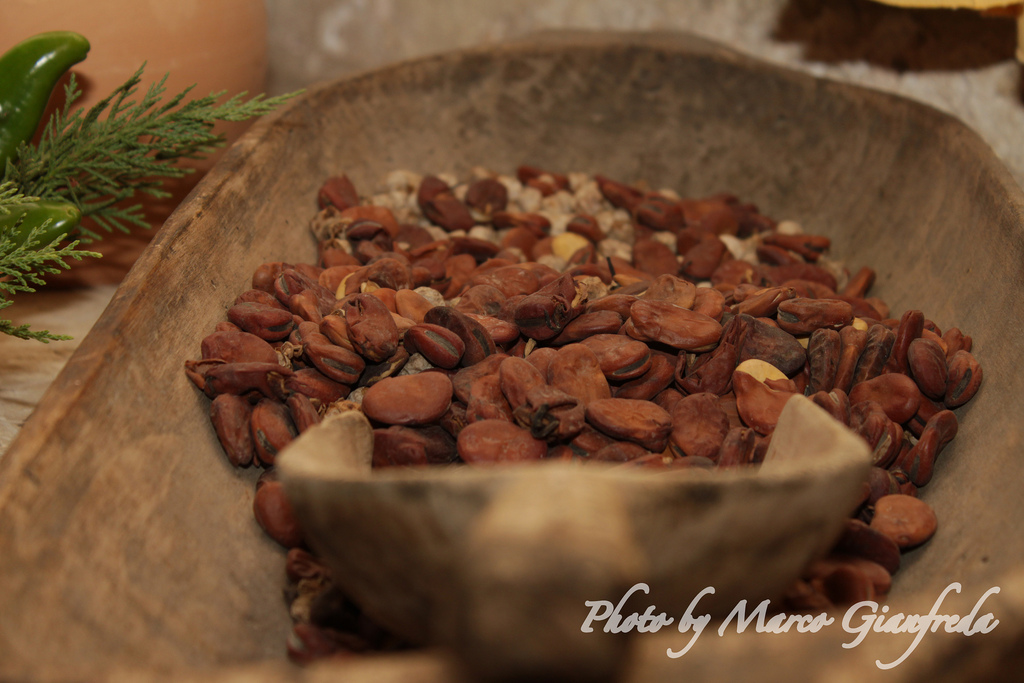
Dried broad beans in a wooden bowl: the base of broad bean soup and of the purée with chicory.
Broad beans: from Carpino to the October pot
The dried broad bean (fava bean) is Puglia’s pulse above all others, and October is its month twice over: you eat the ones harvested in summer and sow next year’s. In Carpino, on the Gargano, the broad bean is a Slow Food Presidium — a label that protects traditional foods at risk of disappearing — backed by the Gargano National Park. According to the Slow Food Foundation, it is sown in October and November, with no fertilisers or sprays; between June and July the yellowed plants are cut by hand, tied into sheaves called manocchi and left to dry in the field. Then they are threshed on the arij, a patch of wetted, pressed earth, with horses walking in circles over them, and the beans are separated from the straw by tossing them into the afternoon breeze.
In the kitchen, dried broad beans make two dishes every Apulian family knows: broad bean soup, and broad bean purée with chicory, bitter greens and all — probably the most Apulian dish there is. They also go into pasta with white broad beans.
Chickpeas, and the black one from the Murgia
The chickpea is the other household pulse, and the dish that brings it to the table comes from the Salento: ciceri e tria, chickpeas and tria, a thick durum wheat tagliatella, part boiled and part fried. It is a recognised traditional product of the province of Lecce, and the dish of Saint Joseph’s Day, 19 March.
Then there is a chickpea unlike any other: the black chickpea of the karst Murgia, another Slow Food Presidium, grown in Acquaviva delle Fonti, Cassano delle Murge and Santeramo in Colle. It is small and wrinkled, with a hooked tip, and its skin is so tough that it needs twelve hours of soaking and about two hours of cooking. It is harvested in August and, dried, can be found all year. Locally it goes into a soup with plenty of sautéed onion, or with tagliolini, tomato and a drizzle of oil.
Did you know? According to the Presidium’s profile, the black chickpea is very rich in iron, which is why on the Murgia it used to be recommended to pregnant women. It also has a natural savouriness that lets you dress it with just extra virgin olive oil, no salt.
The grass pea, the pulse that survives
The grass pea (cicerchia in Italian) looks like a chickpea but is hardier: it grows in poor soil, withstands drought and cold, and has angular seeds, off-white, grey or cream. In Puglia it has been a traditional food product since 2006, with its home area in the Murgia around Bari, and one variety, the cicerchia screziata della Murgia, is on the regional register of varieties at risk of extinction.
It is nothing new. In the 1929 agricultural land survey, the grass pea was a main crop in Andria, Putignano and Spinazzola, where the regional atlas of traditional products lists a “Feast of the Saints: feast of chickpeas and grass peas”. Grass peas need a long soak before cooking: that is the first thing to know if you buy them dried.
And the chestnut, which is not a pulse
Dried chestnuts often ended up in the same autumn pot. They are not a pulse, but the logic is the same: a crop of late summer and autumn put by for the winter and cooked into a soup.
From the larder. If you cannot find grass peas near you, our shop has dried Apulian grass peas and, for a soup ready to soak, the mixed pulse soup from Zollino, with six Apulian pulses.
You must be logged in to post a comment Login