A five-day itinerary through the heart of Puglia, between trulli and Romanesque cathedrals: Bari and Trani, the Castellana Caves, the trulli of Alberobello, the white towns of the Valle d’Itria, the riddle of Castel del Monte, then Ostuni and Polignano a Mare. The Puglia of stone, light and impossible architecture.
This itinerary crosses the heart of Puglia from Bari southwards, runs through the Valle d’Itria and comes back up along the Adriatic coast. Five days to see the most extraordinary buildings in the region: the Norman Romanesque of Bari and Trani, the UNESCO-listed trulli of Alberobello, the whitewashed towns of the Valle d’Itria and the geometric mystery of Castel del Monte.
Day 1: Bari and Apulian Romanesque
The tour starts in Bari. The morning is for Bari Vecchia, the old town. The Basilica of San Nicola is the obvious place to begin: one of the most important Romanesque churches in southern Italy, begun in 1087 to house the relics of Saint Nicholas brought from Myra. Next to it, the Cathedral of San Sabino is Apulian Romanesque in its purest form, with no later additions to alter its original Norman structure. The Swabian castle of Frederick II, the harbour and the lanes of the old town complete the morning.
Apulian Romanesque is an architectural phenomenon of its own: between the eleventh and thirteenth centuries the region built a series of cathedrals (Bari, Trani, Bitonto, Barletta, Altamura) of rare quality and in rare numbers. They were born where Norman culture, Arab influence and the Benedictine tradition met. Seeing them still standing, in their original form, is one of the rarest experiences Italy has to offer.
Day 2: The Castellana Caves and the trulli of Alberobello
The second day heads down onto the Murgia, the limestone plateau in the middle of Puglia. The Castellana Caves open up 3 kilometres of karst galleries, with stalactites and stalagmites up to ten metres tall. The long tour, about two hours, includes the Grotta Bianca, the White Cave, known for the purity of its calcite crystals.
In the afternoon, Alberobello. The trulli are limestone buildings with conical roofs, built dry without mortar: an age-old technique that, according to tradition, allowed them to be taken down and rebuilt quickly to escape taxes. The districts of Aia Piccola and Monti hold more than 1,400 trulli that are still lived in, listed as a UNESCO World Heritage Site in 1996. Dinner in one of the restaurants set inside a trullo is an experience no other place in the world can offer.
Day 3: The Valle d’Itria: Locorotondo, Cisternino, Martina Franca
For anyone who loves small towns, this is the best day of the tour. The Valle d’Itria is a karst upland dotted with trulli, masserie (large fortified farmsteads) and white towns built on limestone hills. The morning is in Locorotondo: its old centre is circular, hence the name (“round place”), whitewashed, with flowered balconies and paved streets that look like a film set. The white DOC wine that shares its name has been made here for centuries.
Cisternino, a few kilometres away, is the least touristy and most genuine town in the valley: its butcher’s shops, with a counter facing the street, cook bombette (little rolls of stuffed meat) to order until late in the evening. In the afternoon, Martina Franca, the Baroque town of the Valle d’Itria, with its seventeenth-century Palazzo Ducale and the collegiate church of San Martino: one of the best preserved Baroque old towns in southern Italy. In July it hosts the Festival della Valle d’Itria, a major opera festival.
Day 4: Castel del Monte, Trani and Barletta
The fourth day heads north and takes in the three symbols of “Imperial Puglia”, the Puglia of Frederick II. Castel del Monte (UNESCO, 1996) is the emperor’s most enigmatic building: a perfect octagonal plan, eight octagonal towers, eight rooms on each floor, a geometry nobody has yet fully explained. Astronomy, the symbolism of numbers, a statement of imperial power: there are dozens of readings, and none rules out the others.
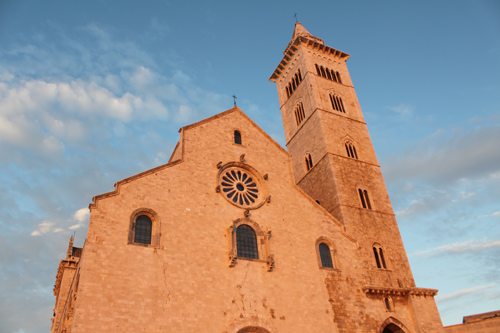
In Trani, lunch is down by the harbour and the visit is to the Romanesque cathedral, built in the twelfth century right on the edge of the Adriatic: the light that falls through its rose windows onto the white naves is one of the most intense moments of the whole itinerary. Barletta closes the day with the Colossus, the five-metre bronze statue of a Roman emperor that is the symbol of the town, the Swabian, Angevin and Aragonese castle, and the Cantina della Disfida.
Day 5: Monopoli, Ostuni and Polignano a Mare
The last day follows the Adriatic coast south. In Monopoli, a visit to an old olive mill: between October and December the olives are crushed before your eyes, with the new oil, still cloudy and peppery, flowing from the stone. In the other months the mill shows the process with its historic millstones still in place.
Ostuni, the White City, can be seen from dozens of kilometres away: a burst of whitewash on a hill 200 metres above the sea, crowned by its fifteenth-century Gothic cathedral. The old town is a maze of narrow lanes that follows its original street plan. Before heading back to Bari, a stop in Polignano a Mare (the cliffs above the Adriatic, the viewpoint with the statue of the singer Domenico Modugno, the old town built on the rock) ends the itinerary on the most photographed view in Puglia.
Practical information
- Length: 5 days and 4 nights. It can be cut to 3 days by focusing on the Valle d’Itria (days 2, 3 and 5).
- Where to stay: Bari or the area around Alberobello and the Valle d’Itria; Brindisi if you are coming from the Salento.
- Car: essential for the towns of the Valle d’Itria and for Castel del Monte; Bari, Trani and Polignano can be reached by train.
- When to go: April to June and September to October; Alberobello is very crowded in August.
- Not to be missed: dinner in a trullo in Alberobello, the bombette of Cisternino, the new olive oil in Monopoli (October to December).
More ideas for longer trips on our page of multi-day itineraries in Puglia.