In short. Trani has the most striking cathedral in Puglia — Romanesque, built on the rock at the edge of the water, with nothing between it and the sea. It also has a Swabian castle on the shore, a working harbour ringed with restaurants, and, in the old Jewish quarter, the Scolanova: the oldest synagogue still standing in Europe.
About 56,000 people live here, and the town gets a great deal out of a small space. It is the jewel of what has recently been rebranded Puglia Imperiale — the stretch north of Bari whose emblem is Castel del Monte.
Start at the harbour
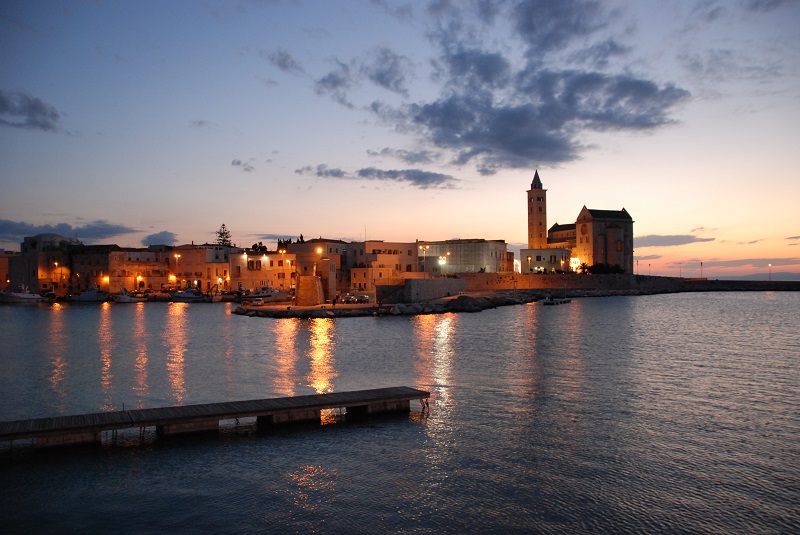
Leave the car and walk to the port. It is the working centre of the town — fishing boats, craft of every size, the smell of fish being landed — and it is ringed with restaurants and bars that make stopping fairly inevitable. In the Middle Ages this was one of the most important ports on the Adriatic, and the town has never quite stopped being organised around it.
The cathedral
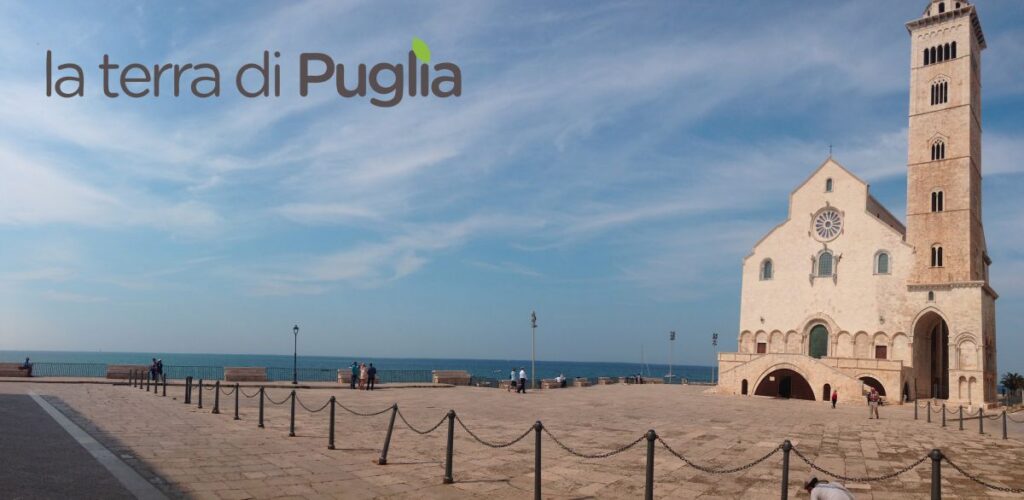
From the harbour the walk leads to the cathedral, and there is no preparing anyone for it: it stands on open ground at the very edge of the sea, so that from certain angles the building and the water are the only two things in the frame. It is Apulian Romanesque at its best, and it is why people come.
Beyond it, jutting into the water, is the Swabian castle, which holds exhibitions and cultural events all year.
The cathedral has its own piece here. Why it was built on that spot, what is underneath it, and what the bronze doors are: the cathedral of Trani, on the water.
The Jewish quarter
The Scolanova. In the old town there is a quarter that surprises even people who know Puglia well. Trani had one of the most flourishing Jewish communities of the medieval Mediterranean, and the Scolanova synagogue is the oldest still standing in Europe. It was turned into a church for centuries and has since returned to use as a synagogue — which is a plainer way of describing a very long story. It is a few minutes’ walk from the cathedral and almost nobody goes.
The rest of it
The old town behind the port is as lively as only a small southern Italian town can be: narrow lanes, historic buildings, and corners worth the detour. The shops sell the local cheeses, which are the thing to buy here. For swimming, the beach at Colonna is the one locals use.
Around it
Trani sits in the middle of Puglia Imperiale, alongside Barletta, Andria, Bisceglie, Canosa, Corato, Margherita di Savoia, Minervino Murge, Spinazzola, San Ferdinando and Trinitapoli. Inland from all of them stands the building the whole area is named for: Castel del Monte. Bari is forty minutes south by train.
Trani is the finest single sight on the Adriatic coast — and it takes half a day.