In short. Bari is the capital of Puglia and the second city of the Italian south after Naples: 320,000 people, a working port, and a medieval old town that is one of the best preserved in the country. Its basilica holds the bones of Saint Nicholas, stolen from Turkey in 1087 — which is why it is also the one Italian city with an Orthodox church inside a Catholic basilica.
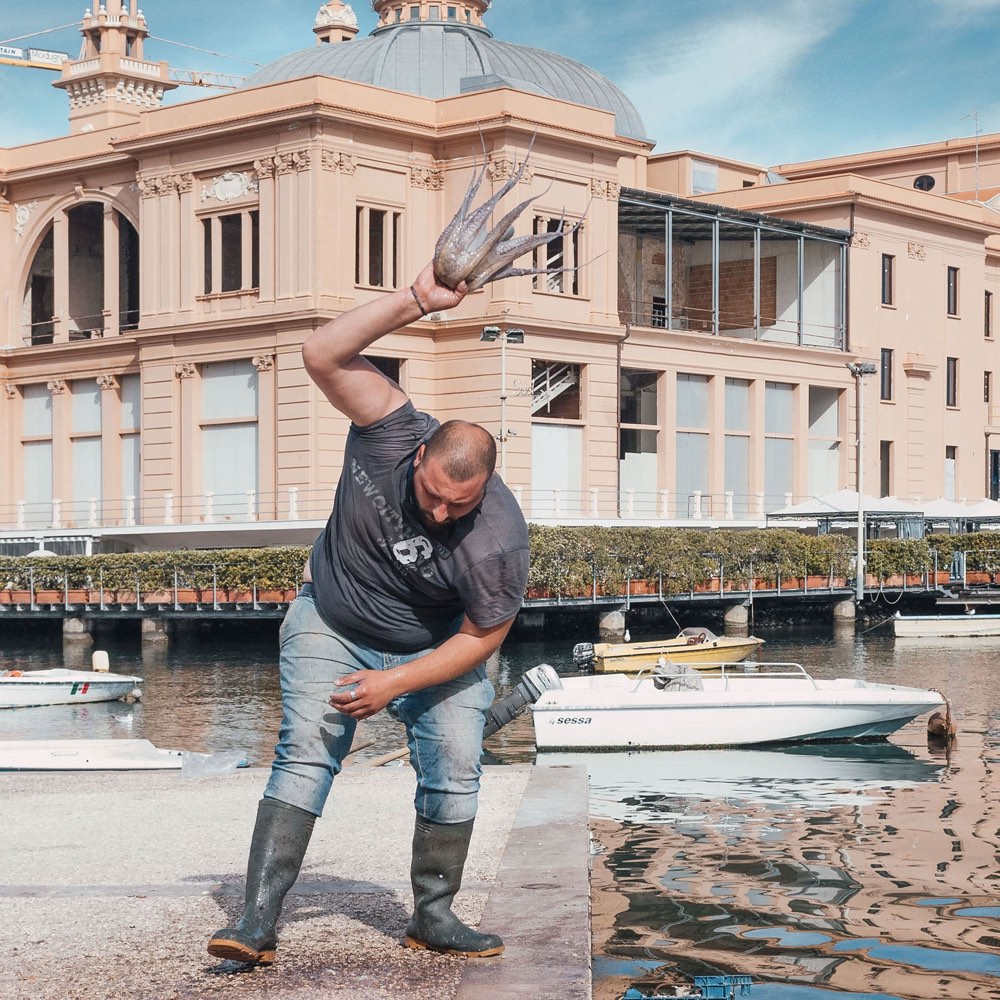
Bari has several faces and does not try to reconcile them. There is the port town, salt in the air, everything blown clean. There is the loud, coloured town of the markets, where the fish goes straight from the boat to the buyer. And there is the composed one, all liberty-style palazzi and Romanesque façades, watching the passers-by like an elegant elderly lady.
Bari Vecchia
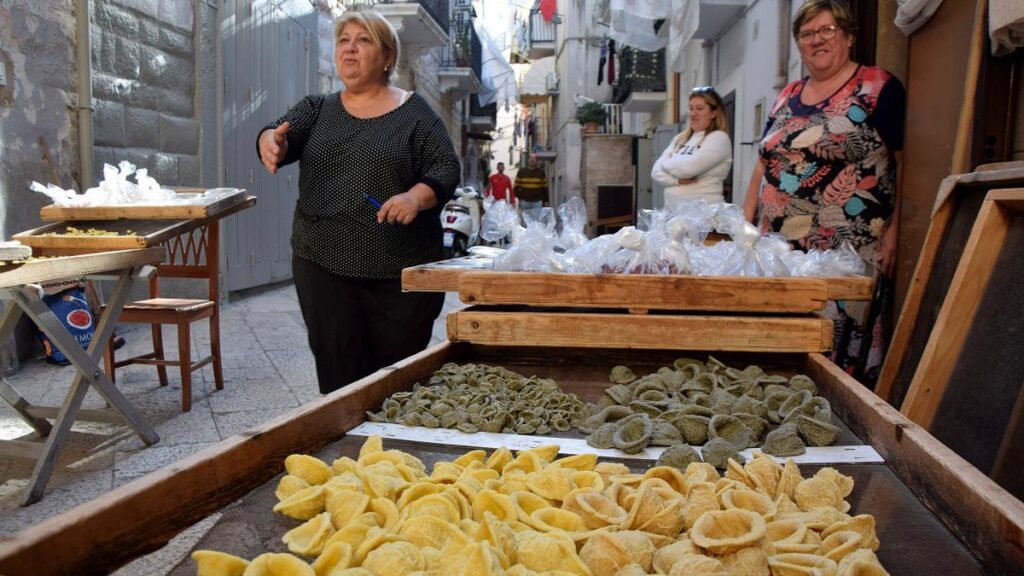
A quarter that grew out of fear, and is still lived in. The old heart of Bari is a labyrinth of narrow lanes, arches, shared courtyards and rock-cut churches that developed with no apparent logic — the only organising principle was defence against pirates. The women who make orecchiette outside their front doors along via dell’Arco Basso are known worldwide, but the real point of them is what they prove: Bari Vecchia is a place where people still live, not an open-air museum. Walk into it without a map. That is how it works.
San Nicola
The patron saint who became Santa Claus, and how he got here. Nicholas was bishop of Myra and died in Asia Minor in the fourth century. In 1087 sailors from Bari took his bones from Myra — in what is now Turkey — and brought them home. The basilica built to hold them is a masterpiece of Apulian Romanesque and one of the principal Christian pilgrimage sites of the Mediterranean. Because Nicholas is venerated by the Orthodox church too, the feast of 7 to 9 May brings Orthodox faithful from Russia, Greece and the Balkans, and the celebrations include a procession by sea. Bari is the only Italian city with an Orthodox church inside a Catholic basilica.
There is a longer piece on him: San Nicola of Bari, who became Santa Claus.
The castle
The Norman-Swabian castle has two famous builders. The Normans put up the first structure in the twelfth century, when they ruled the south of Italy and Sicily; Frederick II — the Puer Apuliae — rebuilt and enlarged it in the thirteenth, turning a military fortress into an imperial residence. Both periods are still legible in it: a Norman plan with Swabian towers.
The rest of the city
Beyond the basilica and the castle there is the cathedral, the rock-cut churches, and around forty churches in the old town altogether. Outside the walls the nineteenth-century city takes over — a grid of straight streets and liberty façades that is where the shops and the evening walk are.
And there is the port: not a decorative one, a real one, with ferries leaving for Greece, Albania and Croatia the way they have for centuries.
Around it
Bari is the natural base for this coast, and the province is where much of the interest is. South along the sea are Monopoli and Polignano; north are Trani and Barletta. Inland, the Murgia begins almost immediately, and the trulli of the Valle d’Itria are fifty kilometres away.
Bari is the capital of Puglia and the front door to the Adriatic coast.