In short. Ostuni is the white town: 30,000 people on three hills at 218 metres, every house limewashed, olive groves running from the walls down to the Adriatic. It has a cathedral with one of the largest rose windows in Europe, six good beaches below it, and the oldest known burial of a pregnant woman anywhere in the world — 25,000 years old, and on display in the old town.
Seen from the plain, Ostuni does not look real. It is a solid white mass on a hillside, and the effect is the reason it has two nicknames — the White Town, and the Nativity Scene Town.
Why it is white
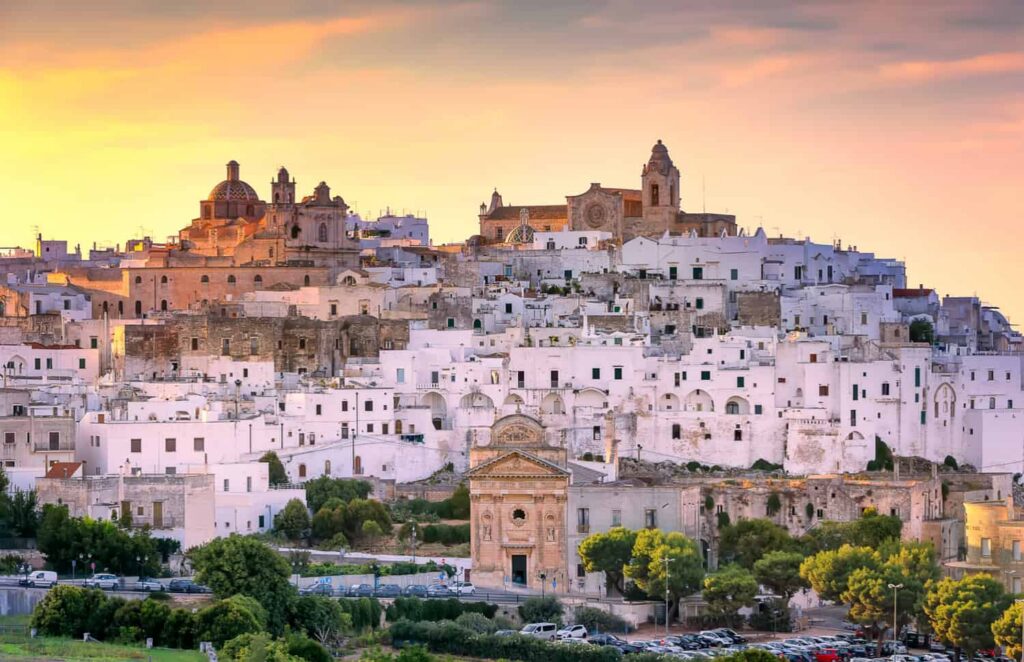
Not for the photographs. The houses were limewashed for hygiene: lime is a natural disinfectant, and it was used against epidemics — the plague above all. What began as a public health measure became the identity of the town, and it is still maintained.
The position is defensive, and it shows. Ostuni sits on three hills at 218 metres above the sea, and from that height the whole plain down to the coast is visible — on a clear day, as far as the Albanian shore. Below the walls the olive groves take over: the trees around Ostuni are among the oldest in Puglia, some of them monumental, up to a thousand years old.
The pleasure of the place is the tangle of lanes inside the walls, which climb, turn and occasionally open without warning into a small square or a courtyard.
Go up at the end of the day. The white walls take the evening light and turn gold, and the temperature finally becomes bearable — midday in August, on that hill and with that much reflected glare, is punishing. In Italian the town has two names, and both are about the same effect: Città Bianca, the white town, and Città Presepe, the nativity-scene town.
The woman of Ostuni
Delia, and 25,000 years. In 1991, excavations in the cave of Santa Maria d’Agnano turned up the skeleton of a woman who had died about 25,000 years ago, and who was pregnant when she died. She is the oldest known ritual burial of a pregnant woman anywhere in the world: the body was laid in a foetal position, and the foetus is still visible inside her. Her remains are in the Museum of Preclassical Civilisations of the Southern Murgia, in the former Monacelle convent in the old town. Around Ostuni there are also Neolithic remains at Lamaforca and San Biagio, and Bronze Age material at Lama Morelli. The first real settlement was Messapian; the town was levelled during the First Punic War and rebuilt by the Romans.
The cathedral, and the rose window
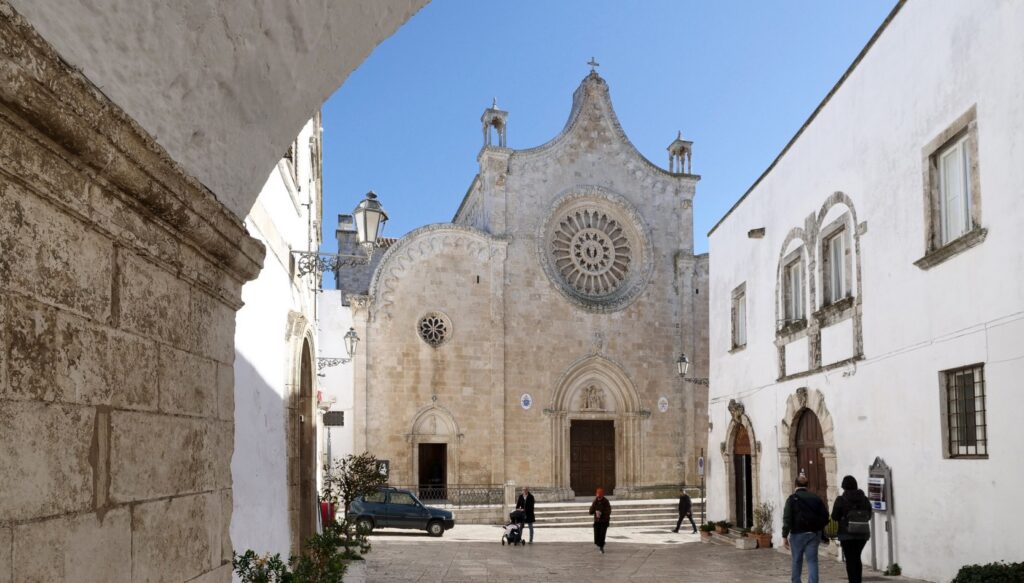
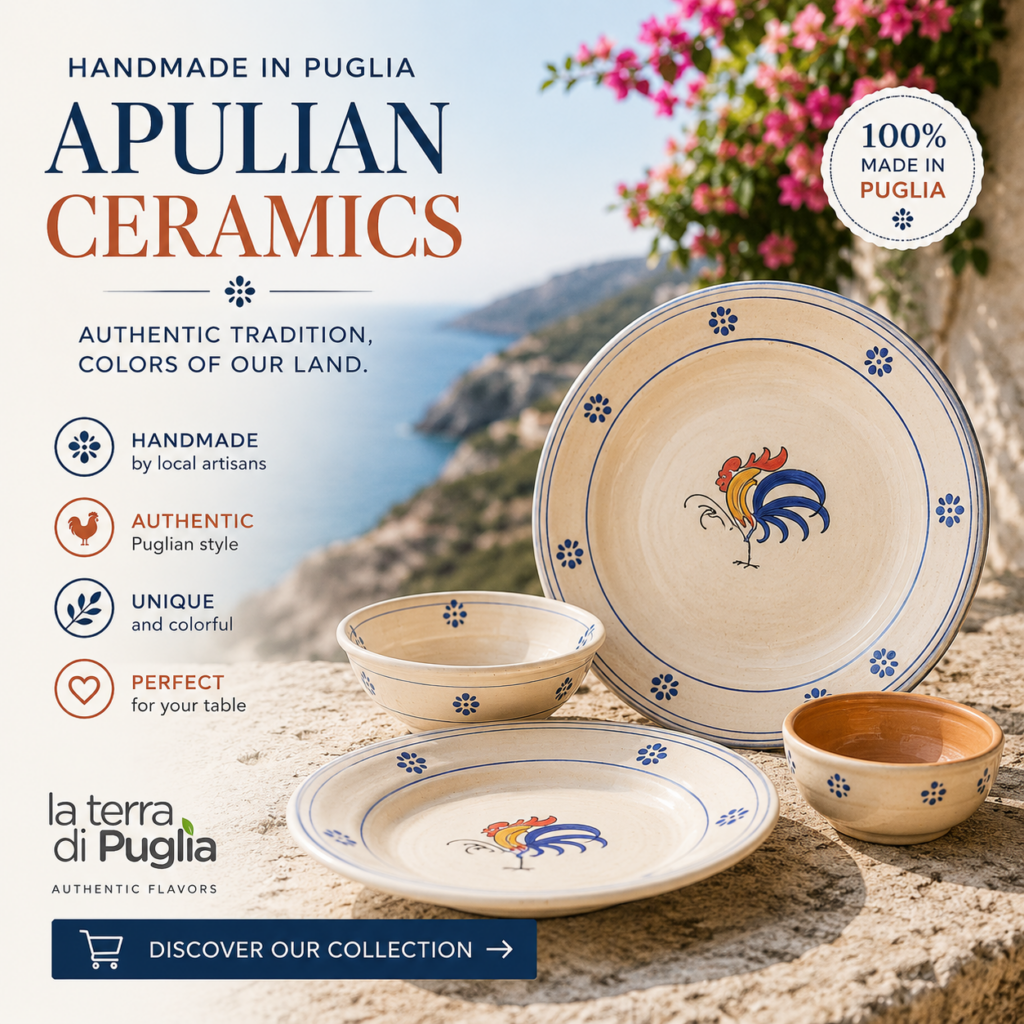
Built between 1435 and 1495 and dedicated to the Assumption, a basilica since 2011. The interior is a Latin cross with three naves, a seventeenth-century walnut choir and an altar of 1734. But the thing everyone photographs is on the outside: the rose window, about eight metres across, one of the largest in Europe, with twenty-four spokes and carved animal and plant decoration. It is late Apulian Gothic at its best, and it is the visual shorthand for the town — you will see it reproduced on the ceramics in every craft shop in the lanes.
Other churches worth the detour: the Chiesa del Carmine, rebuilt from 1615 on a fourteenth-century building, neoclassical outside and baroque within; the Chiesa dello Spirito Santo, a national monument, with reliefs of 1450; and, on the road to Carovigno, the crypt of the Santuario della Nova, founded in 1560 and used in the seventeenth century as a plague hospital — which is when it too was limewashed.
The horseback procession. Sant’Oronzo, the patron of Lecce, has a claim on Ostuni too: tradition says the first Christian bishop of the region, martyred under Nero, took refuge in a cave outside the walls. The sanctuary was built over that cave in the second half of the seventeenth century, and a spring beside it is held to be miraculous. Every year on 25 and 26 August the town honours him with the Cavalcata di Sant’Oronzo: riders in historical costume through the streets, devotion and folk tradition in the same procession.
The beaches
Ostuni is not on the sea — the coast is a few kilometres below the town — but its shoreline is more varied than most in Puglia.
- Torre Canne — very fine sand and clear water, well served, the family default.
- Rosa Marina — the most exclusive stretch, golden sand and well-equipped clubs.
- Pilone — inside the coastal dunes park: unspoilt, and without the crowd.
- Lido Morelli — a long quiet run of white sand backed by dunes.
- Costa Merlata — rocky inlets and small sheltered bays, calm and clear, the best snorkelling here.
- Villanova — sand and rock together, with a marina for boat hire and trips.
The dunes park. The coast between Torre Canne and Ostuni Marina is protected as the Regional Natural Park of the Coastal Dunes — one of the last intact dune systems left on the Adriatic. Pine woods, Mediterranean scrub, sand dunes up to six metres high, and a fauna that includes the kingfisher, the Kentish plover and Hermann’s tortoise. Walking into the park means walking out of mass tourism, even in August.
The steady wind that makes the town breathable in summer also makes this a kitesurfing coast: Torre Canne and Rosa Marina are the spots, with schools and rental for beginners and experienced riders alike.
Ostuni marks the southern end of the Valle d’Itria and the last of the Murgia — south of here you are in the Salento.